


-
Purpose(Empty Backbone)
-
Depositing Lab
-
Sequence Information
Ordering
| Item | Catalog # | Description | Quantity | Price (USD) | |
|---|---|---|---|---|---|
| Plasmid | 29772 | Standard format: Plasmid sent in bacteria as agar stab | 1 | $85 | |
This material is available to academics and nonprofits only.
Backbone
-
Vector backbonepET
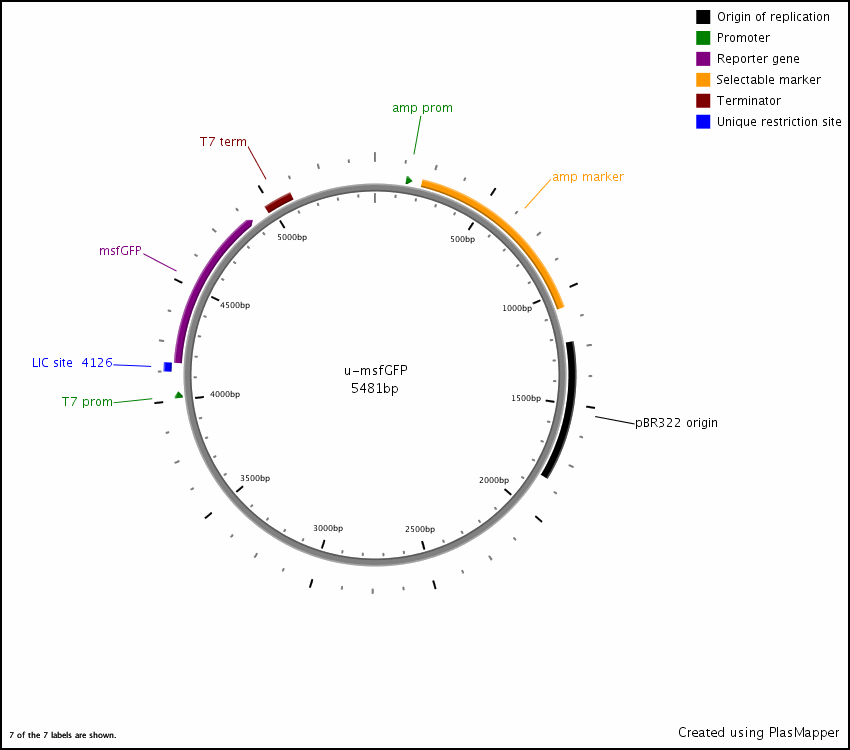
- Backbone size (bp) 5481
-
Modifications to backboneThe GFP is the version described in Pedelacq et. al. (Jan 2006, Nature Biotechnology). The following mutations are included: F100S, M154T, V164A, S30R, Y39N, N105T, Y145F, I171V and A206K. These mutations have been shown to enhance brightness and solubility, and to inhibit dimerization.
-
Vector typeBacterial Expression
Growth in Bacteria
-
Bacterial Resistance(s)Ampicillin, 100 μg/mL
-
Growth Temperature37°C
-
Growth Strain(s)DH5alpha
-
Copy numberLow Copy
Gene/Insert
-
Gene/Insert nameNone
-
Tag
/ Fusion Protein
- GFP (C terminal on backbone)
Cloning Information
- Cloning method Restriction Enzyme
- 5′ cloning site LIC site vuGFP (destroyed during cloning)
- 3′ cloning site LIC site vuGFP (destroyed during cloning)
- 5′ sequencing primer T7 forward
- 3′ sequencing primer GFP reverse (5'gcaccttgaagcgcatgaact) (Common Sequencing Primers)
Resource Information
-
Articles Citing this Plasmid
Terms and Licenses
-
Academic/Nonprofit Terms
-
Industry Terms
- Not Available to Industry
Trademarks:
- Zeocin® is an InvivoGen trademark.
Depositor Comments
This plasmid is an empty vector. Your gene can be inserted with a LIC cloning protocol. This plasmid can be used as a single-expression vector, and it is also compatible with our 2-series polycistronic destination vectors (2D, 2E, and 2Z), if co-expression with other genes is desired.
GFP has a excitation max of 489 nm and an emission max of 510 nm.
To clone into this vector, add LIC tags to the 5' end of your PCR primers.
Forward - 5' TTTAAGAAGGAGATATAGATC3'
Reverse - 5' GTTGGAGGATGAGAGGATCCC 3'
Do NOT include a stop codon with your reverse primer.
Linearize the plasmid with EcoRV, then gel purify.
When digesting the DNA with T4 polymerase, use dGTP for the insert and dCTP for your linearized vector.
More information on this vector can be found through http://qb3.berkeley.edu/qb3/macrolab/
These plasmids were created by your colleagues. Please acknowledge the Principal Investigator, cite the article in which the plasmids were described, and include Addgene in the Materials and Methods of your future publications.
-
For your Materials & Methods section:
pET GFP LIC cloning vector (u-msfGFP) was a gift from Scott Gradia (Addgene plasmid # 29772 ; http://n2t.net/addgene:29772 ; RRID:Addgene_29772)
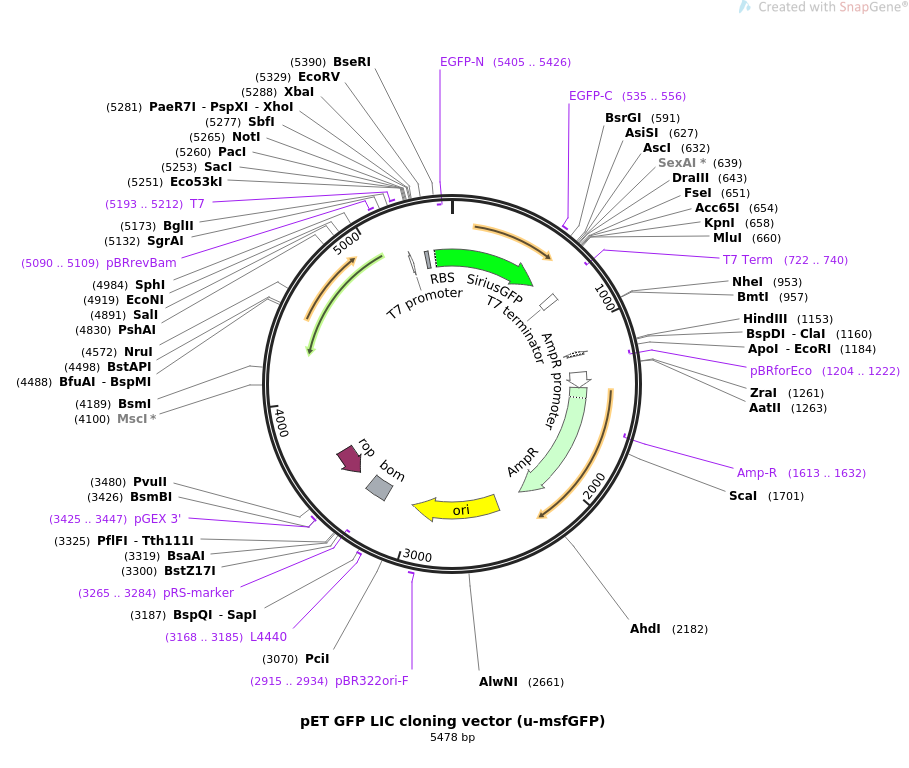
Map uploaded by the depositor.
