


-
Purpose(Empty Backbone)
-
Depositing Lab
-
Sequence Information
Ordering
| Item | Catalog # | Description | Quantity | Price (USD) | |
|---|---|---|---|---|---|
| Plasmid | 34914 | Standard format: Plasmid sent in bacteria as agar stab | 1 | $85 | |
This material is available to academics and nonprofits only.
Backbone
-
Vector backbonepBCN21-R4R3
-
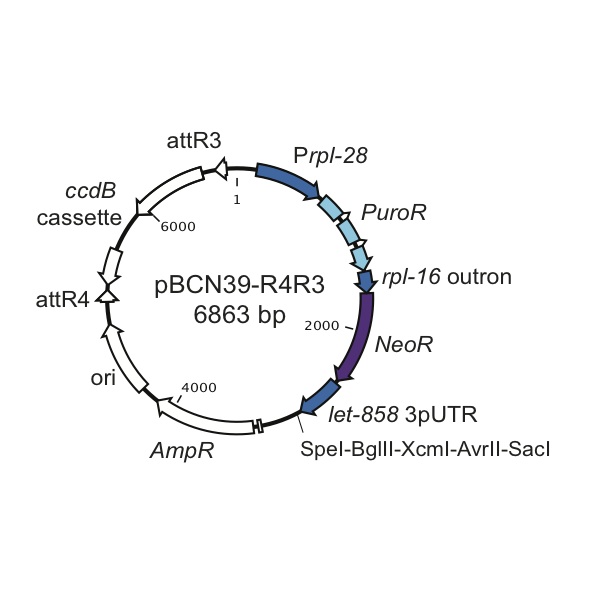
Modifications to backboneContains the dual antibiotic resistance operon Prpl-28::PuroR::rpl-16_outron::NeoR::let-858_3'UTR instead of the puromycin resistance gene. Spe I, Xcm I, Bgl II, Avr I and Sac I restriction sites introduced into backbone for linearisation before bombardment. The ccdB gene was replaced with a version from pDONR221 (Invitrogen) that is compatible with commercially available ccdB Survival E. coli, no longer requiring DB3.1 cells.
-
Vector typeWorm Expression
-
Selectable markersNeomycin (select with G418), Puromycin
Growth in Bacteria
-
Bacterial Resistance(s)Chloramphenicol and Ampicillin, 25 & 100 μg/mL
-
Growth Temperature37°C
-
Growth Strain(s)ccdB Survival
-
Growth instructionsAs a Gateway destination vector the empty vector must be grown in ccdB resistant cells such as DB3.1 or ccdB Survival. Use both Ampicillin and Chloramphenicol selection to avoid loss of the Gateway cassette. Once the Gateway cassette has been replaced with the gene of interest select with Ampicillin in standard E. coli strain such as Top10 or DH5alpha.
-
Copy numberUnknown
Resource Information
-
A portion of this plasmid was derived from a plasmid made byPuromycin resistance gene from pBabePuro (Addgene). rpl-28 promoter and let-858 3'UTR sequences from pPD129.57 vector (Addgene). Neomycin resistance gene from pEGFP-C1 (Clontech).
Terms and Licenses
-
Academic/Nonprofit Terms
-
Industry Terms
- Not Available to Industry
Trademarks:
- Zeocin® is an InvivoGen trademark.
Depositor Comments
Dual resistance (PuroR-NeoR) vector for drug selection following biolistic bombardment in worms.
This vector does not contain a visual marker on the backbone and can be used when the gene of interest has visual phenotype.
This is a Gateway 3-fragment compatible destination vector. It contains AttR4 and AttR3 sites (not AttR1 and AttR2 sites as identified automatically by the Addgene algorithm).
These plasmids were created by your colleagues. Please acknowledge the Principal Investigator, cite the article in which the plasmids were described, and include Addgene in the Materials and Methods of your future publications.
-
For your Materials & Methods section:
pBCN39-R4R3 was a gift from Ben Lehner (Addgene plasmid # 34914 ; http://n2t.net/addgene:34914 ; RRID:Addgene_34914) -
For your References section:
Generating transgenic nematodes by bombardment and antibiotic selection. Semple JI, Biondini L, Lehner B. Nat Methods. 2012 Jan 30;9(2):118-9. doi: 10.1038/nmeth.1864. 10.1038/nmeth.1864 PubMed 22290182

Map uploaded by the depositor.
