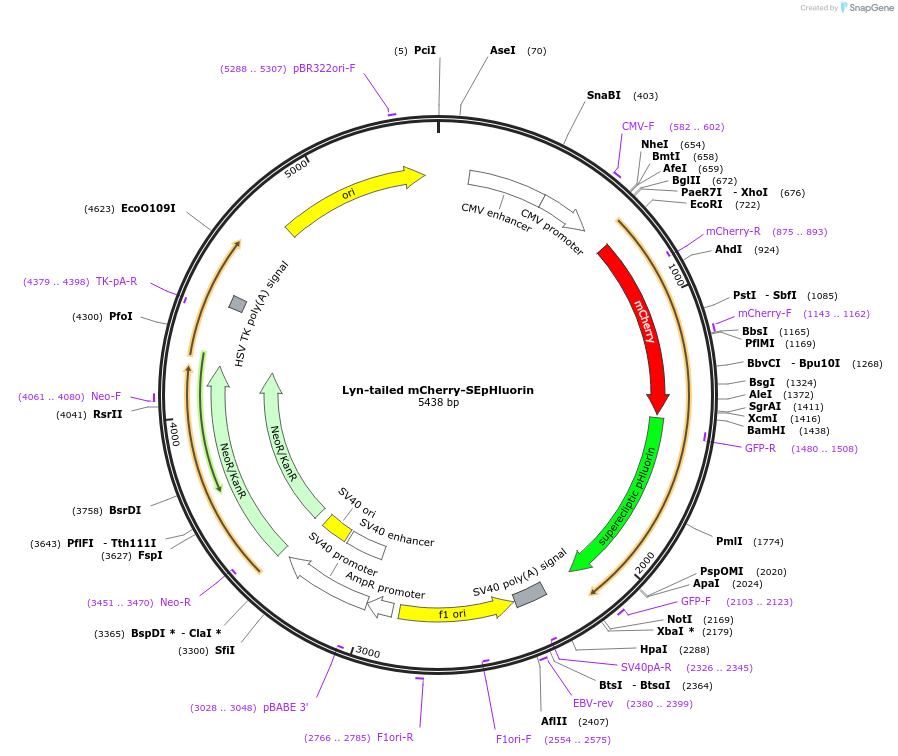
-
Depositing Lab
-
Depositing OrganizationHospital for Sick Children
Located in Canada -
Citations
-
Sequence Information
Ordering
| Item | Catalog # | Description | Quantity | Price (USD) | |
|---|---|---|---|---|---|
| Plasmid | 32002 | Standard format: Plasmid sent in bacteria as agar stab | 1 | $94 | |
| DNA | 32002-D50 | 50 μg of DNA in Tris buffer | $495 | ||
| DNA | 32002-D100 | 100 μg of DNA in Tris buffer | $585 | ||
Backbone
-
Vector backbonepEGFP-N1
-
Backbone manufacturerClontech
-
Modifications to backboneMembrane-targeted SuperEcliptic (SE) pHluorin/mCherry was generated by first constructing a chimeric construct consisting of the green, pH-sensitive fluorescent protein SuperEcliptic (SE) pHluorin co-fused to the red, pH-insensitive mCherry The EGFP coding region from the EGFP-N1 vector (Clontech, Mountain View, CA) was replaced with a PCR product containing the SEpHluorin coding region flanked by BamHI and NotI restriction sites. The PCR product of the mCherry coding sequence was inserted at the EcoRI and BamHI sites. The probe was targeted to the plasma membrane by inclusion of the N-terminal motif of the Src-family kinase Lyn. The membrane targeting sequence of Lyn was inserted between XhoI and EcoRI sites. The forward and reverse oligonucleotide sequences for the Lyn membrane targeting sequence were 5’-TCGAGAGAAATATGGGATGTATTAAATCAAAAAGGAAAGACGGGAG and 5’-AATTCTCCCGTCTTTCCTTTTTGATTTAATACATCCCATATTTCTC, respectively
-
Vector typeMammalian Expression
Growth in Bacteria
-
Bacterial Resistance(s)Kanamycin, 50 μg/mL
-
Growth Temperature37°C
-
Growth Strain(s)DH5alpha
-
Copy numberUnknown
Gene/Insert
-
Gene/Insert nameMembrane-targeting sequence of Lyn kinase
Cloning Information
- Cloning method Restriction Enzyme
- 5′ cloning site XhoI (not destroyed)
- 3′ cloning site EcoRI (not destroyed)
- 5′ sequencing primer 5'd[CGTCGCCGTCCAGCTCGACCAG]3'
- (Common Sequencing Primers)
Terms and Licenses
-
Academic/Nonprofit Terms
-
Industry Terms
- Not Available to Industry
Trademarks:
- Zeocin® is an InvivoGen trademark.
DNA (Catalog # 32002-D50)
Purpose
Ready-to-use, high-purity DNA prep. DNA aliquots are suitable for use in mammalian cell transfections and other molecular biology applications.
Delivery
- Amount 50 μg
- Concentration 1 μg/μL
- Pricing $495 USD
- Storage 4 ℃ (short-term) or -20 ℃ (long-term)
Terms and Licenses
-
Academic/Nonprofit Terms
-
Industry Terms
- Not Available to Industry
Quality Control
Every DNA prep is verified by next-generation sequencing, confirming plasmid identity, sequence integrity, and absence of DNA contaminants. Concentration is confirmed to be within ±2.5% of the stated concentration.
Our production process has been validated to consistently yield endotoxin levels below 1.0 EU/μg. Individual lots are not tested for endotoxin.
DNA (Catalog # 32002-D100)
Purpose
Ready-to-use, high-purity DNA prep. DNA aliquots are suitable for use in mammalian cell transfections and other molecular biology applications.
Delivery
- Amount 100 μg
- Concentration 1 μg/μL
- Pricing $585 USD
- Storage 4 ℃ (short-term) or -20 ℃ (long-term)
Terms and Licenses
-
Academic/Nonprofit Terms
-
Industry Terms
- Not Available to Industry
Quality Control
Every DNA prep is verified by next-generation sequencing, confirming plasmid identity, sequence integrity, and absence of DNA contaminants. Concentration is confirmed to be within ±2.5% of the stated concentration.
Our production process has been validated to consistently yield endotoxin levels below 1.0 EU/μg. Individual lots are not tested for endotoxin.
These plasmids were created by your colleagues. Please acknowledge the Principal Investigator, cite the article in which the plasmids were described, and include Addgene in the Materials and Methods of your future publications.
-
For your Materials & Methods section:
Lyn-tailed mCherry-SEpHluorin was a gift from Sergio Grinstein (Addgene plasmid # 32002 ; http://n2t.net/addgene:32002 ; RRID:Addgene_32002) -
For your References section:
Amiloride inhibits macropinocytosis by lowering submembranous pH and preventing Rac1 and Cdc42 signaling. Koivusalo M, Welch C, Hayashi H, Scott CC, Kim M, Alexander T, Touret N, Hahn KM, Grinstein S. J Cell Biol. 2010 Feb 22;188(4):547-63. Epub 2010 Feb 15. 10.1083/jcb.200908086 PubMed 20156964