



-
PurposeExpresses Phytochrome B (1-908 aa) fused with mCherry and Hras C-terminus in mammalian cells
-
Depositing Lab
-
Depositing OrganizationNational Institute for Basic Biology
Located in Japan -
Sequence Information


Ordering
| Item | Catalog # | Description | Quantity | Price (USD) | |
|---|---|---|---|---|---|
| Plasmid | 100281 | Standard format: Plasmid sent in bacteria as agar stab | 1 | $94 | |
| DNA | 100281-D50 | 50 μg of DNA in Tris buffer | $495 | ||
| DNA | 100281-D100 | 100 μg of DNA in Tris buffer | $585 | ||
Backbone
-
Vector backbonepCAGGS
-
Backbone manufacturerJunichi Miyazaki (Osaka University, Japan)
- Backbone size w/o insert (bp) 4870
- Total vector size (bp) 8551
-
Vector typeMammalian Expression
Growth in Bacteria
-
Bacterial Resistance(s)Ampicillin, 100 μg/mL
-
Growth Temperature37°C
-
Growth Strain(s)DH5alpha
-
Copy numberHigh Copy
Gene/Insert
-
Gene/Insert namePhytochrome B
-
Alt namePhyB
-
SpeciesA. thaliana (mustard weed)
-
MutationHuman codon optimized PhyB (1-908 aa)
-
GenBank IDNM_001335612.1
-
Entrez GenePHYB (a.k.a. AT2G18790, HY3, MSF3.17, MSF3_17, OOP1, OUT OF PHASE 1, PHYTOCHROME B, phytochrome B)
- Promoter CAG promoter
-
Tag
/ Fusion Protein
- mCherry fused with HRas C-terminus for plasma membrane localization. (C terminal on insert)
Cloning Information
- Cloning method Restriction Enzyme
- 5′ cloning site EcoRI (not destroyed)
- 3′ cloning site NotI (not destroyed)
- 5′ sequencing primer catgttcatgccttcttctttttcc
- 3′ sequencing primer agatgctcaaggggcttcatgatg
- (Common Sequencing Primers)
Resource Information
Terms and Licenses
-
Academic/Nonprofit Terms
-
Industry Terms
- Not Available to Industry
Trademarks:
- Zeocin® is an InvivoGen trademark.
Depositor Comments
Expression vector of PhyB-mCherry-HRasCT in mammalian cells. Of note, the expression level of PIF3-mEGFP must be comparable or lower than that of PhyB. We usually co-transfect pCAGGS-PhyB-mCherry-HRasCT and pCAGGS-PIF3-mEGFP plasmids into HeLa cells with lipofection in a 50:1 ratio.
mCherry has a G229L mutation that does not affect function.
DNA (Catalog # 100281-D50)
Purpose
Ready-to-use, high-purity DNA prep. DNA aliquots are suitable for use in mammalian cell transfections and other molecular biology applications.
Delivery
- Amount 50 μg
- Concentration 1 μg/μL
- Pricing $495 USD
- Storage 4 ℃ (short-term) or -20 ℃ (long-term)
Terms and Licenses
-
Academic/Nonprofit Terms
-
Industry Terms
- Not Available to Industry
Quality Control
Every DNA prep is verified by next-generation sequencing, confirming plasmid identity, sequence integrity, and absence of DNA contaminants. Concentration is confirmed to be within ±2.5% of the stated concentration.
Our production process has been validated to consistently yield endotoxin levels below 1.0 EU/μg. Individual lots are not tested for endotoxin.
DNA (Catalog # 100281-D100)
Purpose
Ready-to-use, high-purity DNA prep. DNA aliquots are suitable for use in mammalian cell transfections and other molecular biology applications.
Delivery
- Amount 100 μg
- Concentration 1 μg/μL
- Pricing $585 USD
- Storage 4 ℃ (short-term) or -20 ℃ (long-term)
Terms and Licenses
-
Academic/Nonprofit Terms
-
Industry Terms
- Not Available to Industry
Quality Control
Every DNA prep is verified by next-generation sequencing, confirming plasmid identity, sequence integrity, and absence of DNA contaminants. Concentration is confirmed to be within ±2.5% of the stated concentration.
Our production process has been validated to consistently yield endotoxin levels below 1.0 EU/μg. Individual lots are not tested for endotoxin.
These plasmids were created by your colleagues. Please acknowledge the Principal Investigator, cite the article in which the plasmids were described, and include Addgene in the Materials and Methods of your future publications.
-
For your Materials & Methods section:
pCAGGS-hPhyB-mCherry-HRasCT was a gift from Kazuhiro Aoki (Addgene plasmid # 100281 ; http://n2t.net/addgene:100281 ; RRID:Addgene_100281) -
For your References section:
Efficient synthesis of phycocyanobilin in mammalian cells for optogenetic control of cell signaling. Uda Y, Goto Y, Oda S, Kohchi T, Matsuda M, Aoki K. Proc Natl Acad Sci U S A. 2017 Oct 24. pii: 201707190. doi: 10.1073/pnas.1707190114. 10.1073/pnas.1707190114 PubMed 29078307
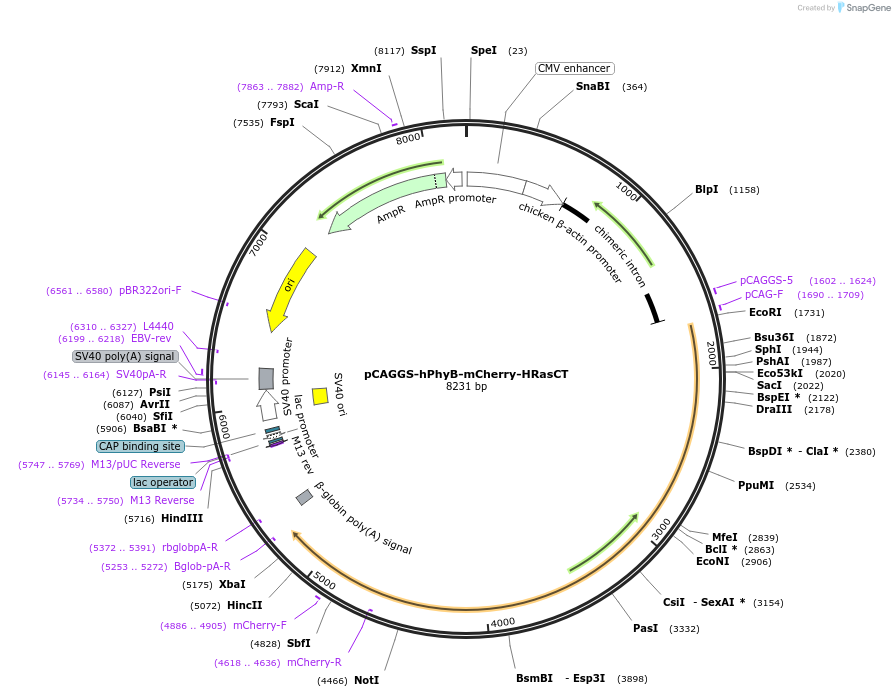
Map uploaded by the depositor.
