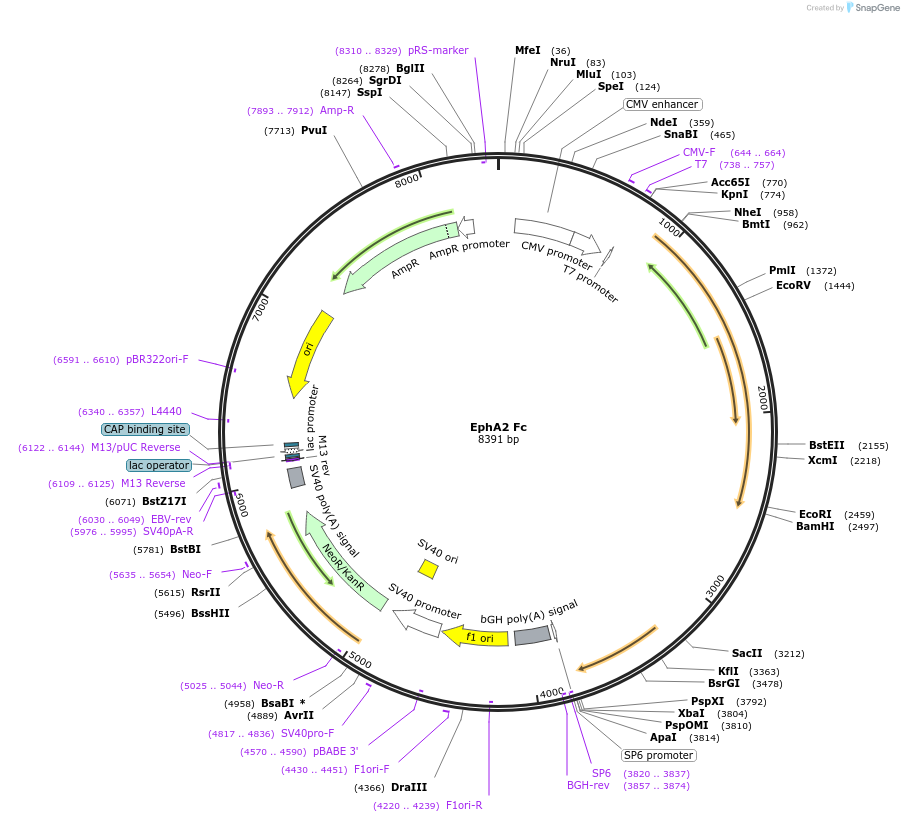
EphA2 Fc
(Plasmid
#105054)
-
PurposeEphA2 extracellular domain fused to human IgG1 Fc for protein production
-
Depositing Lab
-
Depositing OrganizationQIMR Berghofer Medical Research Institute
Located in Australia -
Publication
-
Sequence Information
Ordering
This material is available to academics and nonprofits only.
| Item | Catalog # | Description | Quantity | Price (USD) | |
|---|---|---|---|---|---|
| Plasmid | 105054 | Standard format: Plasmid sent in bacteria as agar stab | 1 | $94 | |
Backbone
-
Vector backbonepIgBOS/PEF BOS
-
Vector typeMammalian Expression
Growth in Bacteria
-
Bacterial Resistance(s)Ampicillin, 100 μg/mL
-
Growth Temperature37°C
-
Growth Strain(s)DH5alpha
-
Copy numberHigh Copy
Gene/Insert
-
Gene/Insert nameEphA2
-
SpeciesM. musculus (mouse)
- Promoter EF1alpha
-
Tags
/ Fusion Proteins
- TEV site (C terminal on backbone)
- human IgG1 Fc (C terminal on backbone)
Cloning Information
- Cloning method Restriction Enzyme
- 5′ cloning site unknown (unknown if destroyed)
- 3′ cloning site unknown (unknown if destroyed)
Terms and Licenses
-
Academic/Nonprofit Terms
-
Industry Terms
- Not Available to Industry
Trademarks:
- Zeocin® is an InvivoGen trademark.
Depositor Comments
The pTIg-BOS-Fc vector retains the advantages of the Ig fusion protein: easy detection using anti-human IgG1 antibodies and rapid purification by protein A Sepharose affinity chromatography. Furthermore, by cleaving the fusion protein with TEV protease, the single chain recombinant target protein can be separated from the IgG-Fc for functional studies.
How to cite this plasmid
( Back to top)
These plasmids were created by your colleagues. Please acknowledge the Principal Investigator, cite the article in which the plasmids were described, and include Addgene in the Materials and Methods of your future publications.
-
For your Materials & Methods section:
EphA2 Fc was a gift from Andrew Boyd (Addgene plasmid # 105054) -
For your References section:
Eph/Ephrin membrane proteins: a mammalian expression vector pTIg-BOS-Fc allowing rapid protein purification. Day BW, Smith FM, Chen K, McCarron JK, Herath NI, Lackmann M, Boyd AW. Protein Pept Lett. 2006;13(2):193-6. PubMed 16472084