



pPEE17
(Plasmid
#128361)
-
PurposeDetecting gene essentiality in Cryptococcus neoformans. Targets DNA constructs to the Safe Haven Site 1, a small gene-free region. Contains amdS2 counterselectable marker. This version of the Safe Haven vector includes direct repeats, enabling the formation of popouts on fluoroacetamide.
-
Depositing Lab
-
Depositing OrganizationUniversity of Queensland
Located in Australia -
Sequence Information


Ordering
| Item | Catalog # | Description | Quantity | Price (USD) | |
|---|---|---|---|---|---|
| Plasmid | 128361 | Standard format: Plasmid sent in bacteria as agar stab | 1 | $94 | |
| DNA | 128361-D50 | 50 μg of DNA in Tris buffer | $495 | ||
| DNA | 128361-D100 | 100 μg of DNA in Tris buffer | $585 | ||
Backbone
-
Vector backbonepBlueScript II SK(-)
-
Backbone manufacturerStratagene
-
Vector typeUnspecified
-
Selectable markersAcetamide, Fluoroacetamide
Growth in Bacteria
-
Bacterial Resistance(s)Ampicillin, 100 μg/mL
-
Growth Temperature37°C
-
Growth Strain(s)DH5alpha
-
Copy numberHigh Copy
Gene/Insert
-
Gene/Insert nameAcetamidase (amdS)
-
SpeciesSynthetic
- Promoter TEF1
Cloning Information
- Cloning method Gibson Cloning
Resource Information
Terms and Licenses
-
Academic/Nonprofit Terms
-
Industry Terms
- Not Available to Industry
Trademarks:
- Zeocin® is an InvivoGen trademark.
Depositor Comments
Contains the Safe Haven Site 1 sequence (CNAG_00777 - CNAG_00778) in the backbone of pBluescript II SK- flanked by blaster repeats to enable integration into the C. neoformans genome via homologous recombination, in addition to a linker sequence containing multiple rare-cutting restriction enzyme cut sites to facilitate linearization prior to biolistic transformation. Importantly, as the Safe Haven and marker fragments were inserted into the pBluescript II SK- backbone in place of the f1 origin of replication, each plasmid still retains the original multicloning site and blue/white screening capabilities. Linearization of the safe haven constructs is made possible by the inclusion of a linker containing cut sites for three rare cutting restriction enzymes, BaeI, AscI and PacI. To use the vectors, the gene of interest is subcloned into the standard pBluescript II SK- multicloning site.
DNA (Catalog # 128361-D50)
Purpose
Ready-to-use, high-purity DNA prep. DNA aliquots are suitable for use in mammalian cell transfections and other molecular biology applications.
Delivery
- Amount 50 μg
- Concentration 1 μg/μL
- Pricing $495 USD
- Storage 4 ℃ (short-term) or -20 ℃ (long-term)
Terms and Licenses
-
Academic/Nonprofit Terms
-
Industry Terms
- Not Available to Industry
Quality Control
Every DNA prep is verified by next-generation sequencing, confirming plasmid identity, sequence integrity, and absence of DNA contaminants. Concentration is confirmed to be within ±2.5% of the stated concentration.
Our production process has been validated to consistently yield endotoxin levels below 1.0 EU/μg. Individual lots are not tested for endotoxin.
DNA (Catalog # 128361-D100)
Purpose
Ready-to-use, high-purity DNA prep. DNA aliquots are suitable for use in mammalian cell transfections and other molecular biology applications.
Delivery
- Amount 100 μg
- Concentration 1 μg/μL
- Pricing $585 USD
- Storage 4 ℃ (short-term) or -20 ℃ (long-term)
Terms and Licenses
-
Academic/Nonprofit Terms
-
Industry Terms
- Not Available to Industry
Quality Control
Every DNA prep is verified by next-generation sequencing, confirming plasmid identity, sequence integrity, and absence of DNA contaminants. Concentration is confirmed to be within ±2.5% of the stated concentration.
Our production process has been validated to consistently yield endotoxin levels below 1.0 EU/μg. Individual lots are not tested for endotoxin.
These plasmids were created by your colleagues. Please acknowledge the Principal Investigator, cite the article in which the plasmids were described, and include Addgene in the Materials and Methods of your future publications.
-
For your Materials & Methods section:
pPEE17 was a gift from James Fraser (Addgene plasmid # 128361 ; http://n2t.net/addgene:128361 ; RRID:Addgene_128361) -
For your References section:
amdS as a dominant recyclable marker in Cryptococcus neoformans. Erpf PE, Stephenson CJ, Fraser JA. Fungal Genet Biol. 2019 Jun 17;131:103241. doi: 10.1016/j.fgb.2019.103241. 10.1016/j.fgb.2019.103241 PubMed 31220607
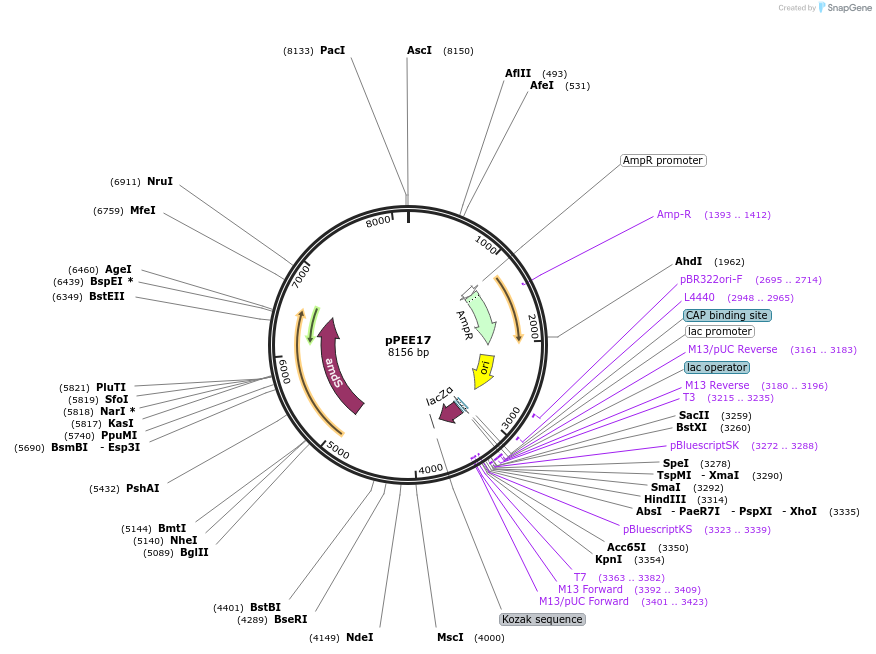
Map uploaded by the depositor.
