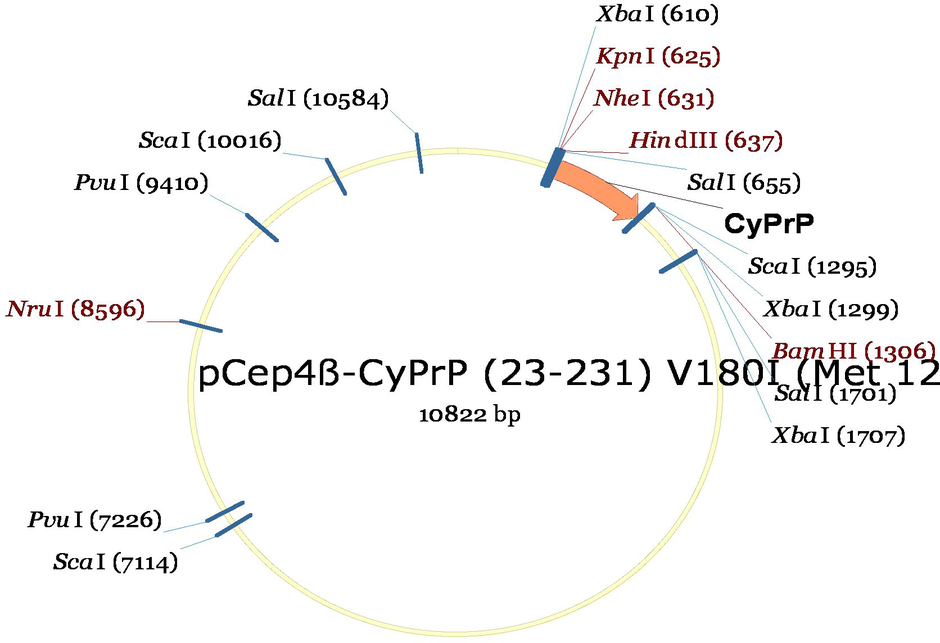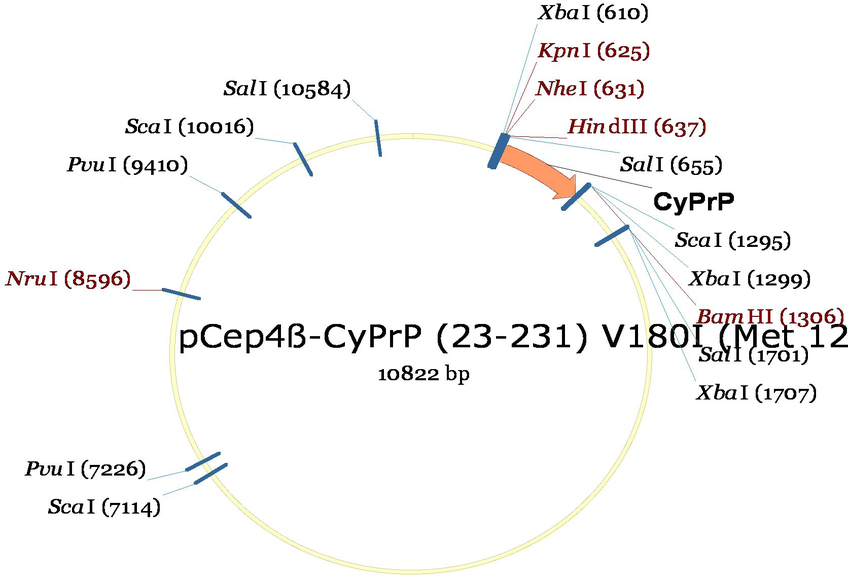



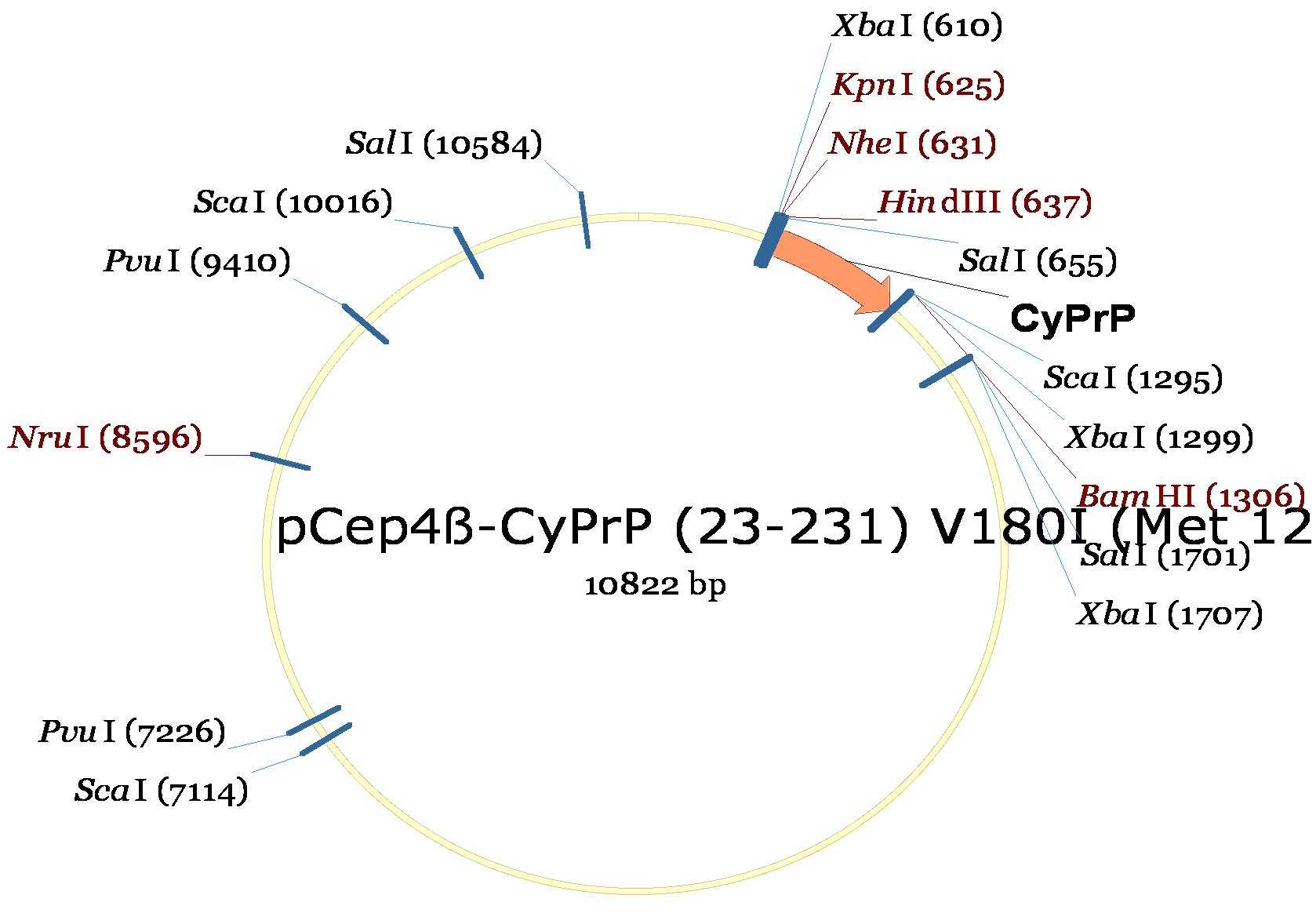
pCep4β-CyPrP (23-231) V180I (Met 129)
(Plasmid
#23307)
-
Depositing Lab
-
Depositing OrganizationLady Davis Institute for Medical Research
Located in Canada -
Publication
-
Sequence Information

Ordering
This material is available to academics and nonprofits only.
| Item | Catalog # | Description | Quantity | Price (USD) | |
|---|---|---|---|---|---|
| Plasmid | 23307 | Standard format: Plasmid sent in bacteria as agar stab | 1 | $94 | |
Backbone
-
Vector backbonepCep4β
-
Backbone manufacturerInvitrogen
- Backbone size w/o insert (bp) 10188
-
Vector typeMammalian Expression
-
Selectable markersHygromycin
Growth in Bacteria
-
Bacterial Resistance(s)Ampicillin, 100 μg/mL
-
Growth Temperature37°C
-
Growth Strain(s)DH5alpha
-
Growth instructionsDH5α in LB
-
Copy numberHigh Copy
Gene/Insert
-
Gene/Insert nameHuman Prion Protein
-
Alt namehPrP
-
Alt namePRNP
-
SpeciesH. sapiens (human)
-
Insert Size (bp)632
-
MutationV180I, Met 129 Polymorphism, Deleted ER Signal Peptide and GPI Anchor Signal Peptide sequences to produce cytosolic PrP (AA 23-231)
-
Entrez GenePRNP (a.k.a. ASCR, AltPrP, CD230, CJD, GSS, KURU, PRIP, PrP, PrP27-30, PrP33-35C, PrPc, p27-30)
Cloning Information
- Cloning method Restriction Enzyme
- 5′ cloning site HindIII (not destroyed)
- 3′ cloning site BamHI (not destroyed)
- 5′ sequencing primer n/a
- (Common Sequencing Primers)
Terms and Licenses
-
Academic/Nonprofit Terms
-
Industry Terms
- Not Available to Industry
Trademarks:
- Zeocin® is an InvivoGen trademark.
Depositor Comments
Reference:
Jodoin J, Laroche-Pierre S, Goodyer CG, LeBlanc AC.(2007) J Neurosci.27:5081-91.
How to cite this plasmid
( Back to top)
These plasmids were created by your colleagues. Please acknowledge the Principal Investigator, cite the article in which the plasmids were described, and include Addgene in the Materials and Methods of your future publications.
-
For your Materials & Methods section:
pCep4β-CyPrP (23-231) V180I (Met 129) was a gift from Andrea LeBlanc (Addgene plasmid # 23307) -
For your References section:
Defective retrotranslocation causes loss of anti-Bax function in human familial prion protein mutants. Jodoin J, Laroche-Pierre S, Goodyer CG, LeBlanc AC. J Neurosci. 2007 May 9. 27(19):5081-91. 10.1523/JNEUROSCI.0957-07.2007 PubMed 17494694
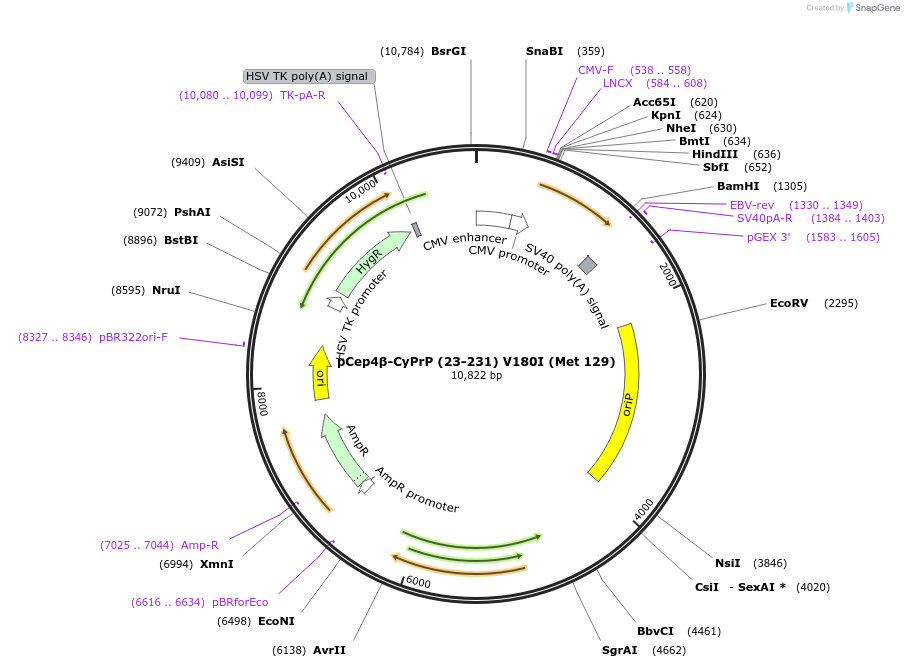
Map uploaded by the depositor.