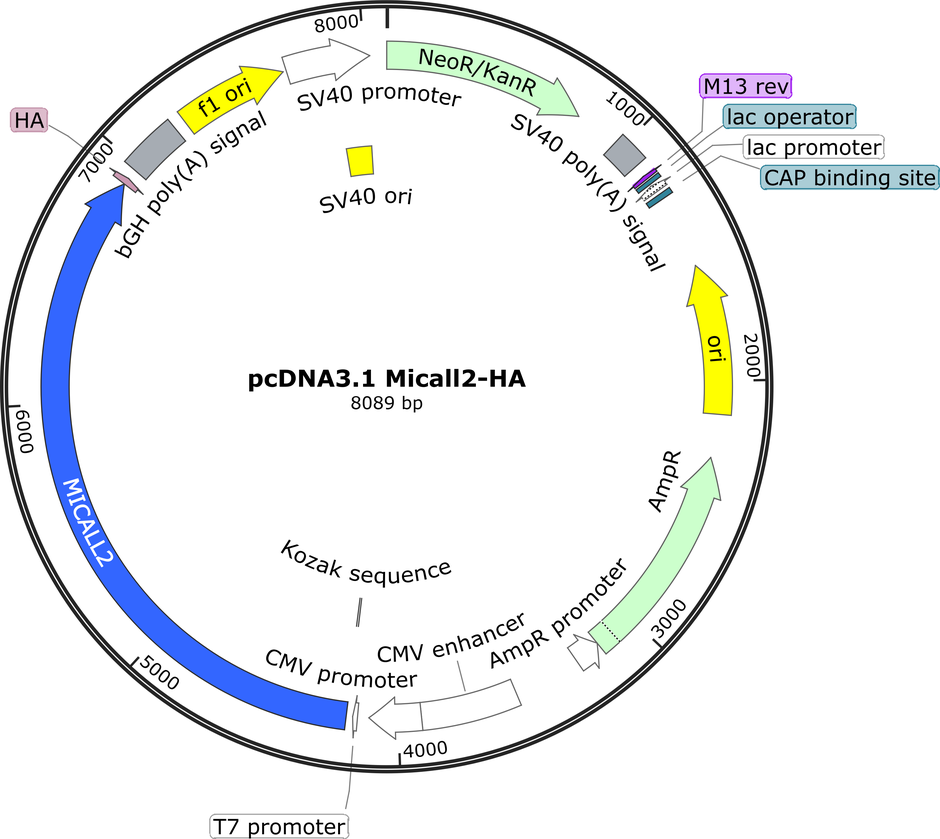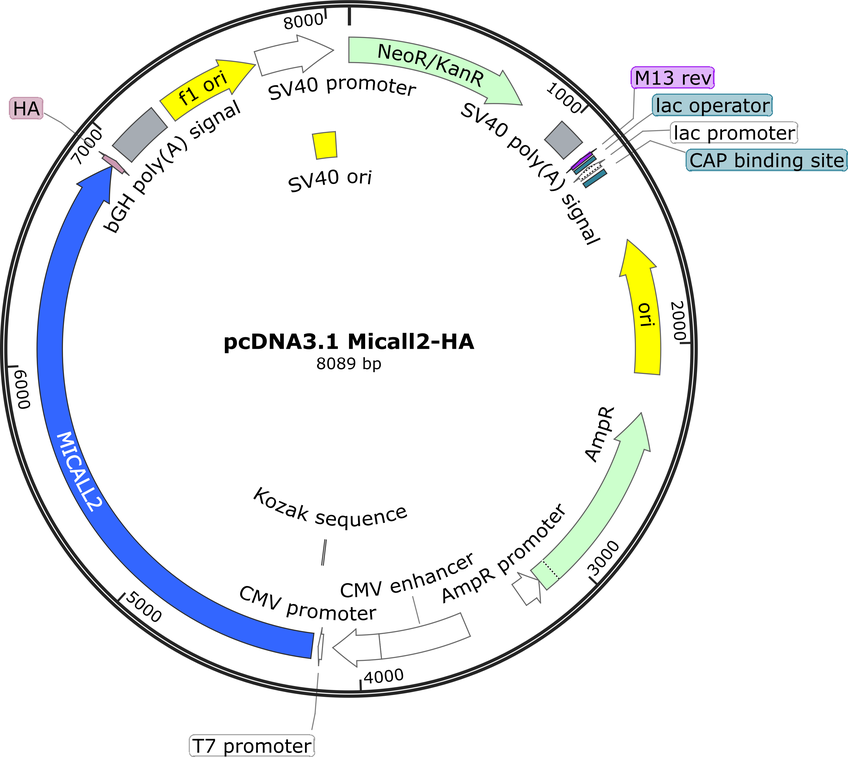



pcDNA3.1 Micall2-HA
(Plasmid
#238507)
-
PurposeExpresses MICALL2 with C-terminal HA-tag in mammalian cells
-
Depositing Lab
-
Depositing OrganizationUniversitaet Konstanz
Located in Germany -
Publication
-
Sequence Information


Ordering
This material is available to academics and nonprofits only.
| Item | Catalog # | Description | Quantity | Price (USD) | |
|---|---|---|---|---|---|
| Plasmid | 238507 | Standard format: Plasmid sent in bacteria as agar stab | 1 | $94 | |
Backbone
-
Vector backbonepcDNA3.1
- Total vector size (bp) 8089
-
Vector typeMammalian Expression
Growth in Bacteria
-
Bacterial Resistance(s)Ampicillin, 100 μg/mL
-
Growth Temperature37°C
-
Growth Strain(s)DH5alpha
-
Copy numberUnknown
Gene/Insert
-
Gene/Insert nameMICAL-like protein 2
-
Alt nameMICALL2
-
Alt nameJRAB
-
SpeciesH. sapiens (human)
-
Insert Size (bp)2712
-
Entrez GeneMICALL2 (a.k.a. JRAB, MICAL-L2)
-
Tag
/ Fusion Protein
- HA-tag (C terminal on insert)
Cloning Information
- Cloning method Gibson Cloning
- 5′ sequencing primer CGCAAATGGGCGGTAGGCGTG
- 3′ sequencing primer TGACACCTACTCAGACAATGC
- (Common Sequencing Primers)
Resource Information
-
A portion of this plasmid was derived from a plasmid made byGene derived from pDONR211 vector (DNASU, catalog #HsCD00296916)
Terms and Licenses
-
Academic/Nonprofit Terms
-
Industry Terms
- Not Available to Industry
Trademarks:
- Zeocin® is an InvivoGen trademark.
Depositor Comments
Mutation in original Plasmid from DNASU V85A mutated back to valine
Primer fw: ACATGGtGGCCTTGAAGGTGCCTGAC
Primer rev: AAGGCCaCCATGTCCTCGGCATCCAG
How to cite this plasmid
( Back to top)
These plasmids were created by your colleagues. Please acknowledge the Principal Investigator, cite the article in which the plasmids were described, and include Addgene in the Materials and Methods of your future publications.
-
For your Materials & Methods section:
pcDNA3.1 Micall2-HA was a gift from Florian Stengel (Addgene plasmid # 238507 ; http://n2t.net/addgene:238507 ; RRID:Addgene_238507) -
For your References section:
Probing the proteome-wide impact of inhibitors of Leucine-rich Repeat Kinases 1 and 2 on protein-protein interactions and phosphorylation. Jansen J, Wendel M, Raig ND, Kraus T, Surridge KJ, Mahesula S, Richter-Müller N, Mathea S, Reck-Peterson SL, Knapp S, Stengel F. bioRxiv 2025.09.03.674114 10.1101/2025.09.03.674114
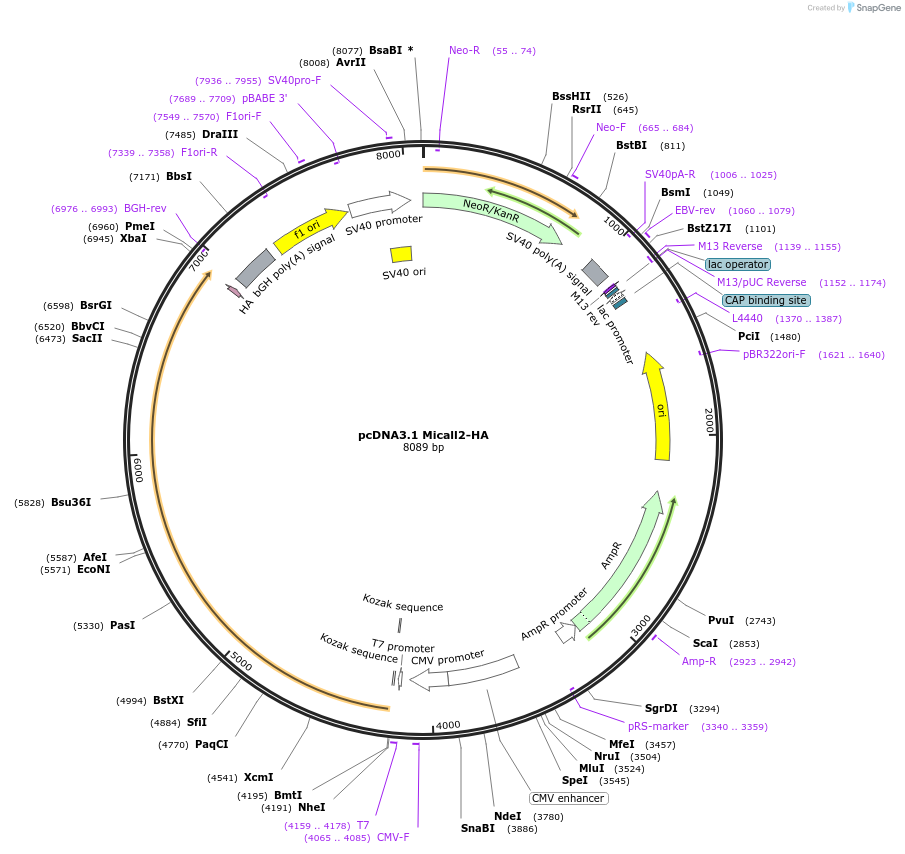
Map uploaded by the depositor.