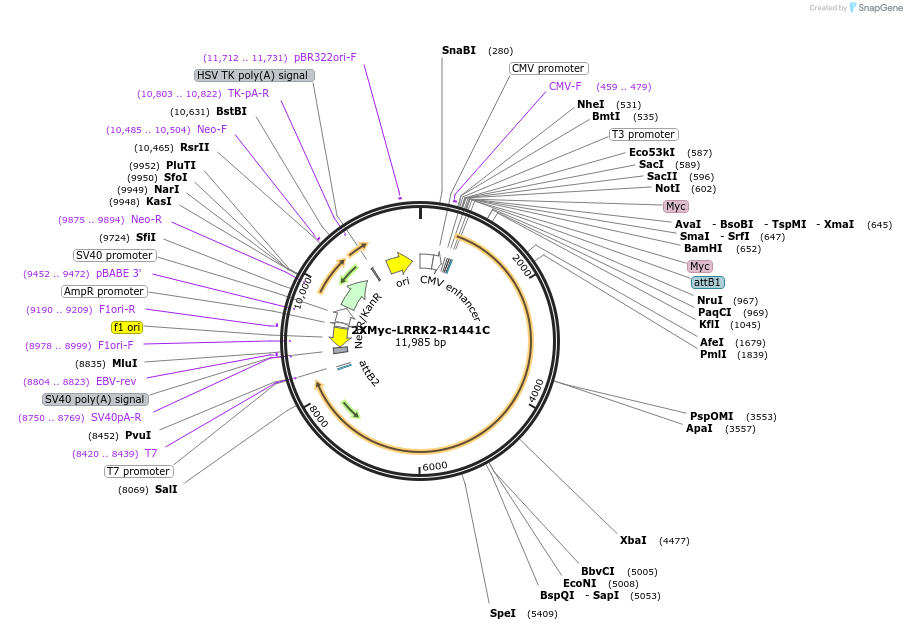
-
Depositing Lab
-
Depositing OrganizationNational Institute on Aging (NIA)
Located in the United States of America -
Publication
-
Sequence Information
Ordering
| Item | Catalog # | Description | Quantity | Price (USD) | |
|---|---|---|---|---|---|
| Plasmid | 25363 | Standard format: Plasmid sent in bacteria as agar stab | 1 | $94 | |
| DNA | 25363-D50 | 50 μg of DNA in Tris buffer | $495 | ||
| DNA | 25363-D100 | 100 μg of DNA in Tris buffer | $585 | ||
Backbone
-
Vector backbonepCMV-Tag 3B
-
Backbone manufacturerCookson Lab
- Backbone size w/o insert (bp) 4300
-
Vector typeMammalian Expression
Growth in Bacteria
-
Bacterial Resistance(s)Kanamycin, 50 μg/mL
-
Growth Temperature37°C
-
Growth Strain(s)Stbl3
-
Growth instructionsStbl3
-
Copy numberHigh Copy
Gene/Insert
-
Gene/Insert nameLRRK2
-
SpeciesH. sapiens (human)
-
Insert Size (bp)7581
-
MutationArginine 1441 mutated to Cysteine
-
Entrez GeneLRRK2 (a.k.a. AURA17, DARDARIN, PARK8, RIPK7, ROCO2)
-
Tag
/ Fusion Protein
- 2XMyc (N terminal on insert)
Cloning Information
- Cloning method Restriction Enzyme
- 5′ sequencing primer CMV-F
- 3′ sequencing primer SV40pA-R
- (Common Sequencing Primers)
Resource Information
Terms and Licenses
-
Academic/Nonprofit Terms
-
Industry Terms
- Not Available to Industry
Trademarks:
- Zeocin® is an InvivoGen trademark.
Depositor Comments
An additional Myc tag has been added to the original vector. The 2XMyc vector was adapted to the invitrogen gateway system by insertion of a gateway cloning cassette. LRRK2 was cloned by gateway recombination.
In order to provide these LRRK2 plasmids as a resource to the community, we depend on the contributing academic laboratory for quality control. Therefore, the full-length LRRK2 plasmids are distributed in the format provided by the contributing institution "as is" with no additional guarantee.
Addgene is not responsible for any errors in these constructs.
It is strongly encouraged that a diagnostic digest be performed on this plasmid before use in an experiment (see attached PDF).
If there is an issue with your stock, please contact the Cookson lab for a replacement.
DNA (Catalog # 25363-D50)
Purpose
Ready-to-use, high-purity DNA prep. DNA aliquots are suitable for use in mammalian cell transfections and other molecular biology applications.
Delivery
- Amount 50 μg
- Concentration 1 μg/μL
- Pricing $495 USD
- Storage 4 ℃ (short-term) or -20 ℃ (long-term)
Terms and Licenses
-
Academic/Nonprofit Terms
-
Industry Terms
- Not Available to Industry
Quality Control
Every DNA prep is verified by next-generation sequencing, confirming plasmid identity, sequence integrity, and absence of DNA contaminants. Concentration is confirmed to be within ±2.5% of the stated concentration.
Our production process has been validated to consistently yield endotoxin levels below 1.0 EU/μg. Individual lots are not tested for endotoxin.
DNA (Catalog # 25363-D100)
Purpose
Ready-to-use, high-purity DNA prep. DNA aliquots are suitable for use in mammalian cell transfections and other molecular biology applications.
Delivery
- Amount 100 μg
- Concentration 1 μg/μL
- Pricing $585 USD
- Storage 4 ℃ (short-term) or -20 ℃ (long-term)
Terms and Licenses
-
Academic/Nonprofit Terms
-
Industry Terms
- Not Available to Industry
Quality Control
Every DNA prep is verified by next-generation sequencing, confirming plasmid identity, sequence integrity, and absence of DNA contaminants. Concentration is confirmed to be within ±2.5% of the stated concentration.
Our production process has been validated to consistently yield endotoxin levels below 1.0 EU/μg. Individual lots are not tested for endotoxin.
These plasmids were created by your colleagues. Please acknowledge the Principal Investigator, cite the article in which the plasmids were described, and include Addgene in the Materials and Methods of your future publications.
-
For your Materials & Methods section:
2XMyc-LRRK2-R1441C was a gift from Mark Cookson (Addgene plasmid # 25363 ; http://n2t.net/addgene:25363 ; RRID:Addgene_25363) -
For your References section:
The Parkinson Disease-associated Leucine-rich Repeat Kinase 2 (LRRK2) Is a Dimer That Undergoes Intramolecular Autophosphorylation. . J Biol Chem. 2008 Jun 13;283(24):16906-14. 10.1074/jbc.M708718200 PubMed 18397888