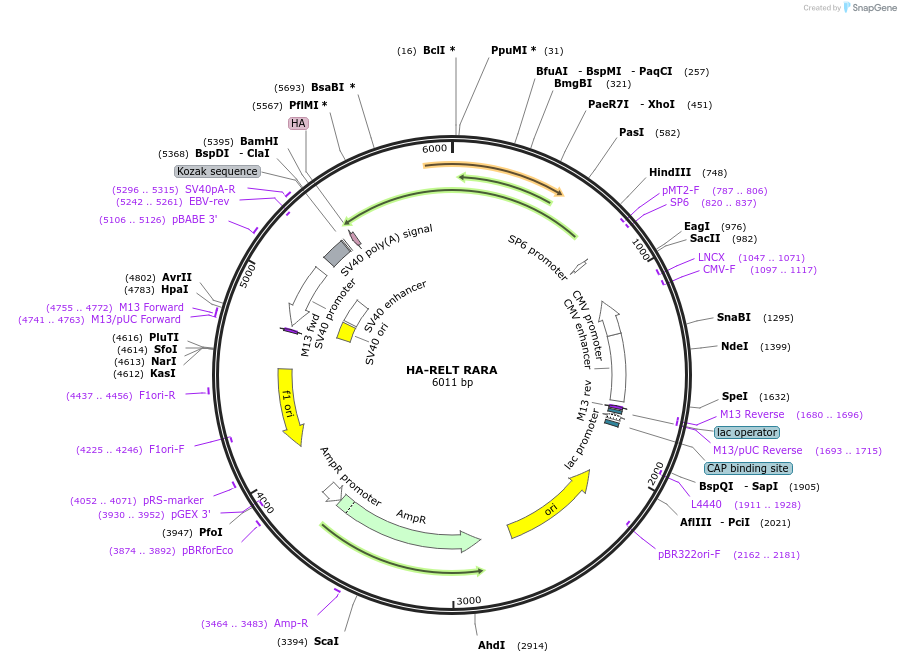
HA-RELT RARA
(Plasmid
#260223)
-
PurposeExpression in mammalian cells
-
Depositing Lab
-
Depositing OrganizationCalifornia Northstate University
Located in the United States of America -
Sequence Information
Ordering
| Item | Catalog # | Description | Quantity | Price (USD) | |
|---|---|---|---|---|---|
| Plasmid | 260223 | Standard format: Plasmid sent in bacteria as agar stab | 1 | $94 | |
Backbone
-
Vector backbonepcDNA3
-
Vector typeMammalian Expression
Growth in Bacteria
-
Bacterial Resistance(s)Ampicillin, 100 μg/mL
-
Growth Temperature37°C
-
Growth Strain(s)DH5alpha
-
Copy numberHigh Copy
Gene/Insert
-
Gene/Insert nameRELT (Receptor Expressed in Lymphoid Tissues)
-
SpeciesH. sapiens (human)
-
Insert Size (bp)1300
-
Mutation349-352 RFRV(R)RARA to disrupt binding by OXSR1 and SPAK kinases
-
Entrez GeneRELT (a.k.a. FLJ14993, TNFRSF19L)
-
Tag
/ Fusion Protein
- HA (C terminal on insert)
Cloning Information
- Cloning method Restriction Enzyme
- 5′ cloning site Unknown (unknown if destroyed)
Terms and Licenses
-
Academic/Nonprofit Terms
-
Industry Terms
- Not Available to Industry
Trademarks:
- Zeocin® is an InvivoGen trademark.
Depositor Comments
Please cite: Batiste M, Joy B, Yee CK, Cho L, Christensen A, Abed I, Nguyen K, Yanumula A, Chang H, Cho ED, Wang W, Chou E, Chang EH, Shyu YL, Abram A, Alcaide J, Zhou J, Gillespie B, Senderovich M, Cusick GA, Le AV, Hoang F, Shi Y, Mohamed E, Cusick JK. RELT Is Upregulated in Breast Cancer and Induces Death in Breast Cancer Cells. Biomedicines. 2024 Nov 22;12(12):2667. doi: 10.3390/biomedicines12122667. PMID: 39767574; PMCID: PMC11727564.
These plasmids were created by your colleagues. Please acknowledge the Principal Investigator, cite the article in which the plasmids were described, and include Addgene in the Materials and Methods of your future publications.
-
For your Materials & Methods section:
HA-RELT RARA was a gift from John Cusick (Addgene plasmid # 260223 ; http://n2t.net/addgene:260223 ; RRID:Addgene_260223) -
For your References section:
RELT Is Upregulated in Breast Cancer and Induces Death in Breast Cancer Cells. Batiste M, Joy B, Yee CK, Cho L, Christensen A, Abed I, Nguyen K, Yanumula A, Chang H, Cho ED, Wang W, Chou E, Chang EH, Shyu YL, Abram A, Alcaide J, Zhou J, Gillespie B, Senderovich M, Cusick GA, Le AV, Hoang F, Shi Y, Mohamed E, Cusick JK. Biomedicines. 2024 Nov 22;12(12):2667. doi: 10.3390/biomedicines12122667. 10.3390/biomedicines12122667 PubMed 39767574