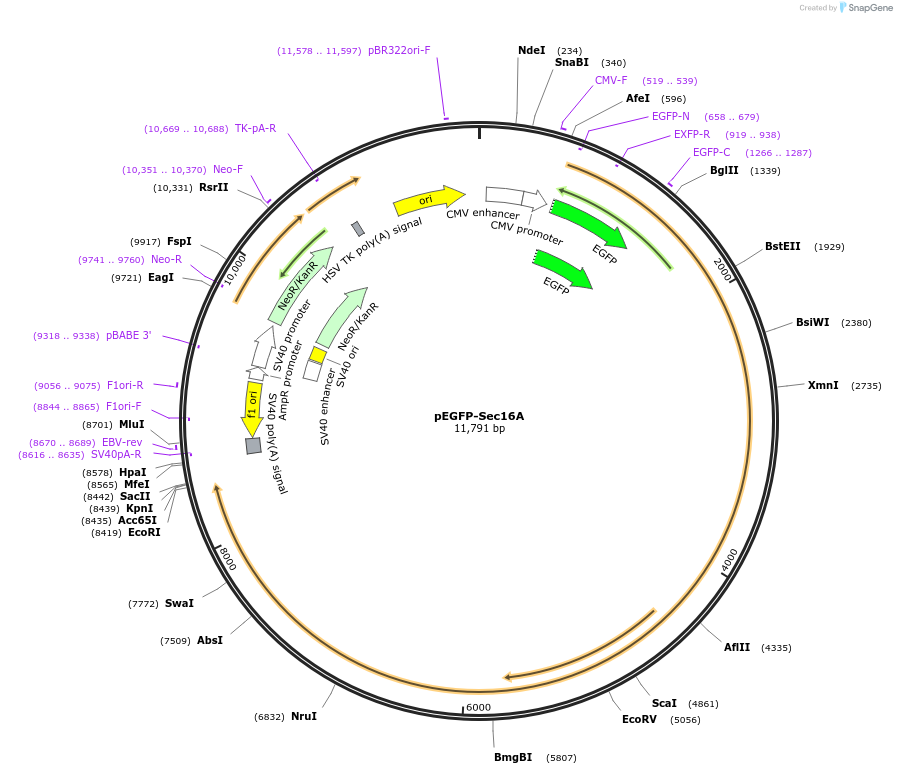
-
PurposeExpresses Sec16A as a GFP fusion
-
Depositing Lab
-
Depositing OrganizationUniversity of Bristol
Located in the United Kingdom of Great Britain and Northern Ireland -
Citations
-
Sequence Information
Ordering
| Item | Catalog # | Description | Quantity | Price (USD) | |
|---|---|---|---|---|---|
| Plasmid | 36155 | Standard format: Plasmid sent in bacteria as agar stab | 1 | $94 | |
| DNA | 36155-D50 | 50 μg of DNA in Tris buffer | $495 | ||
| DNA | 36155-D100 | 100 μg of DNA in Tris buffer | $585 | ||
Backbone
-
Vector backbonepEGFP-C1
-
Backbone manufacturerClontech
-
Vector typeMammalian Expression
-
Selectable markersNeomycin (select with G418)
Growth in Bacteria
-
Bacterial Resistance(s)Kanamycin, 50 μg/mL
-
Growth Temperature37°C
-
Growth Strain(s)Stbl3
-
Growth instructionsDifficult to grow and prep without apparent loss of some of insert.
-
Copy numberHigh Copy
Gene/Insert
-
Gene/Insert nameSec16A
-
Alt nameKIAA0310
-
SpeciesH. sapiens (human)
-
Entrez GeneSEC16A (a.k.a. KIAA0310, SEC16L, p250)
- Promoter CMV
-
Tag
/ Fusion Protein
- EGFP (N terminal on insert)
Cloning Information
- Cloning method Restriction Enzyme
- 5′ cloning site BglII (not destroyed)
- 3′ cloning site EcoRI (not destroyed)
- 5′ sequencing primer GGGGAGATCTATGCAGCCACCGCCCCAGACGG
- 3′ sequencing primer GGGGGAATTCTCAGTTCAGCACCAGGTGCTTCC
- (Common Sequencing Primers)
Resource Information
-
A portion of this plasmid was derived from a plasmid made byOriginal insert from Kasuza as detailed in the attachment. Cloned by Peter Watson, now at University of Cardiff when he was a postdoc in the lab.
Terms and Licenses
-
Academic/Nonprofit Terms
-
Industry Terms
- Not Available to Industry
Trademarks:
- Zeocin® is an InvivoGen trademark.
Depositor Comments
Please note: Plasmid contains a D1555N mutation in Sec16A compared to the NCBI reference sequence NP_055681.1, this mutation is not known to affect plasmid function.
DNA (Catalog # 36155-D50)
Purpose
Ready-to-use, high-purity DNA prep. DNA aliquots are suitable for use in mammalian cell transfections and other molecular biology applications.
Delivery
- Amount 50 μg
- Concentration 1 μg/μL
- Pricing $495 USD
- Storage 4 ℃ (short-term) or -20 ℃ (long-term)
Terms and Licenses
-
Academic/Nonprofit Terms
-
Industry Terms
- Not Available to Industry
Quality Control
Every DNA prep is verified by next-generation sequencing, confirming plasmid identity, sequence integrity, and absence of DNA contaminants. Concentration is confirmed to be within ±2.5% of the stated concentration.
Our production process has been validated to consistently yield endotoxin levels below 1.0 EU/μg. Individual lots are not tested for endotoxin.
DNA (Catalog # 36155-D100)
Purpose
Ready-to-use, high-purity DNA prep. DNA aliquots are suitable for use in mammalian cell transfections and other molecular biology applications.
Delivery
- Amount 100 μg
- Concentration 1 μg/μL
- Pricing $585 USD
- Storage 4 ℃ (short-term) or -20 ℃ (long-term)
Terms and Licenses
-
Academic/Nonprofit Terms
-
Industry Terms
- Not Available to Industry
Quality Control
Every DNA prep is verified by next-generation sequencing, confirming plasmid identity, sequence integrity, and absence of DNA contaminants. Concentration is confirmed to be within ±2.5% of the stated concentration.
Our production process has been validated to consistently yield endotoxin levels below 1.0 EU/μg. Individual lots are not tested for endotoxin.
These plasmids were created by your colleagues. Please acknowledge the Principal Investigator, cite the article in which the plasmids were described, and include Addgene in the Materials and Methods of your future publications.
-
For your Materials & Methods section:
pEGFP-Sec16A was a gift from David Stephens (Addgene plasmid # 36155 ; http://n2t.net/addgene:36155 ; RRID:Addgene_36155) -
For your References section:
Sec16 defines endoplasmic reticulum exit sites and is required for secretory cargo export in mammalian cells. Watson P, Townley AK, Koka P, Palmer KJ, Stephens DJ. Traffic. 2006 Dec;7(12):1678-87. Epub 2006 Sep 27. 10.1111/j.1600-0854.2006.00493.x PubMed 17005010