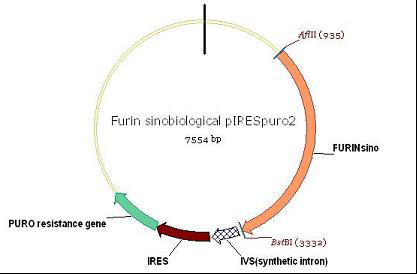



pIRESpuro2_furin_cDNA
(Plasmid
#63685)
-
Purposehuman furin cDNA (NM_002569.2) cloned into pIRESpuro2, between the AflII and BstB1 restriction sites after PCR amplification using primers 5’-GAGAGACTTAAGATGGAGCTGAGGCCCTGG (Forward) and 5’-GACCGATTCG
-
Depositing Lab
-
Depositing OrganizationJohns Hopkins University and School of Medicine
Located in the United States of America -
Sequence Information
Full plasmid sequence is not available for this item.


Ordering
| Item | Catalog # | Description | Quantity | Price (USD) | |
|---|---|---|---|---|---|
| Plasmid | 63685 | Standard format: Plasmid sent in bacteria as agar stab | 1 | $94 * | |
* Log in to view industry pricing.
Backbone
-
Vector backbonepIRESpuro2
-
Backbone manufacturerCloneTech
- Backbone size w/o insert (bp) 5192
- Total vector size (bp) 7554
-
Vector typeMammalian Expression
-
Selectable markersPuromycin
Growth in Bacteria
-
Bacterial Resistance(s)Kanamycin, 50 μg/mL
-
Growth Temperature37°C
-
Growth Strain(s)DH5alpha
-
Copy numberHigh Copy
Gene/Insert
-
Gene/Insert nameFURIN
-
Alt nameHomo sapiens furin (paired basic amino acid cleaving enzyme) (FURIN), mRNA
-
SpeciesH. sapiens (human)
-
Insert Size (bp)2397
-
GenBank IDNM_002569.2
-
Entrez GeneFURIN (a.k.a. FUR, PACE, PCSK3, SPC1)
Cloning Information
- Cloning method Restriction Enzyme
- 5′ cloning site aflII (unknown if destroyed)
- 3′ cloning site BstBI (unknown if destroyed)
- 5′ sequencing primer GAGAGACTTAAGATGGAGCTGAGGCCCTGG
- 3′ sequencing primer GACCGATTCGAATCATCAGAGGGCGCTCTGGTC
- (Common Sequencing Primers)
Terms and Licenses
-
Academic/Nonprofit Terms
-
Industry Terms
Trademarks:
- Zeocin® is an InvivoGen trademark.
How to cite this plasmid
( Back to top)
These plasmids were created by your colleagues. Please acknowledge the Principal Investigator, cite the article in which the plasmids were described, and include Addgene in the Materials and Methods of your future publications.
-
For your Materials & Methods section:
pIRESpuro2_furin_cDNA was a gift from Richard Roden (Addgene plasmid # 63685) -
For your References section:
Preparation and properties of a papillomavirus infectious intermediate and its utility for neutralization studies. Wang JW, Jagu S, Kwak K, Wang C, Peng S, Kirnbauer R, Roden RB. Virology. 2014 Jan 20;449:304-16. doi: 10.1016/j.virol.2013.10.038. Epub 2013 Dec 20. 10.1016/j.virol.2013.10.038 PubMed 24418565
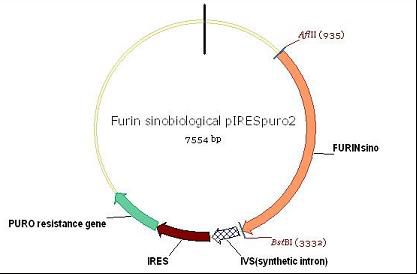
Map uploaded by the depositor.