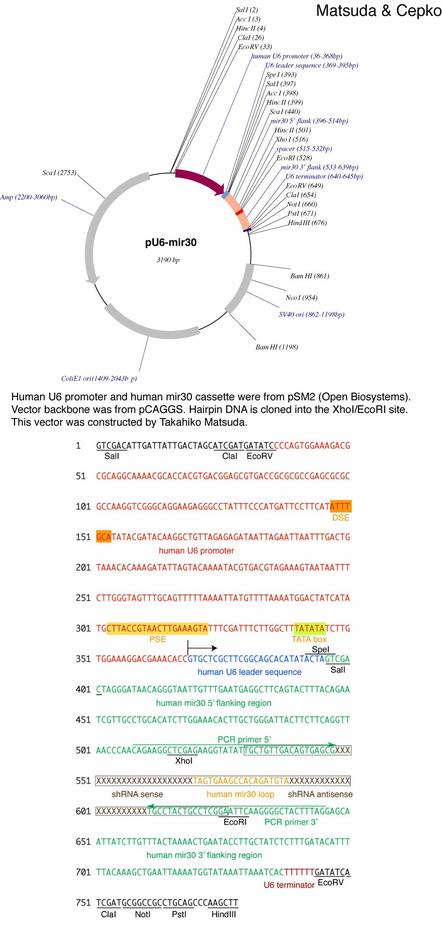



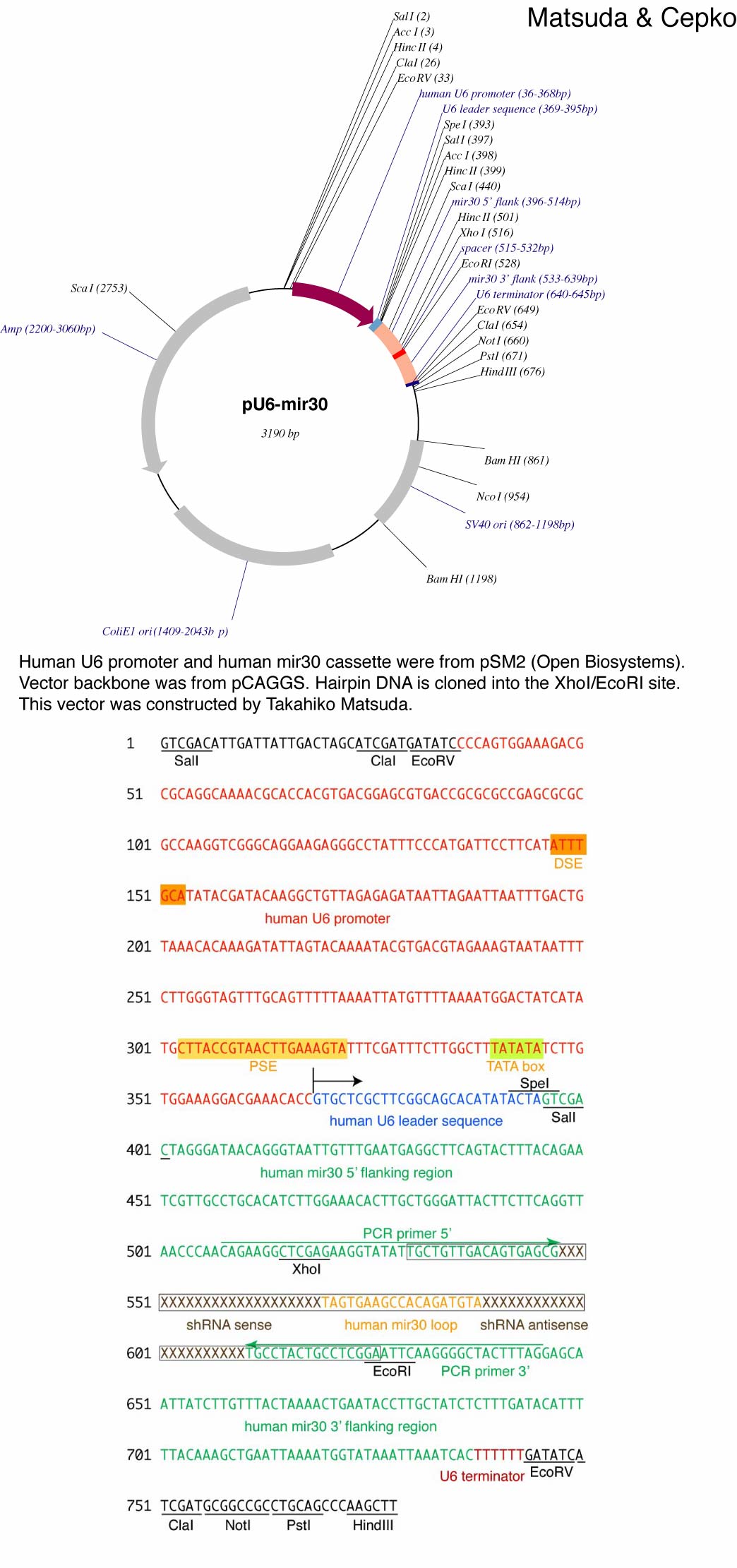
pU6-mir30
(Plasmid
#13773)
-
Depositing Lab
-
Sequence Information

Ordering
This material is available to academics and nonprofits only.
| Item | Catalog # | Description | Quantity | Price (USD) | |
|---|---|---|---|---|---|
| Plasmid | 13773 | Standard format: Plasmid sent in bacteria as agar stab | 1 | $94 | |
Backbone
-
Vector backbonepCAGEN
- Backbone size w/o insert (bp) 2524
-
Vector typeMammalian Expression, RNAi
Growth in Bacteria
-
Bacterial Resistance(s)Ampicillin, 100 μg/mL
-
Growth Temperature37°C
-
Growth Strain(s)DH5alpha
-
Copy numberHigh Copy
Gene/Insert
-
Gene/Insert namehuman U6 promoter-mir30 cassette
-
Insert Size (bp)666
Cloning Information
- Cloning method Restriction Enzyme
- 5′ cloning site SalI (not destroyed)
- 3′ cloning site PstI (not destroyed)
- 5′ sequencing primer N/A
- (Common Sequencing Primers)
Resource Information
-
A portion of this plasmid was derived from a plasmid made byThe mir30 cassette with the human U6 promoter was amplified by PCR using pSM2 (Open Biosystems) as a template.
Terms and Licenses
-
Academic/Nonprofit Terms
-
Industry Terms
- Not Available to Industry
Trademarks:
- Zeocin® is an InvivoGen trademark.
Depositor Comments
Haipin DNA can be cloned into the XhoI/EcoRI sites. A protocol for hairpin DNA design and cloning was reported by Gregory Hannon lab (Paddison et al. Nat. Methods 1, 163-167 (2004)).
http://katahdin.cshl.org:9331/RNAi_web/scripts/main2.pl
How to cite this plasmid
( Back to top)
These plasmids were created by your colleagues. Please acknowledge the Principal Investigator, cite the article in which the plasmids were described, and include Addgene in the Materials and Methods of your future publications.
-
For your Materials & Methods section:
pU6-mir30 was a gift from Connie Cepko (Addgene plasmid # 13773) -
For your References section:
Controlled expression of transgenes introduced by in vivo electroporation. Matsuda T, Cepko CL. Proc Natl Acad Sci U S A. 2007 Jan 16;104(3):1027-32. doi: 10.1073/pnas.0610155104 10.1073/pnas.0610155104 PubMed 17209010
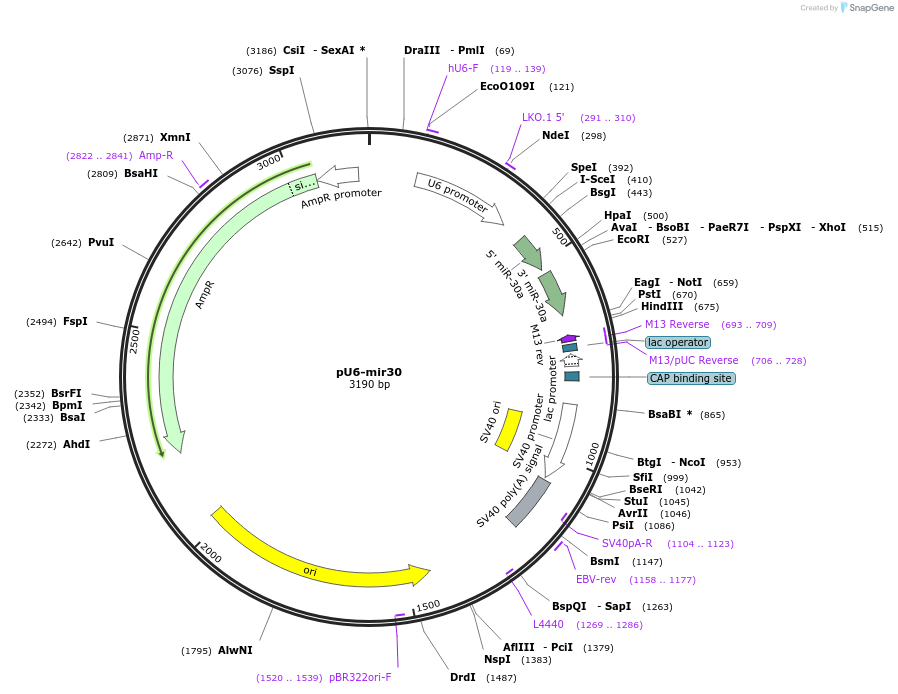
Map uploaded by the depositor.