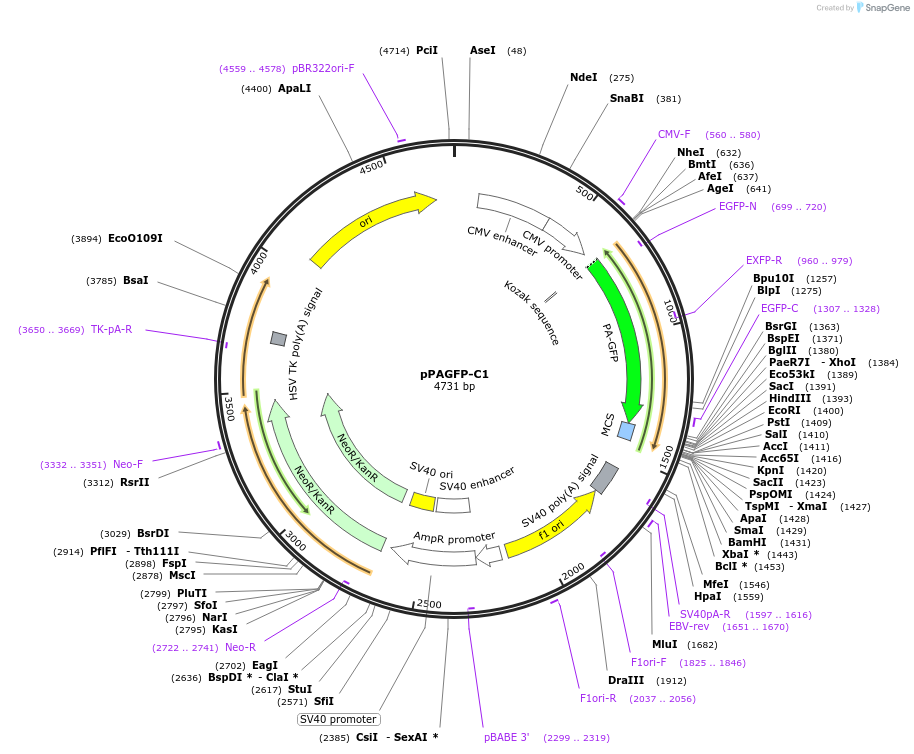
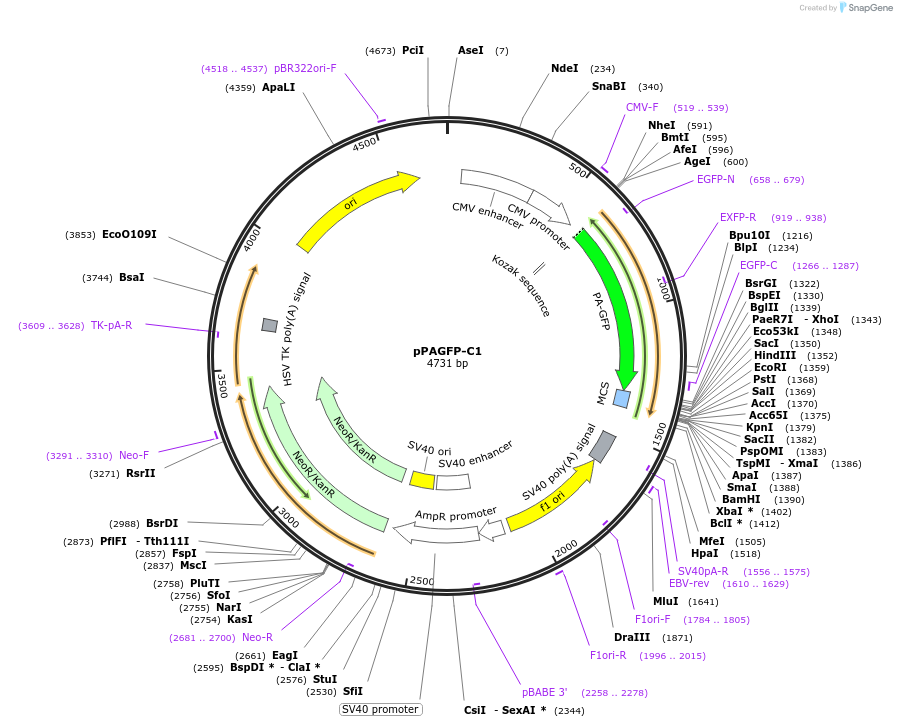
-
Depositing Lab
-
Depositing OrganizationNational Institute of Child Health and Human Development (NICHD)
Located in the United States of America -
Publication
-
Citations
-
Sequence Information
Ordering
| Item | Catalog # | Description | Quantity | Price (USD) | |
|---|---|---|---|---|---|
| Plasmid | 11910 | Standard format: Plasmid sent in bacteria as agar stab | 1 | $94 | |
| DNA | 11910-D50 | 50 μg of DNA in Tris buffer | $495 | ||
| DNA | 11910-D100 | 100 μg of DNA in Tris buffer | $585 | ||
Backbone
-
Vector backbonepEGFP-C1
-
Backbone manufacturerClontech
- Backbone size w/o insert (bp) 4731
-
Vector typeMammalian Expression
-
Selectable markersNeomycin (select with G418)
Growth in Bacteria
-
Bacterial Resistance(s)Kanamycin, 50 μg/mL
-
Growth Temperature37°C
-
Growth Strain(s)DH5alpha
-
Copy numberUnknown
Gene/Insert
-
Gene/Insert namePAGFP
-
Alt namephotoactivatable green fluorescent protein
-
SpeciesAequorea victoria
-
MutationThese plasmids are essentially the same as the Clontech pEGFP-C1 version with four mutations (L64F/T65S/V163A/T203H). The PAGFP also contains an A206K mutation to disrupt dimerization
Cloning Information
- Cloning method Restriction Enzyme
- 5′ sequencing primer n/a
- (Common Sequencing Primers)
Terms and Licenses
-
Academic/Nonprofit Terms
-
Industry Terms
- Not Available to Industry
Trademarks:
- Zeocin® is an InvivoGen trademark.
Depositor Comments
The pPAGFP-C1 was not published. It was prepared by removing the PAGFP cDNA from pPAGFP-N1 with an AgeI/BsrGI restriction digest and subcloning it into a similarly digested pEYFP-C1 (Clontech). The pPAGFP-C1 was confirmed by sequencing. If you use this construct in future publications, use your best judgement for citation.
The fluorescent protein encoding region contains one of the three substitutions (A206K) suggested by Dr. Roger Tsien. This mutation disrupts fluorescent protein dimerization even at high concentrations. The mutation does not seem to have much effect on the fluorescent properties of the CFP, GFP and YFP versions, so hopefully it will not affect PAGFP too much. The PAGFP A206K mutant does not display obvious fluorescent differences compared with the original, but please bear in mind that I haven't characterized it to the same extent.
The citation for the A206K mutation in fluorescent proteins is Science 2002 296:913.
DNA (Catalog # 11910-D50)
Purpose
Ready-to-use, high-purity DNA prep. DNA aliquots are suitable for use in mammalian cell transfections and other molecular biology applications.
Delivery
- Amount 50 μg
- Concentration 1 μg/μL
- Pricing $495 USD
- Storage 4 ℃ (short-term) or -20 ℃ (long-term)
Terms and Licenses
-
Academic/Nonprofit Terms
-
Industry Terms
- Not Available to Industry
Quality Control
Every DNA prep is verified by next-generation sequencing, confirming plasmid identity, sequence integrity, and absence of DNA contaminants. Concentration is confirmed to be within ±2.5% of the stated concentration.
Our production process has been validated to consistently yield endotoxin levels below 1.0 EU/μg. Individual lots are not tested for endotoxin.
DNA (Catalog # 11910-D100)
Purpose
Ready-to-use, high-purity DNA prep. DNA aliquots are suitable for use in mammalian cell transfections and other molecular biology applications.
Delivery
- Amount 100 μg
- Concentration 1 μg/μL
- Pricing $585 USD
- Storage 4 ℃ (short-term) or -20 ℃ (long-term)
Terms and Licenses
-
Academic/Nonprofit Terms
-
Industry Terms
- Not Available to Industry
Quality Control
Every DNA prep is verified by next-generation sequencing, confirming plasmid identity, sequence integrity, and absence of DNA contaminants. Concentration is confirmed to be within ±2.5% of the stated concentration.
Our production process has been validated to consistently yield endotoxin levels below 1.0 EU/μg. Individual lots are not tested for endotoxin.
These plasmids were created by your colleagues. Please acknowledge the Principal Investigator, cite the article in which the plasmids were described, and include Addgene in the Materials and Methods of your future publications.
-
For your Materials & Methods section:
pPAGFP-C1 was a gift from Jennifer Lippincott-Schwartz (Addgene plasmid # 11910 ; http://n2t.net/addgene:11910 ; RRID:Addgene_11910) -
For your References section:
A photoactivatable GFP for selective photolabeling of proteins and cells. Patterson GH, Lippincott-Schwartz J. Science. 2002 Sep 13. 297(5588):1873-7. 10.1126/science.1074952 PubMed 12228718