




pCEFL EGFP-TEADi
(Plasmid
#140144)
-
PurposeTEAD inhibitor (TEADi): GFP-tagged inhibitor of the interaction of YAP1 and TAZ with TEAD transcription factors with nuclear localization signal.
-
Depositing Lab
-
Depositing OrganizationNational Cancer Institute (NCI)
Located in the United States of America -
Citations
-
Sequence Information


Ordering
| Item | Catalog # | Description | Quantity | Price (USD) | |
|---|---|---|---|---|---|
| Plasmid | 140144 | Standard format: Plasmid sent in bacteria as agar stab | 1 | $94 | |
| DNA | 140144-D50 | 50 μg of DNA in Tris buffer | $495 | ||
| DNA | 140144-D100 | 100 μg of DNA in Tris buffer | $585 | ||
Backbone
-
Vector backbonepCEFL
- Total vector size (bp) 6803
-
Vector typeMammalian Expression
-
Selectable markersPuromycin
Growth in Bacteria
-
Bacterial Resistance(s)Ampicillin, 100 μg/mL
-
Growth Temperature37°C
-
Growth Strain(s)DH5alpha
-
Copy numberHigh Copy
Gene/Insert
-
Gene/Insert nameEGFP TEADi
-
Alt nameGreen fluorescent tagged TEAD inhibitor
-
SpeciesH. sapiens (human)
-
Insert Size (bp)1077
- Promoter EF1a
-
Tag
/ Fusion Protein
- EGFP (N terminal on insert)
Cloning Information
- Cloning method Restriction Enzyme
- 5′ cloning site HindIII (not destroyed)
- 3′ cloning site NotI (not destroyed)
- 5′ sequencing primer TTCTTCCATTTCAGGTGTCG
- 3′ sequencing primer ATT TAG GTG ACA CTA TAG
- (Common Sequencing Primers)
Resource Information
Terms and Licenses
-
Academic/Nonprofit Terms
-
Industry Terms
- Not Available to Industry
Trademarks:
- Zeocin® is an InvivoGen trademark.
Depositor Comments
We have observed that in certain cancer cell lines TEADi gets degraded or is expressed at low levels, resulting in incomplete TEAD inhibition. We recommend checking by Western Blot with anti-GFP antibody that the correct molecular weight of the full construct is expressed (approximately 39kDa) and check that known targets of TEAD are downregulated upon expression of TEADi. As with other dominant negative proteins, good levels of expression are necessary for TEADi to block TEADs.
DNA (Catalog # 140144-D50)
Purpose
Ready-to-use, high-purity DNA prep. DNA aliquots are suitable for use in mammalian cell transfections and other molecular biology applications.
Delivery
- Amount 50 μg
- Concentration 1 μg/μL
- Pricing $495 USD
- Storage 4 ℃ (short-term) or -20 ℃ (long-term)
Terms and Licenses
-
Academic/Nonprofit Terms
-
Industry Terms
- Not Available to Industry
Quality Control
Every DNA prep is verified by next-generation sequencing, confirming plasmid identity, sequence integrity, and absence of DNA contaminants. Concentration is confirmed to be within ±2.5% of the stated concentration.
Our production process has been validated to consistently yield endotoxin levels below 1.0 EU/μg. Individual lots are not tested for endotoxin.
DNA (Catalog # 140144-D100)
Purpose
Ready-to-use, high-purity DNA prep. DNA aliquots are suitable for use in mammalian cell transfections and other molecular biology applications.
Delivery
- Amount 100 μg
- Concentration 1 μg/μL
- Pricing $585 USD
- Storage 4 ℃ (short-term) or -20 ℃ (long-term)
Terms and Licenses
-
Academic/Nonprofit Terms
-
Industry Terms
- Not Available to Industry
Quality Control
Every DNA prep is verified by next-generation sequencing, confirming plasmid identity, sequence integrity, and absence of DNA contaminants. Concentration is confirmed to be within ±2.5% of the stated concentration.
Our production process has been validated to consistently yield endotoxin levels below 1.0 EU/μg. Individual lots are not tested for endotoxin.
These plasmids were created by your colleagues. Please acknowledge the Principal Investigator, cite the article in which the plasmids were described, and include Addgene in the Materials and Methods of your future publications.
-
For your Materials & Methods section:
pCEFL EGFP-TEADi was a gift from Ramiro Iglesias-Bartolome (Addgene plasmid # 140144 ; http://n2t.net/addgene:140144 ; RRID:Addgene_140144) -
For your References section:
YAP1/TAZ-TEAD transcriptional networks maintain skin homeostasis by regulating cell proliferation and limiting KLF4 activity. Yuan Y, Park J, Feng A, Awasthi P, Wang Z, Chen Q, Iglesias-Bartolome R. Nat Commun. 2020 Mar 19;11(1):1472. doi: 10.1038/s41467-020-15301-0. 10.1038/s41467-020-15301-0 PubMed 32193376
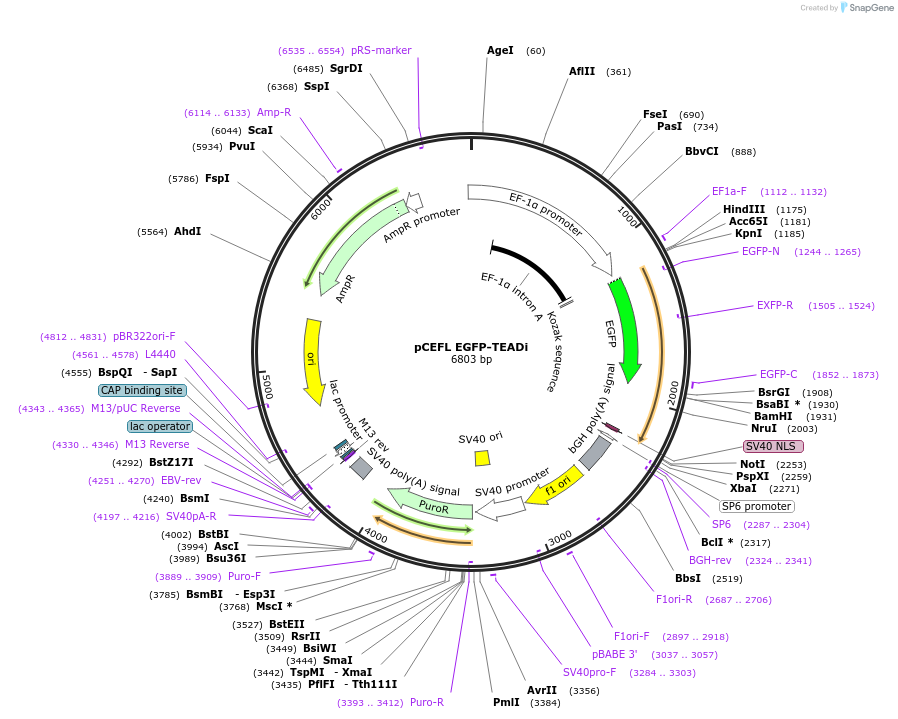
Map uploaded by the depositor.

Map uploaded by the depositor.
