



-
Depositing Lab
-
Depositing OrganizationScripps California (The Scripps Research Institute)
Located in the United States of America -
Publication
-
Citations
-
Sequence Information


Ordering
| Item | Catalog # | Description | Quantity | Price (USD) | |
|---|---|---|---|---|---|
| Plasmid | 14906 | Standard format: Plasmid sent in bacteria as agar stab | 1 | $94 | |
| DNA | 14906-D50 | 50 μg of DNA in Tris buffer | $495 | ||
| DNA | 14906-D100 | 100 μg of DNA in Tris buffer | $585 | ||
Backbone
-
Vector backbonepSV2neo
- Backbone size w/o insert (bp) 5700
-
Vector typeMammalian Expression
Growth in Bacteria
-
Bacterial Resistance(s)Ampicillin, 100 μg/mL
-
Growth Temperature37°C
-
Growth Strain(s)DH5alpha
-
Copy numberHigh Copy
Gene/Insert
-
Gene/Insert nameHLA-A2/K^b
-
Alt nameHLA-A2.1
-
Alt nameH-2K^b
-
Alt nameHLA-A
-
SpeciesH. sapiens (human)
-
Insert Size (bp)8200
-
Entrez GeneHLA-A (a.k.a. HLAA)
Cloning Information
- Cloning method Restriction Enzyme
- 5′ cloning site HindIII (not destroyed)
- 3′ cloning site BamHI (destroyed during cloning)
- 5′ sequencing primer SV40pro-F
- (Common Sequencing Primers)
Resource Information
-
A portion of this plasmid was derived from a plasmid made byA2 from Harry Orr; K^b from Bruce Wallace
Terms and Licenses
-
Academic/Nonprofit Terms
-
Industry Terms
- Not Available to Industry
Trademarks:
- Zeocin® is an InvivoGen trademark.
Depositor Comments
A Hind III-Bgl II fragment of the genomic clone of HLA-A2.1, which contained the genetic information coding for the leader sequence, alphal and alpha2 domains of the HLA-A2.1 molecule, was ligated to a Bam HI-Bam HI fragment excised from the Kb gene, which contained the alpha3, cytoplasmic, and transmembrane regions of the Kb molecule . The A2/Kb construct was purified and ligated into the Bam HI-Hind III sites of pSV2. The depositor notes that this contains the HLA-A2.1 Promoter, and was used for making the transgenic mouse in Vitiello A et.al.
This construct was originally described as conferring Neomycin resistance, but based on user feedback, we are no longer confident that the Neo-resistance gene is intact.
DNA (Catalog # 14906-D50)
Purpose
Ready-to-use, high-purity DNA prep. DNA aliquots are suitable for use in mammalian cell transfections and other molecular biology applications.
Delivery
- Amount 50 μg
- Concentration 1 μg/μL
- Pricing $495 USD
- Storage 4 ℃ (short-term) or -20 ℃ (long-term)
Terms and Licenses
-
Academic/Nonprofit Terms
-
Industry Terms
- Not Available to Industry
Quality Control
Every DNA prep is verified by next-generation sequencing, confirming plasmid identity, sequence integrity, and absence of DNA contaminants. Concentration is confirmed to be within ±2.5% of the stated concentration.
Our production process has been validated to consistently yield endotoxin levels below 1.0 EU/μg. Individual lots are not tested for endotoxin.
DNA (Catalog # 14906-D100)
Purpose
Ready-to-use, high-purity DNA prep. DNA aliquots are suitable for use in mammalian cell transfections and other molecular biology applications.
Delivery
- Amount 100 μg
- Concentration 1 μg/μL
- Pricing $585 USD
- Storage 4 ℃ (short-term) or -20 ℃ (long-term)
Terms and Licenses
-
Academic/Nonprofit Terms
-
Industry Terms
- Not Available to Industry
Quality Control
Every DNA prep is verified by next-generation sequencing, confirming plasmid identity, sequence integrity, and absence of DNA contaminants. Concentration is confirmed to be within ±2.5% of the stated concentration.
Our production process has been validated to consistently yield endotoxin levels below 1.0 EU/μg. Individual lots are not tested for endotoxin.
These plasmids were created by your colleagues. Please acknowledge the Principal Investigator, cite the article in which the plasmids were described, and include Addgene in the Materials and Methods of your future publications.
-
For your Materials & Methods section:
HLA-A2/K^b was a gift from Linda Sherman (Addgene plasmid # 14906 ; http://n2t.net/addgene:14906 ; RRID:Addgene_14906) -
For your References section:
Species-restricted interactions between CD8 and the alpha 3 domain of class I influence the magnitude of the xenogeneic response. Irwin MJ, Heath WR, Sherman LA. J Exp Med. 1989 Oct 1. 170(4):1091-101. 10.1084/jem.170.4.1091 PubMed 2477484
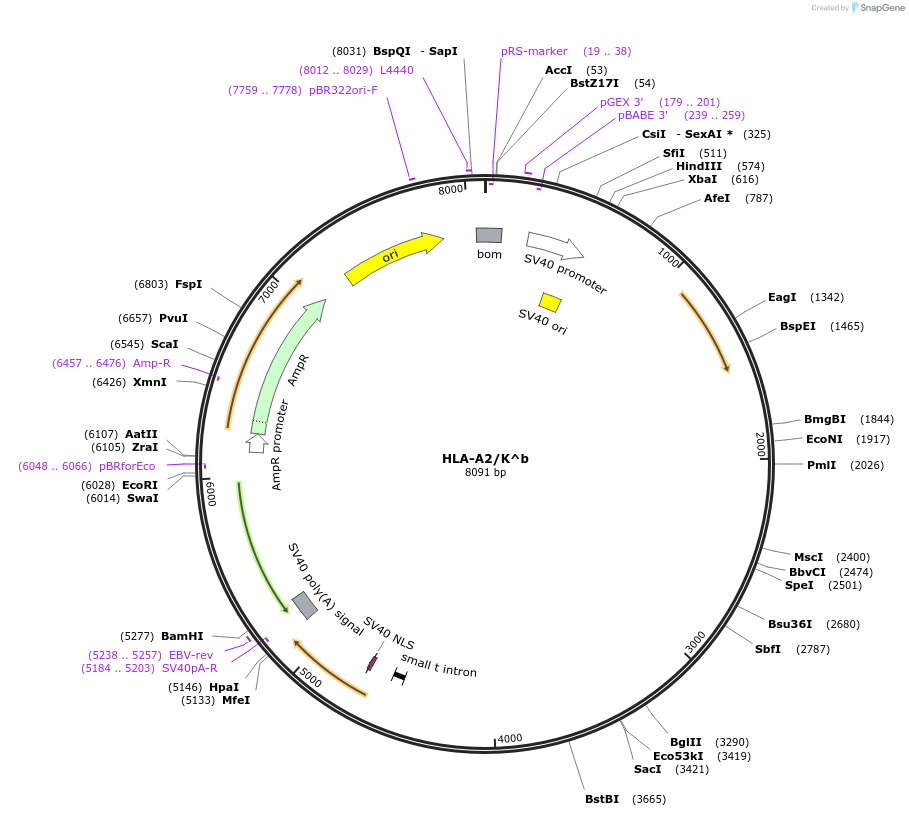
Map uploaded by the depositor.
