



p1.2-Hyg-Fur
(Plasmid
#162774)
-
PurposeSoluble human PACE/furin protease expression
-
Depositing Lab
-
Depositing OrganizationFederal Research Centre "Fundamentals of Biotechnology" of the Russian Academy of Sciences
Located in the Russian Federation -
Publication
-
Sequence Information


Ordering
| Item | Catalog # | Description | Quantity | Price (USD) | |
|---|---|---|---|---|---|
| Plasmid | 162774 | Standard format: Plasmid sent in bacteria as agar stab | 1 | $94 | |
| DNA | 162774-D50 | 50 μg of DNA in Tris buffer | $495 | ||
| DNA | 162774-D100 | 100 μg of DNA in Tris buffer | $585 | ||
Backbone
-
Vector backbonep1.1
-
Backbone manufacturerLMBT, LTD
- Backbone size w/o insert (bp) 11914
-
Modifications to backboneThe region containing the EMCV IRES and the DHFR ORF from the p1.1 expression vector is removed. Antibiotic resistance genes and the SV40 promoter and terminator regions are added.
-
Vector typeMammalian Expression
-
Selectable markersHygromycin
Growth in Bacteria
-
Bacterial Resistance(s)Ampicillin, 100 μg/mL
-
Growth Temperature37°C
-
Growth Strain(s)DH5alpha
-
Copy numberHigh Copy
Gene/Insert
-
Gene/Insert nameHuman PACE/furin protease soluble
-
SpeciesH. sapiens (human)
-
Insert Size (bp)2166
-
GenBank IDNM_002569
-
Entrez GeneFURIN (a.k.a. FUR, PACE, PCSK3, SPC1)
- Promoter CHO EEF1A1 (Translation Elongation Factor 1 Alpha 1)
Cloning Information
- Cloning method Restriction Enzyme
- 5′ cloning site AbsI (not destroyed)
- 3′ cloning site XbaI/NheI (destroyed during cloning)
- 5′ sequencing primer SQ-5CH6-F GCCGCTGCTTCCTGTGAC
- 3′ sequencing primer SQ-3CH1-R ACAAACAGTTCTGAGACCG
- (Common Sequencing Primers)
Resource Information
-
A portion of this plasmid was derived from a plasmid made bySoluble human PACE/furin ORF was obtained by PCR using plasmid SC118550 (Origene, USA) as a template, the ORF was brought in line with the reference sequence NM_002569 by adding six missing nucleotides (coding VQ).
Terms and Licenses
-
Academic/Nonprofit Terms
-
Industry Terms
- Not Available to Industry
Trademarks:
- Zeocin® is an InvivoGen trademark.
DNA (Catalog # 162774-D50)
Purpose
Ready-to-use, high-purity DNA prep. DNA aliquots are suitable for use in mammalian cell transfections and other molecular biology applications.
Delivery
- Amount 50 μg
- Concentration 1 μg/μL
- Pricing $495 USD
- Storage 4 ℃ (short-term) or -20 ℃ (long-term)
Terms and Licenses
-
Academic/Nonprofit Terms
-
Industry Terms
- Not Available to Industry
Quality Control
Every DNA prep is verified by next-generation sequencing, confirming plasmid identity, sequence integrity, and absence of DNA contaminants. Concentration is confirmed to be within ±2.5% of the stated concentration.
Our production process has been validated to consistently yield endotoxin levels below 1.0 EU/μg. Individual lots are not tested for endotoxin.
DNA (Catalog # 162774-D100)
Purpose
Ready-to-use, high-purity DNA prep. DNA aliquots are suitable for use in mammalian cell transfections and other molecular biology applications.
Delivery
- Amount 100 μg
- Concentration 1 μg/μL
- Pricing $585 USD
- Storage 4 ℃ (short-term) or -20 ℃ (long-term)
Terms and Licenses
-
Academic/Nonprofit Terms
-
Industry Terms
- Not Available to Industry
Quality Control
Every DNA prep is verified by next-generation sequencing, confirming plasmid identity, sequence integrity, and absence of DNA contaminants. Concentration is confirmed to be within ±2.5% of the stated concentration.
Our production process has been validated to consistently yield endotoxin levels below 1.0 EU/μg. Individual lots are not tested for endotoxin.
These plasmids were created by your colleagues. Please acknowledge the Principal Investigator, cite the article in which the plasmids were described, and include Addgene in the Materials and Methods of your future publications.
-
For your Materials & Methods section:
p1.2-Hyg-Fur was a gift from Ivan Vorobiev (Addgene plasmid # 162774 ; http://n2t.net/addgene:162774 ; RRID:Addgene_162774) -
For your References section:
A Highly Productive CHO Cell Line Secreting Human Blood Clotting Factor IX. Kovnir SV, Orlova NA, Shakhparonov MI, Skryabin KG, Gabibov AG, Vorobiev II. Acta Naturae. 2018 Jan-Mar;10(1):51-65. PubMed 29713519
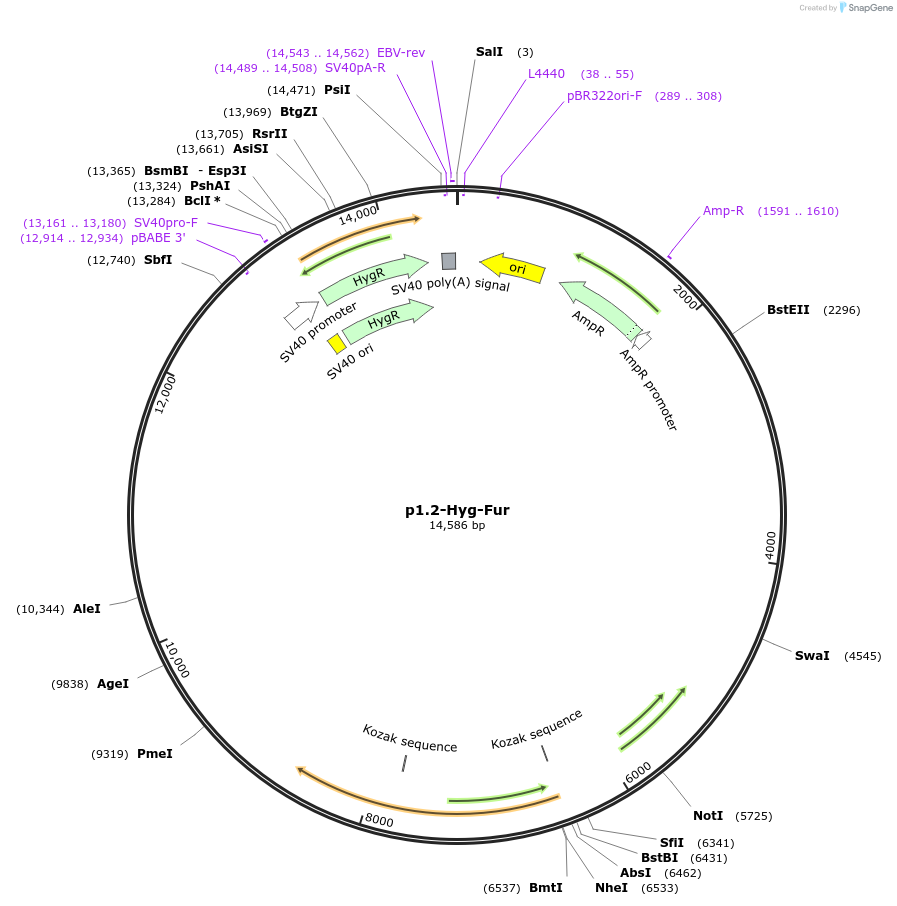
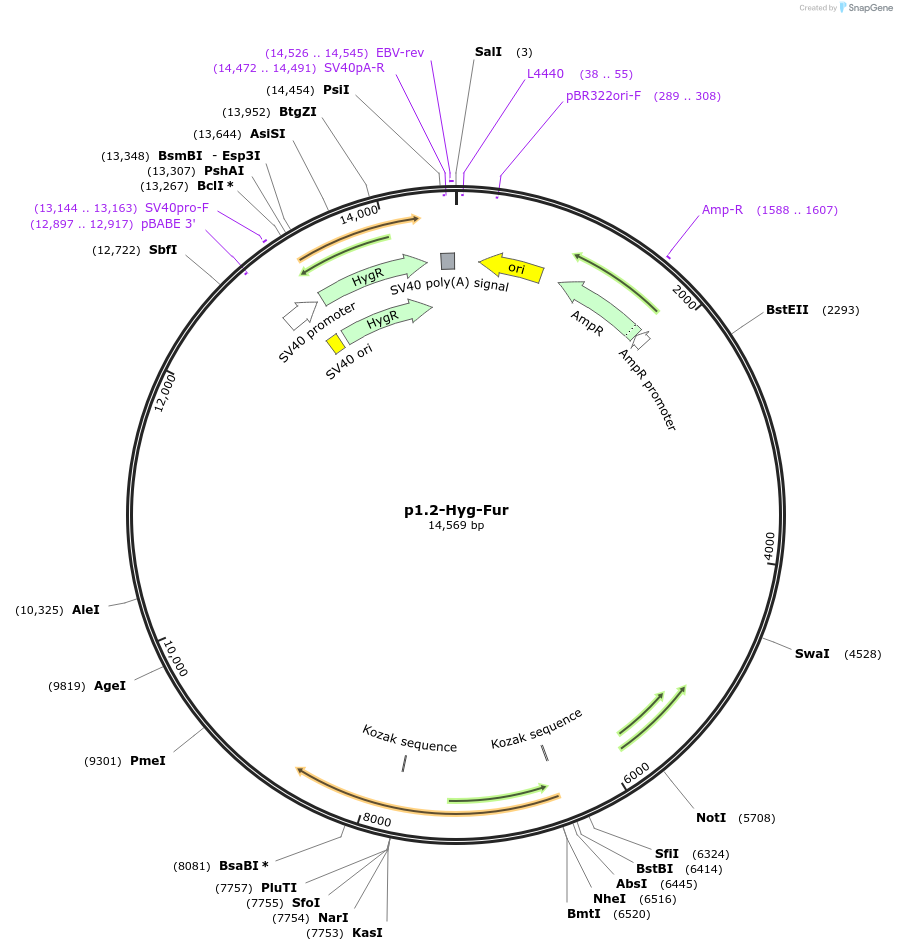
Map uploaded by the depositor.
