



pUDE1084
(Plasmid
#168500)
-
Purposeexpression of T7RNA polymerase and CRISPR endonunclease Fncas12a
-
Depositing Lab
-
Depositing OrganizationDelft University of Technology
Located in Netherlands -
Sequence Information


Ordering
| Item | Catalog # | Description | Quantity | Price (USD) | |
|---|---|---|---|---|---|
| Plasmid | 168500 | Standard format: Plasmid sent in bacteria as agar stab | 1 | $94 | |
| DNA | 168500-D50 | 50 μg of DNA in Tris buffer | $495 | ||
| DNA | 168500-D100 | 100 μg of DNA in Tris buffer | $585 | ||
Backbone
-
Vector backbonepGGKd034
- Backbone size w/o insert (bp) 5890
- Total vector size (bp) 13273
-
Vector typeCRISPR
-
Selectable markersHygromycin
Growth in Bacteria
-
Bacterial Resistance(s)Ampicillin, 100 μg/mL
-
Growth Temperature37°C
-
Growth Strain(s)DH5alpha
-
Copy numberHigh Copy
Gene/Insert 1
-
Gene/Insert nameFncas12a
-
SpeciesSynthetic; Francisella tularensis subsp. novicida U112
-
Insert Size (bp)4038
- Promoter TEF1
Cloning Information for Gene/Insert 1
- Cloning method Gibson Cloning
- 5′ sequencing primer CGCTCATAGCTTCAAAATGTTTCTACTCC
- (Common Sequencing Primers)
Gene/Insert 2
-
Gene/Insert nameT7RNA polymerase
-
SpeciesBacteriophage T7
-
Insert Size (bp)2682
- Promoter TDH3
Cloning Information for Gene/Insert 2
- Cloning method Gibson Cloning
- 5′ sequencing primer GTACTAGCGTTGAATGTTAGCG
- (Common Sequencing Primers)
Resource Information
-
A portion of this plasmid was derived from a plasmid made byFncpf1 has been cloned from the Addgene plasmid #69976 (pY004) harbouring the human codon-optimized F. novicida cpf1 tagged with C-terminal nuclear localization signal (NLS) and 3xHA tag. (Zetsche B., Gootenberg J.S., Abudayyeh O.O., Slaymaker I.M., Makarova K.S., Essletzbichler P., Volz S.E., Joung J., van der Oost J., Regev A.et al. Cpf1 is a single RNA-guided endonuclease of a class 2 CRISPR-Cas system. Cell. 2015; 163:759–771.) The T7 RNA polymerase has been cloned from the Addgene plasmid #33152 (pRS315-nls-T7-RNAP) harbouring the NLS-T7RNApol gene (Dower, K. and Rosbash, M. (2002) T7 RNA polymerase-directed transcripts are processed in yeast and link 39 end formation to mRNA nuclear export. RNA, 8, 686-697)
Terms and Licenses
-
Academic/Nonprofit Terms
-
Industry Terms
- Not Available to Industry
Trademarks:
- Zeocin® is an InvivoGen trademark.
DNA (Catalog # 168500-D50)
Purpose
Ready-to-use, high-purity DNA prep. DNA aliquots are suitable for use in mammalian cell transfections and other molecular biology applications.
Delivery
- Amount 50 μg
- Concentration 1 μg/μL
- Pricing $495 USD
- Storage 4 ℃ (short-term) or -20 ℃ (long-term)
Terms and Licenses
-
Academic/Nonprofit Terms
-
Industry Terms
- Not Available to Industry
Quality Control
Every DNA prep is verified by next-generation sequencing, confirming plasmid identity, sequence integrity, and absence of DNA contaminants. Concentration is confirmed to be within ±2.5% of the stated concentration.
Our production process has been validated to consistently yield endotoxin levels below 1.0 EU/μg. Individual lots are not tested for endotoxin.
DNA (Catalog # 168500-D100)
Purpose
Ready-to-use, high-purity DNA prep. DNA aliquots are suitable for use in mammalian cell transfections and other molecular biology applications.
Delivery
- Amount 100 μg
- Concentration 1 μg/μL
- Pricing $585 USD
- Storage 4 ℃ (short-term) or -20 ℃ (long-term)
Terms and Licenses
-
Academic/Nonprofit Terms
-
Industry Terms
- Not Available to Industry
Quality Control
Every DNA prep is verified by next-generation sequencing, confirming plasmid identity, sequence integrity, and absence of DNA contaminants. Concentration is confirmed to be within ±2.5% of the stated concentration.
Our production process has been validated to consistently yield endotoxin levels below 1.0 EU/μg. Individual lots are not tested for endotoxin.
These plasmids were created by your colleagues. Please acknowledge the Principal Investigator, cite the article in which the plasmids were described, and include Addgene in the Materials and Methods of your future publications.
-
For your Materials & Methods section:
pUDE1084 was a gift from Jean-Marc Daran (Addgene plasmid # 168500 ; http://n2t.net/addgene:168500 ; RRID:Addgene_168500) -
For your References section:
gEL DNA: A Cloning- and Polymerase Chain Reaction-Free Method for CRISPR-Based Multiplexed Genome Editing. Randazzo P, Bennis NX, Daran JM, Daran-Lapujade P. CRISPR J. 2021 Apr 23. doi: 10.1089/crispr.2020.0028. 10.1089/crispr.2020.0028 PubMed 33900846
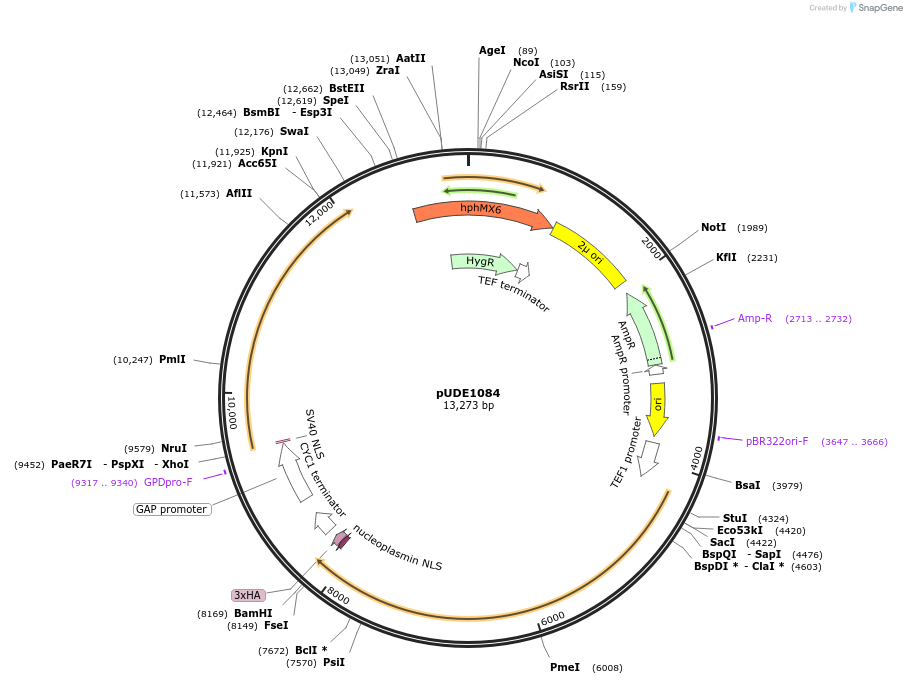
Map uploaded by the depositor.
