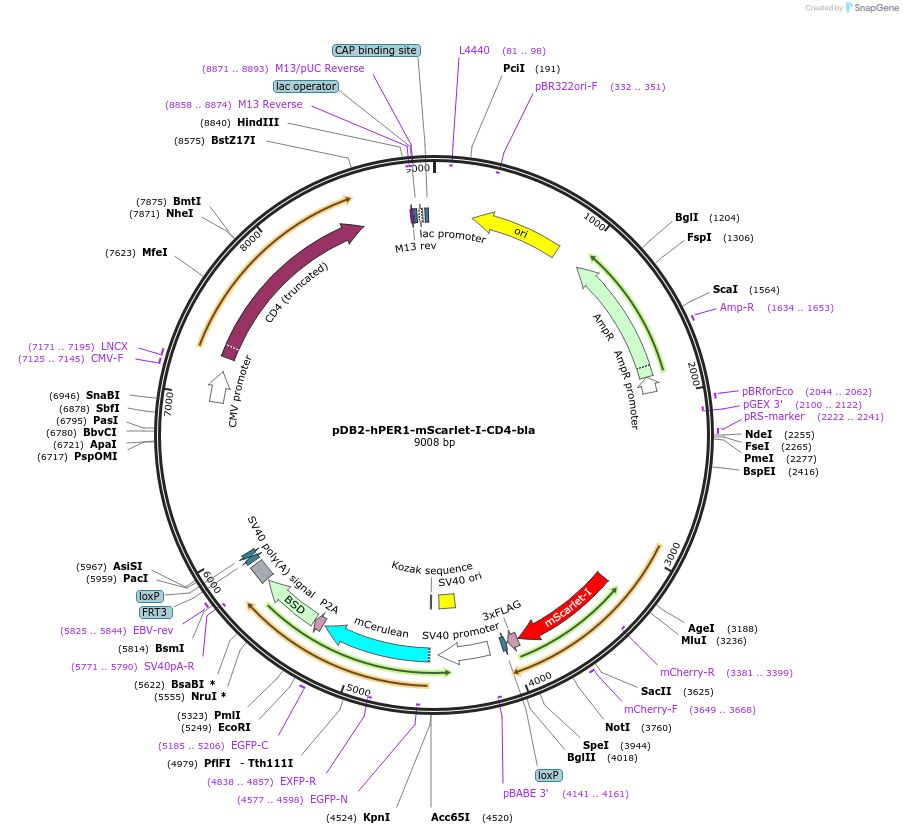
pDB2-hPER1-mScarlet-I-CD4-bla
(Plasmid
#189980)
-
PurposeDonor Vector to integrate mScarlet-I C-terminal into the human PER1 Locus to express it as a fusion protein
-
Depositing Lab
-
Depositing OrganizationCharite Universitaetsmedizin Berlin
Located in Germany -
Sequence Information
Ordering
| Item | Catalog # | Description | Quantity | Price (USD) | |
|---|---|---|---|---|---|
| Plasmid | 189980 | Standard format: Plasmid sent in bacteria as agar stab | 1 | $94 | |
| DNA | 189980-D50 | 50 μg of DNA in Tris buffer | $495 | ||
| DNA | 189980-D100 | 100 μg of DNA in Tris buffer | $585 | ||
Backbone
-
Vector backbonepDB2, derived from pUC57
- Backbone size w/o insert (bp) 8315
- Total vector size (bp) 9008
-
Modifications to backboneregions homologous to the hPER1 genomic region (surrounding STOP codon) flank insert + floxed positive selection cassette (mCerulean-P2A-blaR). Silent mutations to the hPER1 genomic sequence were inserted to avoid donor vector targeting by Cas9/sgRNA. Negative Selection cassette expresses hCD4. Should be used together with Cas9/sgRNA plasmid #189987 or #189988
-
Vector typeCRISPR
-
Selectable markersBlasticidin
Growth in Bacteria
-
Bacterial Resistance(s)Ampicillin, 100 μg/mL
-
Growth Temperature37°C
-
Growth Strain(s)DH5alpha
-
Copy numberHigh Copy
Gene/Insert
-
Gene/Insert namemScarlet-I
-
SpeciesSynthetic
-
Insert Size (bp)693
-
Tag
/ Fusion Protein
- 3xFlag (C terminal on insert)
Cloning Information
- Cloning method Restriction Enzyme
- 5′ cloning site MluI (not destroyed)
- 3′ cloning site SpeI (not destroyed)
- 5′ sequencing primer --
- 3′ sequencing primer --
- (Common Sequencing Primers)
Resource Information
-
A portion of this plasmid was derived from a plasmid made byhCD4 was cloned from Addgene #35712, mScarlet was cloned from #98839
Terms and Licenses
-
Academic/Nonprofit Terms
-
Industry Terms
- Not Available to Industry
Trademarks:
- Zeocin® is an InvivoGen trademark.
Depositor Comments
Please visit https://www.biorxiv.org/content/10.1101/2024.02.06.579141v1 for bioRxiv preprint.
DNA (Catalog # 189980-D50)
Purpose
Ready-to-use, high-purity DNA prep. DNA aliquots are suitable for use in mammalian cell transfections and other molecular biology applications.
Delivery
- Amount 50 μg
- Concentration 1 μg/μL
- Pricing $495 USD
- Storage 4 ℃ (short-term) or -20 ℃ (long-term)
Terms and Licenses
-
Academic/Nonprofit Terms
-
Industry Terms
- Not Available to Industry
Quality Control
Every DNA prep is verified by next-generation sequencing, confirming plasmid identity, sequence integrity, and absence of DNA contaminants. Concentration is confirmed to be within ±2.5% of the stated concentration.
Our production process has been validated to consistently yield endotoxin levels below 1.0 EU/μg. Individual lots are not tested for endotoxin.
DNA (Catalog # 189980-D100)
Purpose
Ready-to-use, high-purity DNA prep. DNA aliquots are suitable for use in mammalian cell transfections and other molecular biology applications.
Delivery
- Amount 100 μg
- Concentration 1 μg/μL
- Pricing $585 USD
- Storage 4 ℃ (short-term) or -20 ℃ (long-term)
Terms and Licenses
-
Academic/Nonprofit Terms
-
Industry Terms
- Not Available to Industry
Quality Control
Every DNA prep is verified by next-generation sequencing, confirming plasmid identity, sequence integrity, and absence of DNA contaminants. Concentration is confirmed to be within ±2.5% of the stated concentration.
Our production process has been validated to consistently yield endotoxin levels below 1.0 EU/μg. Individual lots are not tested for endotoxin.
These plasmids were created by your colleagues. Please acknowledge the Principal Investigator, cite the article in which the plasmids were described, and include Addgene in the Materials and Methods of your future publications.
-
For your Materials & Methods section:
pDB2-hPER1-mScarlet-I-CD4-bla was a gift from Achim Kramer (Addgene plasmid # 189980 ; http://n2t.net/addgene:189980 ; RRID:Addgene_189980) -
For your References section:
Circadian period is compensated for repressor protein turnover rates in single cells. Gabriel CH, Del Olmo M, Rizki Widini A, Roshanbin R, Woyde J, Hamza E, Gutu NN, Zehtabian A, Ewers H, Granada A, Herzel H, Kramer A. Proc Natl Acad Sci U S A. 2024 Aug 20;121(34):e2404738121. doi: 10.1073/pnas.2404738121. Epub 2024 Aug 14. 10.1073/pnas.2404738121 PubMed 39141353