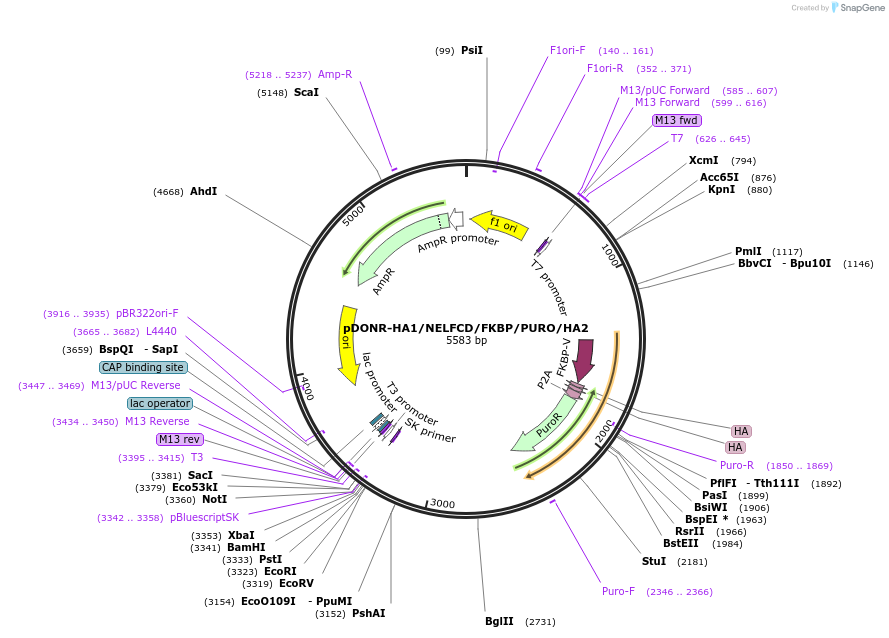
pDONR-HA1/NELFCD/FKBP/PURO/HA2
(Plasmid
#244455)
-
PurposeDonor plasmid for knock-in insertion of a degron (FKBP for dTAG.v1) tag with a cleavable puromycin resistance gene into the NELFCD human locus.
-
Depositing Lab
-
Depositing OrganizationUniversity of Copenhagen
Located in Denmark -
Sequence Information
Ordering
This material is available to academics and nonprofits only.
| Item | Catalog # | Description | Quantity | Price (USD) | |
|---|---|---|---|---|---|
| Plasmid | 244455 | Standard format: Plasmid sent in bacteria as agar stab | 1 | $94 | |
Backbone
-
Vector backbonepBluescript II SK(-)
- Total vector size (bp) 5584
-
Vector typeBacterial Expression
-
Selectable markersPuromycin
Growth in Bacteria
-
Bacterial Resistance(s)Ampicillin, 100 μg/mL
-
Growth Temperature37°C
-
Growth Strain(s)DH5alpha
-
Copy numberUnknown
Gene/Insert 1
-
Gene/Insert nameNELFCD homology arm 1
-
SpeciesH. sapiens (human)
Cloning Information for Gene/Insert 1
- Cloning method Gibson Cloning
- 5′ sequencing primer ctatagggcgaattgggtacATGTTGGAGATGGGTGGTG
- 3′ sequencing primer gcccgagccaccgccaccGTTCACCATGATGAAGTTAGATTTG
- (Common Sequencing Primers)
Gene/Insert 2
-
Gene/Insert nameF36V mutant of FK506-binding protein FKBP12 with puromycin and 2xHA
Cloning Information for Gene/Insert 2
- Cloning method Gibson Cloning
- 5′ sequencing primer tggaggatgctctaaattaGGCACCGGGCTTGCGGGTC
- 3′ sequencing primer tgacccgcaagcccggtgcctaatttagagcatcctccagag
- (Common Sequencing Primers)
Resource Information
Terms and Licenses
-
Academic/Nonprofit Terms
-
Industry Terms
- Not Available to Industry
Trademarks:
- Zeocin® is an InvivoGen trademark.
How to cite this plasmid
( Back to top)
These plasmids were created by your colleagues. Please acknowledge the Principal Investigator, cite the article in which the plasmids were described, and include Addgene in the Materials and Methods of your future publications.
-
For your Materials & Methods section:
pDONR-HA1/NELFCD/FKBP/PURO/HA2 was a gift from Lea Gregersen (Addgene plasmid # 244455 ; http://n2t.net/addgene:244455 ; RRID:Addgene_244455) -
For your References section:
Oxidative stress triggers RNAPII arrest through PARylation and DNA damage. Thomas QA, Wu L, Lesage E, Iversen HKM, Lopez Martinez D, Kompocholi S, Liu H, Nieto Moreno N, Gregersen LH. Nat Commun. 2026 Aug 10;17(1):9571. doi: 10.1038/s41467-026-76443-1. 10.1038/s41467-026-76443-1 PubMed 42706228