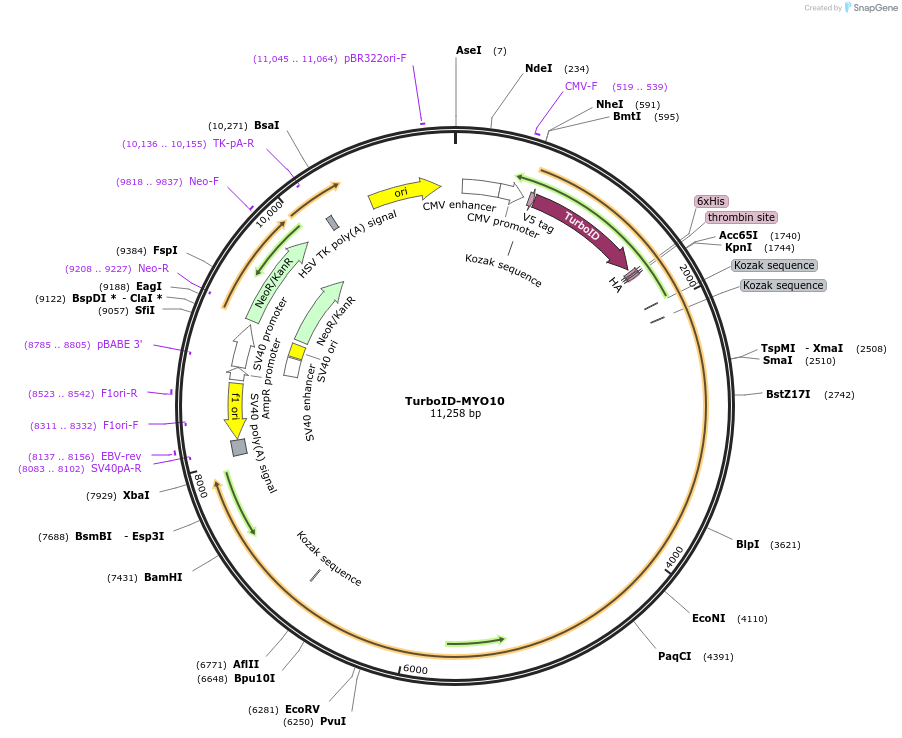
TurboID-MYO10
(Plasmid
#245883)
-
PurposeExpress human MYO10 tagged with TurboID for proximity-dependent biotinylation studies
-
Depositing Lab
-
Depositing OrganizationTurku Bioscience Centre
Located in Finland -
Publication
-
Sequence Information
Ordering
This material is available to academics and nonprofits only.
| Item | Catalog # | Description | Quantity | Price (USD) | |
|---|---|---|---|---|---|
| Plasmid | 245883 | Standard format: Plasmid sent in bacteria as agar stab | 1 | $94 | |
Backbone
-
Vector backboneEGFPC1
-
Modifications to backboneTurboID is replacing the EGFP sequence from the original backbone
-
Vector typeMammalian Expression
Growth in Bacteria
-
Bacterial Resistance(s)Kanamycin, 50 μg/mL
-
Growth Temperature37°C
-
Growth Strain(s)DH5alpha
-
Copy numberUnknown
Gene/Insert
-
Gene/Insert nameMYO10
-
SpeciesH. sapiens (human)
-
Entrez GeneMYO10 (a.k.a. MyoX)
-
Tag
/ Fusion Protein
- TurboID (N terminal on insert)
Cloning Information
- Cloning method Other
- 5′ sequencing primer CMV
- (Common Sequencing Primers)
Resource Information
-
A portion of this plasmid was derived from a plasmid made byThe TurboID-MYO10 plasmid was generated by replacing the EGFP sequence in the EGFPC1-hMyoX plasmid with the TurboID sequence using a gene block. EGFPC1-hMyoX plasmid was a gift from Emanuel Strehler (Addgene plasmid # 47608).
Terms and Licenses
-
Academic/Nonprofit Terms
-
Industry Terms
- Not Available to Industry
Trademarks:
- Zeocin® is an InvivoGen trademark.
Depositor Comments
Addgene NGS finds the same Q680R hMyo10 variant as is documented for Addgene plasmid # 47608 (NCBI reference AAF37875.1). Please visit https://doi.org/10.64898/2025.12.03.691809 for bioRxiv preprint.
How to cite this plasmid
( Back to top)
These plasmids were created by your colleagues. Please acknowledge the Principal Investigator, cite the article in which the plasmids were described, and include Addgene in the Materials and Methods of your future publications.
-
For your Materials & Methods section:
TurboID-MYO10 was a gift from Guillaume Jacquemet (Addgene plasmid # 245883 ; http://n2t.net/addgene:245883 ; RRID:Addgene_245883) -
For your References section:
CCT8 associates with the MYO10 motor domain and regulates filopodia and breast cancer cell invasion. Popović A, Ojalill M, Touma C, Ball NJ, Miihkinen M, Joshi O, Dibus M, Pylvänäinen J, Ivaska J, Goult BT, Jacquemet G. J Cell Sci jcs.265278 10.1242/jcs.265278