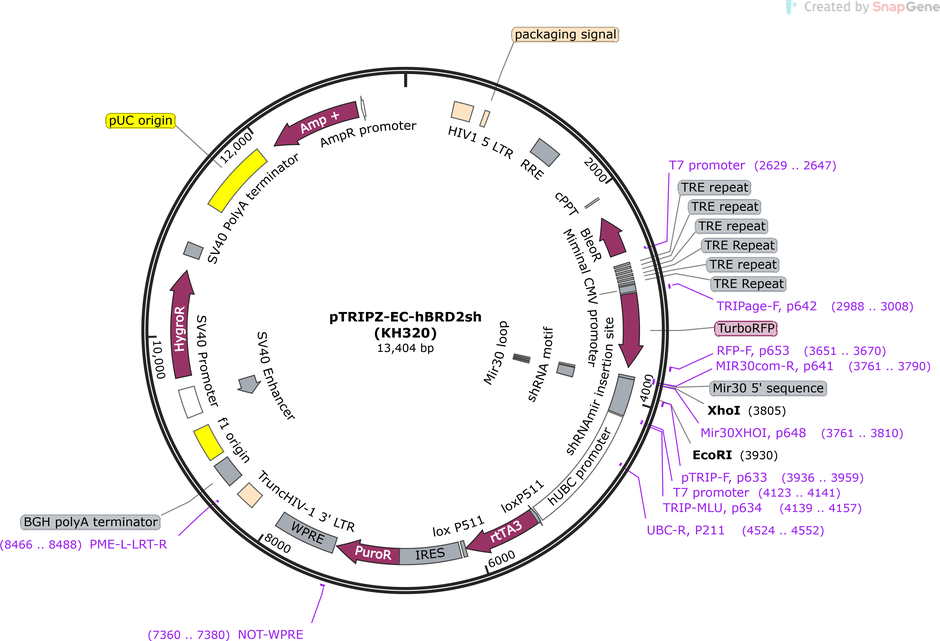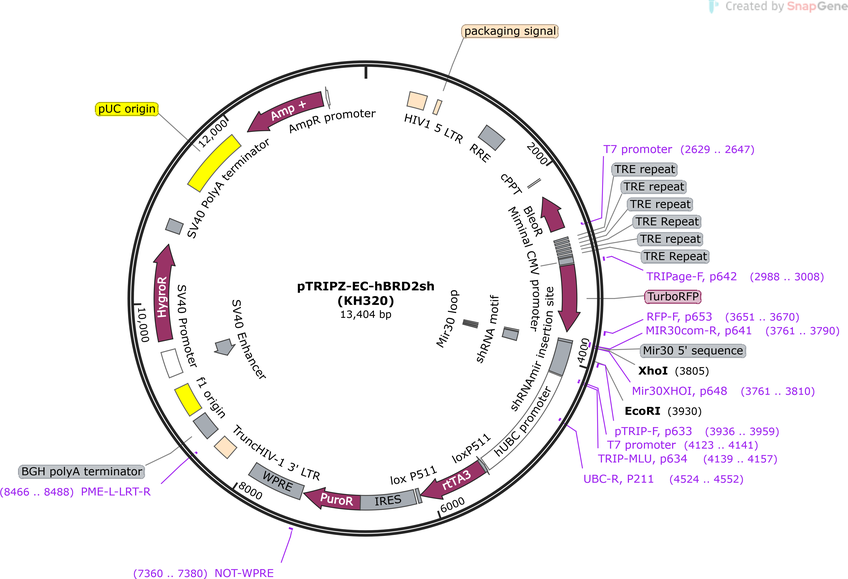



pTRIPZ-EC-hBRD2shRNA(KH320)
(Plasmid
#258560)
-
PurposeInducible shRNA against human BRD2 on optimized TRIPZ vector. Lab code is KH320.
-
Depositing Lab
-
Depositing OrganizationUniversity of North Texas Health Science Center
Located in the United States of America -
Sequence Information


Ordering
This material is available to academics and nonprofits only.
| Item | Catalog # | Description | Quantity | Price (USD) | |
|---|---|---|---|---|---|
| Plasmid | 258560 | Standard format: Plasmid sent in bacteria as agar stab | 1 | $94 | |
Backbone
-
Vector backbonepTRIPZ-EC
-
Backbone manufacturerHu Lab
- Backbone size w/o insert (bp) 13303
- Total vector size (bp) 13404
-
Vector typeMammalian Expression, Lentiviral
-
Selectable markersPuromycin
Growth in Bacteria
-
Bacterial Resistance(s)Ampicillin, 100 μg/mL
-
Growth Temperature37°C
-
Growth Strain(s)NEB Stable
-
Copy numberUnknown
Gene/Insert
-
Gene/Insert namehuman bromodomain extra terminal protein 2
-
Alt nameBRD2
-
gRNA/shRNA sequenceCCCGGAAGCCCTACACCATTA
-
SpeciesH. sapiens (human)
-
GenBank IDNM_005104
-
Entrez GeneBRD2 (a.k.a. BRD2-IT1, D6S113E, FSH, FSHRG1, FSRG1, NAT, O27.1.1, RING3, RNF3)
- Promoter CMV minimum with TRE repeat
Cloning Information
- Cloning method Restriction Enzyme
- 5′ cloning site XhoI (not destroyed)
- 3′ cloning site EcoRI (not destroyed)
- 5′ sequencing primer RFP-F, p653: tggctgtggccaagtactgc
- 3′ sequencing primer TRIP-MLU, p634: ggccacgcgtcctaggtaa
- (Common Sequencing Primers)
Resource Information
Terms and Licenses
-
Academic/Nonprofit Terms
-
Industry Terms
- Not Available to Industry
Trademarks:
- Zeocin® is an InvivoGen trademark.
How to cite this plasmid
( Back to top)
These plasmids were created by your colleagues. Please acknowledge the Principal Investigator, cite the article in which the plasmids were described, and include Addgene in the Materials and Methods of your future publications.
-
For your Materials & Methods section:
pTRIPZ-EC-hBRD2shRNA(KH320) was a gift from Kejin Hu (Addgene plasmid # 258560 ; http://n2t.net/addgene:258560 ; RRID:Addgene_258560) -
For your References section:
BRD2 impedes iPSC reprogramming by regulating lipid biosynthesis and the matrisome via its ET tail. Cevallos RR, Zhang R, Sian R, Chen SG, Hu K. Commun Biol (2026). doi: 10.1038/s42003-026-10691-1 10.1038/s42003-026-10691-1
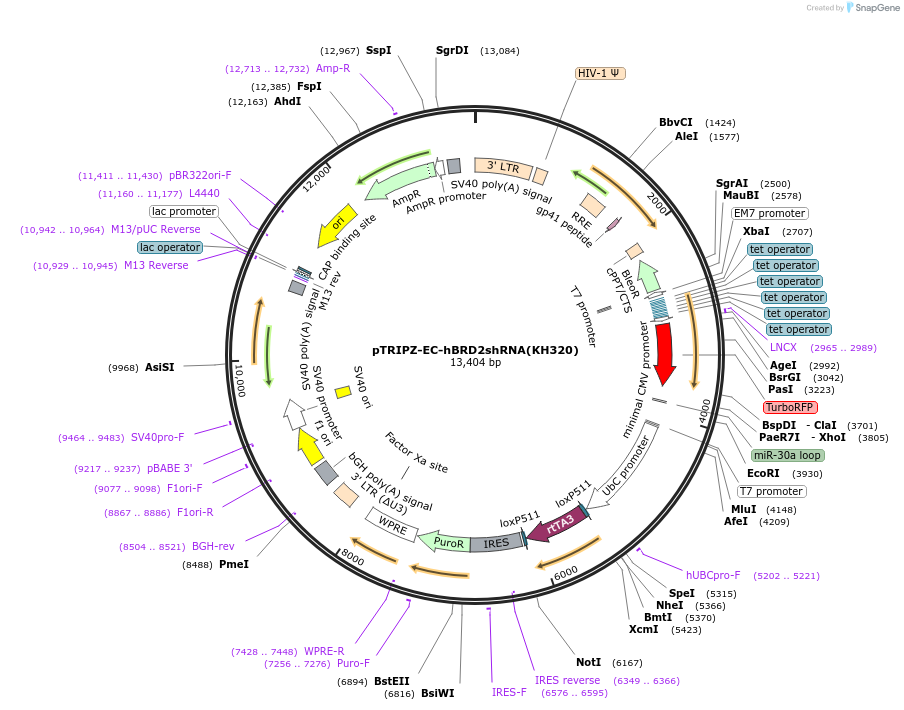
Map uploaded by the depositor.