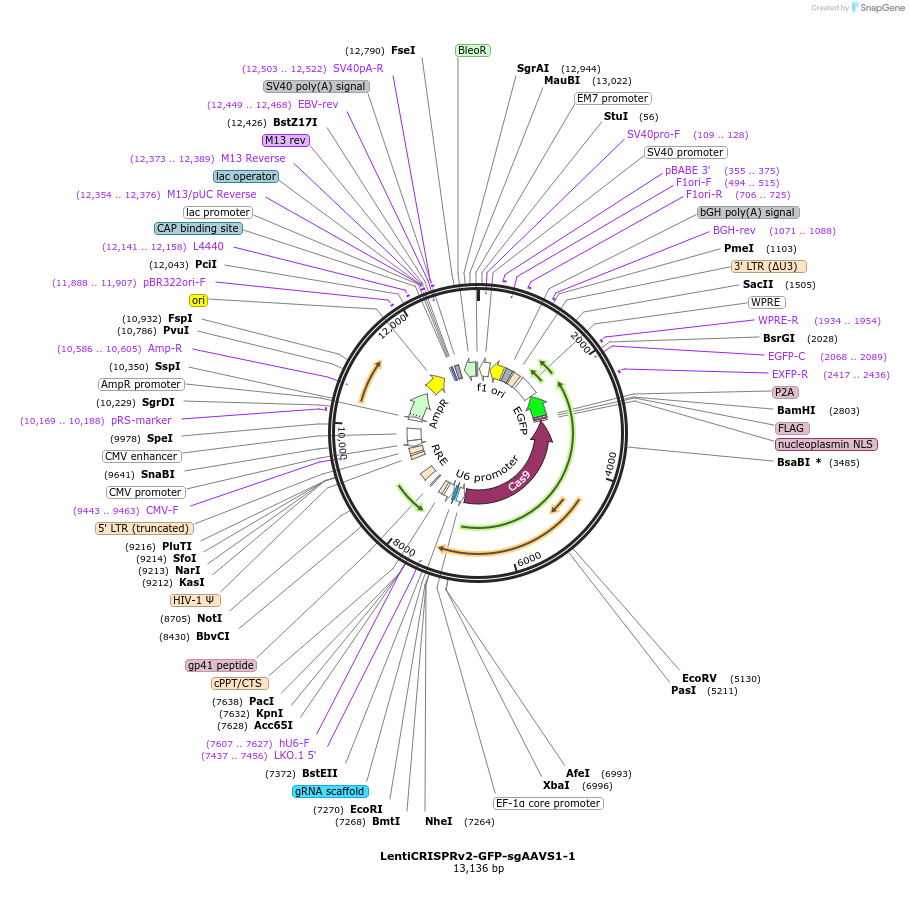
LentiCRISPRv2-GFP-sgAAVS1-1
(Plasmid
#261346)
-
PurposeLentiviral vector encoding GFP alongside Cas9 and a control gRNA targeting the AAVS1 safe harbor locus
-
Depositing Lab
-
Depositing OrganizationUniversity of Texas Southwestern Medical Center
Located in the United States of America -
Sequence Information
Ordering
This material is available to academics and nonprofits only.
| Item | Catalog # | Description | Quantity | Price (USD) | |
|---|---|---|---|---|---|
| Plasmid | 261346 | Standard format: Plasmid sent in bacteria as agar stab | 1 | $94 | |
Backbone
-
Vector backboneLentiCRISPRv2-GFP
-
Backbone manufacturerDavid Feldser, Addgene plasmid #82416
-
Vector typeMammalian Expression, Lentiviral, CRISPR
-
Selectable markersGFP
Growth in Bacteria
-
Bacterial Resistance(s)Ampicillin, 100 μg/mL
-
Growth Temperature37°C
-
Growth Strain(s)NEB Stable
-
Copy numberUnknown
Gene/Insert
-
Gene/Insert nameAAVS1
-
gRNA/shRNA sequenceGTCACCAATCCTGTCCCTAG
-
SpeciesH. sapiens (human)
-
Insert Size (bp)4104
-
Entrez GeneAAVS1 (a.k.a. AAV)
- Promoter EF-1alpha
-
Tag
/ Fusion Protein
- Nucleoplasmin NLS, FLAG (C terminal on insert)
Cloning Information
- Cloning method Restriction Enzyme
- 5′ cloning site BsmBI (not destroyed)
- 3′ cloning site BsmBI (not destroyed)
Resource Information
Terms and Licenses
-
Academic/Nonprofit Terms
-
Industry Terms
- Not Available to Industry
Trademarks:
- Zeocin® is an InvivoGen trademark.
Depositor Comments
Please visit https://doi.org/10.1101/2025.09.15.676412 for bioRxiv preprint.
How to cite this plasmid
( Back to top)
These plasmids were created by your colleagues. Please acknowledge the Principal Investigator, cite the article in which the plasmids were described, and include Addgene in the Materials and Methods of your future publications.
-
For your Materials & Methods section:
LentiCRISPRv2-GFP-sgAAVS1-1 was a gift from Samuel McBrayer (Addgene plasmid # 261346 ; http://n2t.net/addgene:261346 ; RRID:Addgene_261346) -
For your References section:
Gliomas phenocopy an inborn error of metabolism to drive neuronal activity and tumor growth. Abdullah KG, Miki K, Edgar CK, Wu SA, Xiao Y, Huang YT, Drexler R, Krishna S, Puliyappadamba VT, Tay LWR, Yuan F, Savani MR, Ghoche MT, Kotermanski SE, Traylor JI, Guo L, Gunn K, Hicks WH, Shi DD, Yalcin B, Kilian K, Tang M, Moyer M, Levitt MM, El-Shami M, Oken S, Manoj N, Gattie LC, Smith BC, Kaphle P, Shipman T, West RE 3rd, Liang C, Eshac Y, Chia TY, Patel TR, Hatanpaa KJ, Raj P, Miska JM, Ramirez DMO, Ma S, Nolin TD, Lega BC, Zinn PO, Kuhn BJ, Clark NM, Williams C, Mani DR, Gillette MA, Calzado MA, Xu L, Zacharias LG, Cai F, Ksendzovsky A, Mathews TP, Losman JA, Levi B, Barron T, Gibson JR, Richardson TE, Khan OH, Agnihotri S, Hervey-Jumper SL, Chamberland S, Monje M, Huber KM, DeBerardinis RJ, McBrayer SK. Cell. 2026 Sep 15:S0092-8674(26)01010-X. doi: 10.1016/j.cell.2026.08.037. 10.1016/j.cell.2026.08.037 PubMed 42743926