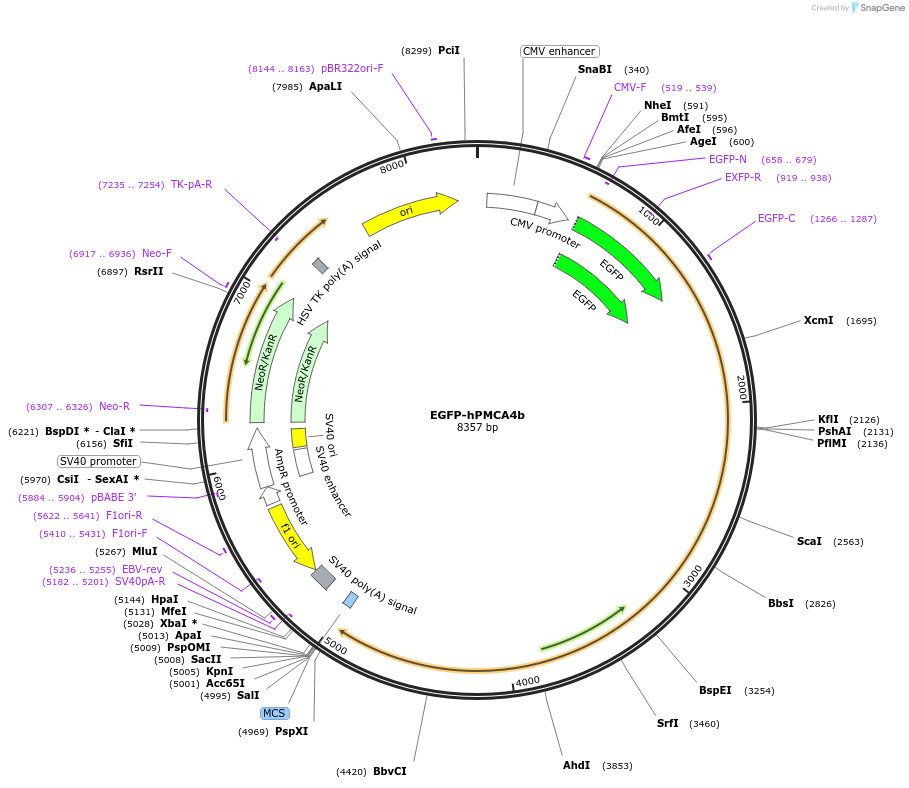
-
Depositing Lab
-
Depositing OrganizationMayo Foundation for Medical Education and Research (Inactive/For Deposit Only)
Located in United States of America -
Citations
-
Sequence Information
Ordering
| Item | Catalog # | Description | Quantity | Price (USD) | |
|---|---|---|---|---|---|
| Plasmid | 47589 | Standard format: Plasmid sent in bacteria as agar stab | 1 | $94 | |
| DNA | 47589-D50 | 50 μg of DNA in Tris buffer | $495 | ||
| DNA | 47589-D100 | 100 μg of DNA in Tris buffer | $585 | ||
Backbone
-
Vector backbonepEGFP-C2
-
Backbone manufacturerClontech
- Backbone size w/o insert (bp) 4700
-
Vector typeMammalian Expression
Growth in Bacteria
-
Bacterial Resistance(s)Kanamycin, 50 μg/mL
-
Growth Temperature37°C
-
Growth Strain(s)DH5alpha
-
Copy numberHigh Copy
Gene/Insert
-
Gene/Insert namePMCA4x/b
-
Alt nameATPase, Ca++ transporting, plasma membrane 4
-
Alt nameATP2B4
-
SpeciesH. sapiens (human)
-
Insert Size (bp)3622
-
MutationK442R and P673L relative to NP_001675.3
-
Entrez GeneATP2B4 (a.k.a. ATP2B2, MXRA1, PMCA4, PMCA4b, PMCA4x)
- Promoter CMV
-
Tag
/ Fusion Protein
- EGFP (N terminal on backbone)
Cloning Information
- Cloning method Restriction Enzyme
- 5′ cloning site XhoI (not destroyed)
- 3′ cloning site XhoI (not destroyed)
- 5′ sequencing primer EGFP-C
- 3′ sequencing primer SV40pA-R
- (Common Sequencing Primers)
Terms and Licenses
-
Academic/Nonprofit Terms
-
Industry Terms
- Not Available to Industry
Trademarks:
- Zeocin® is an InvivoGen trademark.
Depositor Comments
HPMCA4x/b coding sequence starts with amino acid 2 (Thr) at pos 1354.
This plasmid carries two missense mutations that cause K442R and P663L in the amino acid sequence of hPMCA4b. The depositing lab did not notice any functional consequences in the assays they performed. However, these were mostly concerned with membrane localization and did not include any enzymatic functional studies. Thus, it is not know whether (and how) these two mutations affect the calcium-pumping enzymatic function of the encoded GFP-hPMCA4b protein.
DNA (Catalog # 47589-D50)
Purpose
Ready-to-use, high-purity DNA prep. DNA aliquots are suitable for use in mammalian cell transfections and other molecular biology applications.
Delivery
- Amount 50 μg
- Concentration 1 μg/μL
- Pricing $495 USD
- Storage 4 ℃ (short-term) or -20 ℃ (long-term)
Terms and Licenses
-
Academic/Nonprofit Terms
-
Industry Terms
- Not Available to Industry
Quality Control
Every DNA prep is verified by next-generation sequencing, confirming plasmid identity, sequence integrity, and absence of DNA contaminants. Concentration is confirmed to be within ±2.5% of the stated concentration.
Our production process has been validated to consistently yield endotoxin levels below 1.0 EU/μg. Individual lots are not tested for endotoxin.
DNA (Catalog # 47589-D100)
Purpose
Ready-to-use, high-purity DNA prep. DNA aliquots are suitable for use in mammalian cell transfections and other molecular biology applications.
Delivery
- Amount 100 μg
- Concentration 1 μg/μL
- Pricing $585 USD
- Storage 4 ℃ (short-term) or -20 ℃ (long-term)
Terms and Licenses
-
Academic/Nonprofit Terms
-
Industry Terms
- Not Available to Industry
Quality Control
Every DNA prep is verified by next-generation sequencing, confirming plasmid identity, sequence integrity, and absence of DNA contaminants. Concentration is confirmed to be within ±2.5% of the stated concentration.
Our production process has been validated to consistently yield endotoxin levels below 1.0 EU/μg. Individual lots are not tested for endotoxin.
These plasmids were created by your colleagues. Please acknowledge the Principal Investigator, cite the article in which the plasmids were described, and include Addgene in the Materials and Methods of your future publications.
-
For your Materials & Methods section:
EGFP-hPMCA4b was a gift from Emanuel Strehler (Addgene plasmid # 47589 ; http://n2t.net/addgene:47589 ; RRID:Addgene_47589) -
For your References section:
Alternative splicing of the first intracellular loop of plasma membrane Ca2+-ATPase isoform 2 alters its membrane targeting. Chicka MC, Strehler EE. J Biol Chem. 2003 May 16;278(20):18464-70. Epub 2003 Mar 6. 10.1074/jbc.M301482200 PubMed 12624087