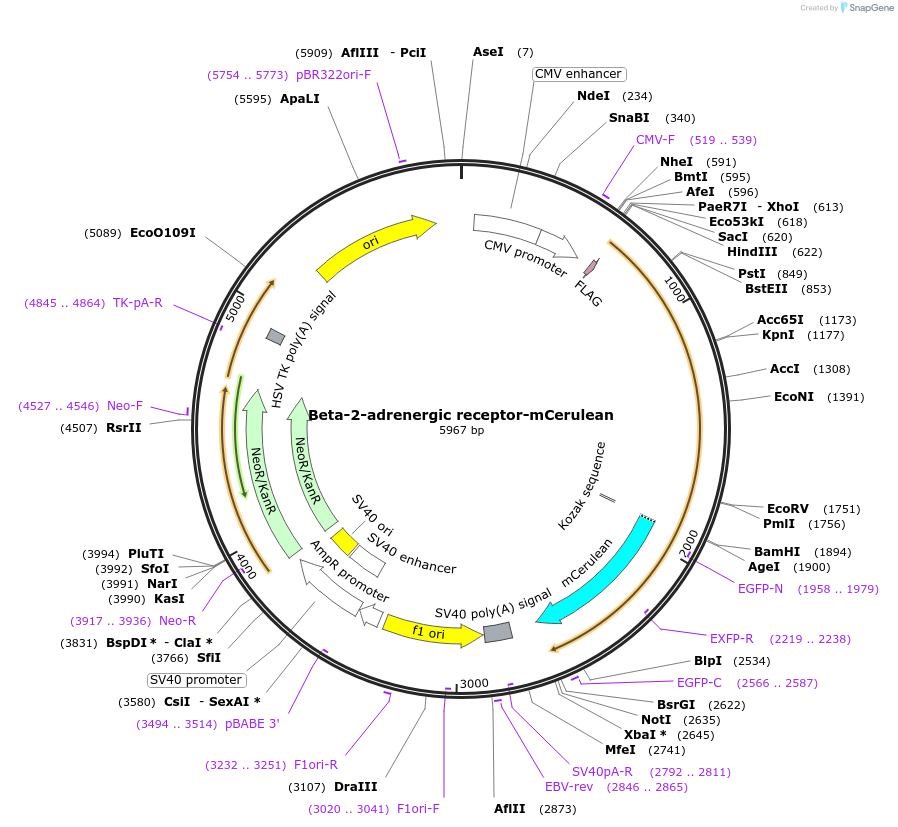
Beta-2-adrenergic receptor-mCerulean
(Plasmid
#66957)
-
PurposeBeta-2-adrenergic receptor tagged with mCerulean on carboxyl terminus
-
Depositing Lab
-
Depositing OrganizationGeisinger Health Center
Located in the United States of America -
Sequence Information
Ordering
| Item | Catalog # | Description | Quantity | Price (USD) | |
|---|---|---|---|---|---|
| Plasmid | 66957 | Standard format: Plasmid sent in bacteria as agar stab | 1 | $94 | |
| DNA | 66957-D50 | 50 μg of DNA in Tris buffer | $495 | ||
| DNA | 66957-D100 | 100 μg of DNA in Tris buffer | $585 | ||
Backbone
-
Vector backboneDerived from pECFP-N1
-
Backbone manufacturerClontech
- Backbone size w/o insert (bp) 3954
- Total vector size (bp) 5967
-
Vector typeMammalian Expression
-
Selectable markersNeomycin (select with G418)
Growth in Bacteria
-
Bacterial Resistance(s)Kanamycin, 50 μg/mL
-
Growth Temperature37°C
-
Growth Strain(s)DH10B
-
Copy numberHigh Copy
Gene/Insert
-
Gene/Insert nameBeta-2-adrenergic receptor-mCerulean
-
Alt nameADRB2
-
SpeciesH. sapiens (human); Aequorea victoria
-
Insert Size (bp)2013
-
Entrez GeneADRB2 (a.k.a. ADRB2R, ADRBR, ARB2, B2AR, BAR, BETA2AR)
- Promoter CMV
-
Tag
/ Fusion Protein
- mCerulean (C terminal on insert)
Cloning Information
- Cloning method Restriction Enzyme
- 5′ cloning site HindIII (not destroyed)
- 3′ cloning site NotI (not destroyed)
- 5′ sequencing primer CMV Forward
- (Common Sequencing Primers)
Resource Information
-
A portion of this plasmid was derived from a plasmid made byBeta-2-adrenergic receptor-GFP was obtained from Gerda Breitweiser, Weis Center for Research, Geisinger Clinic, Danville, PA. Monomeric Cerulean was obtained from David Piston, Vanderbilt University, Nashville, TN.
Terms and Licenses
-
Academic/Nonprofit Terms
-
Industry Terms
- Not Available to Industry
Trademarks:
- Zeocin® is an InvivoGen trademark.
Depositor Comments
Reference for monomeric Cerulean:
Rizzo MA, Springer GH, Granada B, Piston DW. An improved cyan fluorescent protein variant useful for FRET. Nat Biotechnol. 2004;22(4):445-9. PubMed PMID: 14990965.
DNA (Catalog # 66957-D50)
Purpose
Ready-to-use, high-purity DNA prep. DNA aliquots are suitable for use in mammalian cell transfections and other molecular biology applications.
Delivery
- Amount 50 μg
- Concentration 1 μg/μL
- Pricing $495 USD
- Storage 4 ℃ (short-term) or -20 ℃ (long-term)
Terms and Licenses
-
Academic/Nonprofit Terms
-
Industry Terms
- Not Available to Industry
Quality Control
Every DNA prep is verified by next-generation sequencing, confirming plasmid identity, sequence integrity, and absence of DNA contaminants. Concentration is confirmed to be within ±2.5% of the stated concentration.
Our production process has been validated to consistently yield endotoxin levels below 1.0 EU/μg. Individual lots are not tested for endotoxin.
DNA (Catalog # 66957-D100)
Purpose
Ready-to-use, high-purity DNA prep. DNA aliquots are suitable for use in mammalian cell transfections and other molecular biology applications.
Delivery
- Amount 100 μg
- Concentration 1 μg/μL
- Pricing $585 USD
- Storage 4 ℃ (short-term) or -20 ℃ (long-term)
Terms and Licenses
-
Academic/Nonprofit Terms
-
Industry Terms
- Not Available to Industry
Quality Control
Every DNA prep is verified by next-generation sequencing, confirming plasmid identity, sequence integrity, and absence of DNA contaminants. Concentration is confirmed to be within ±2.5% of the stated concentration.
Our production process has been validated to consistently yield endotoxin levels below 1.0 EU/μg. Individual lots are not tested for endotoxin.
These plasmids were created by your colleagues. Please acknowledge the Principal Investigator, cite the article in which the plasmids were described, and include Addgene in the Materials and Methods of your future publications.
-
For your Materials & Methods section:
Beta-2-adrenergic receptor-mCerulean was a gift from Catherine Berlot (Addgene plasmid # 66957 ; http://n2t.net/addgene:66957 ; RRID:Addgene_66957) -
For your References section:
Live cell imaging of Gs and the beta2-adrenergic receptor demonstrates that both alphas and beta1gamma7 internalize upon stimulation and exhibit similar trafficking patterns that differ from that of the beta2-adrenergic receptor. Hynes TR, Mervine SM, Yost EA, Sabo JL, Berlot CH. J Biol Chem. 2004 Oct 15;279(42):44101-12. Epub 2004 Aug 5. 10.1074/jbc.M405151200 PubMed 15297467