


DMX Barcoding Kit
(Kit #
1000000291
)
Depositing Lab: David Baker
The DMX Barcoding Kit provides the position-specific barcode plasmids used in the demultiplexing (DMX) pipeline, a method for converting cheap DNA oligo pools into arrayed, clonal, sequence-verified constructs. The kit comprises four sets of 24 unique molecular identifiers (96 plasmids total), which combine to uniquely tag over 330,000 wells. Barcodes are ligated to genes of interest by isothermal Golden Gate assembly directly in bacterial lysate, eliminating the need for indexed PCR and thermocyclers, and are read out by nanopore long-read sequencing, making demultiplexing agnostic to gene length. DMX reduces the per-construct cost of arrayed gene sourcing five- to eight-fold, relative to ordering individual gene fragments.
This kit will be sent as bacterial glycerol stocks in 96-well plate format.
Original Publication
Accelerating protein design by scaling experimental characterization. Qian J, Milles LF, Wicky BIM, Ragotte RJ, Motmaen A, Borst AJ, Skotheim R, Ols S, Coventry B, Li X, Kibler RD, Goreshnik I, Expòsit M, Loré K, Stewart L, Baker D. Nat Commun. 2026. doi: 10.1038/s41467-026-76740-9. Article (Link opens in a new window)
Description
Experimental characterization is a major bottleneck in protein design, and the dominant cost is synthetic DNA. Oligo pools are far cheaper per base than arrayed gene fragments, but the pooled format is incompatible with the arrayed workflows used for most downstream biochemistry. Demultiplexing (DMX) bridges this gap: it is a five-day protocol that takes an amplified oligo pool library and returns arrayed cultures of clonal, sequence-verified plasmids in an expression-ready E. coli strain, suitable for direct use with Semi-Automated Protein Production (SAPP) or any other arrayed testing modality.
The core of the method is a combinatorial barcoding scheme. Each of the four position-specific barcode sets in this kit contains 24 unique molecular identifiers (UMIs) of 25 bp, filtered for:
- pairwise Hamming distance greater than five
- absence of homopolymers longer than four bp
- absence of common restriction sites
Flanking primer sequences, Golden Gate overhangs, and BsaI sites were then appended. Because the four sets combine positionally, a single 96-well plate of barcodes tags up to 24⁴ wells. After colony picking into plates, cultures are compressed into reaction plates, heat-lysed, and barcodes are ligated to the gene of interest by Golden Gate assembly directly in the lysate at 37 °C — an isothermal step that removes the thermocycler requirement that limits conventional dual-indexed PCR barcoding.
Barcoded products are pooled and sequenced on a nanopore flow cell; long reads make barcode-to-gene mapping independent of insert length, so libraries with genes well beyond the 300–600 bp amplicon ceiling of short-read approaches can be demultiplexed. An automated bioinformatics pipeline handles basecalling, filtering, demultiplexing, alignment, and consensus calling, and outputs a non-redundant pick list for re-arraying. The protocol was developed with an acoustic liquid handler and colony picker, but can be run manually with multichannel pipettes for smaller campaigns.
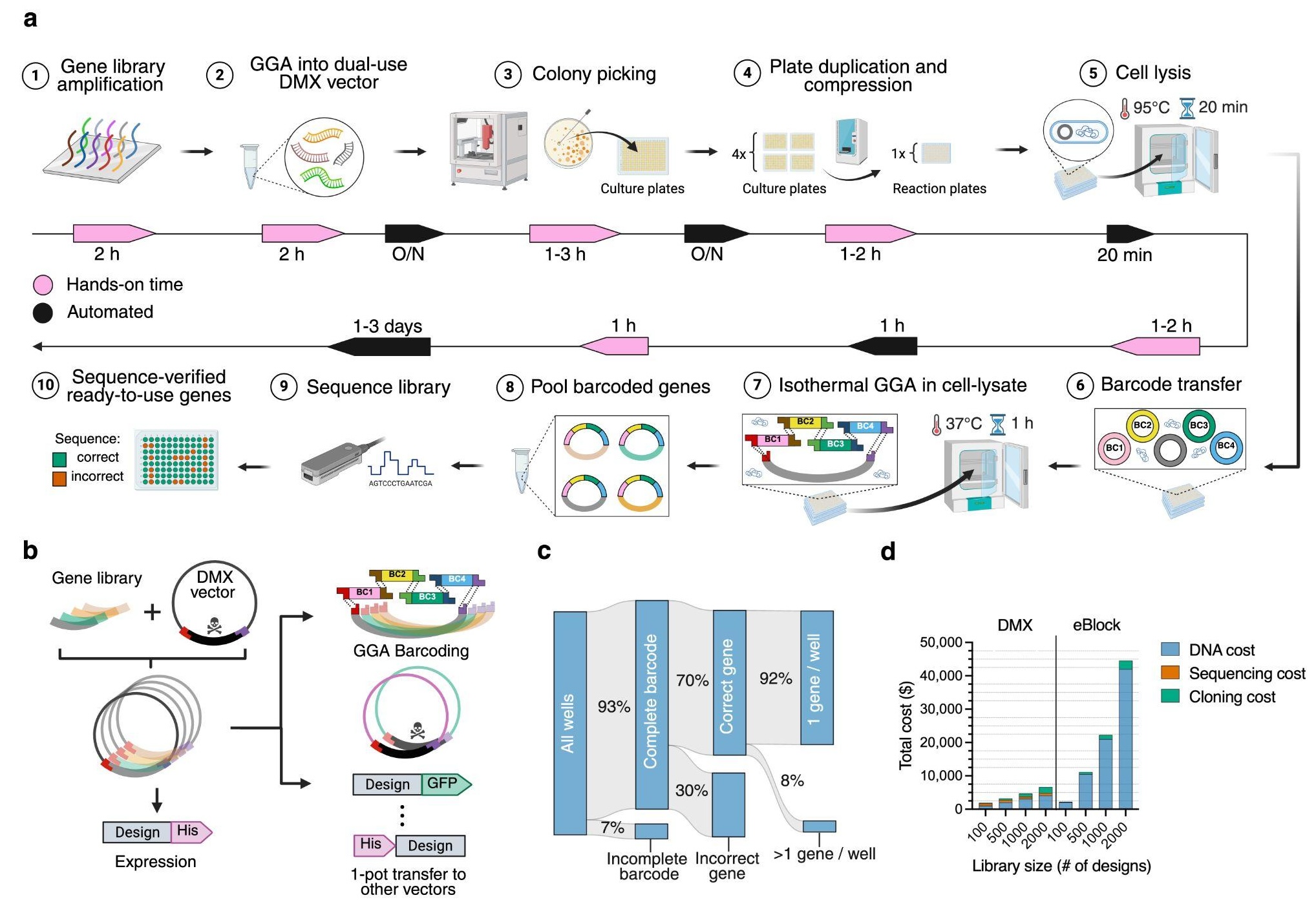
Figure 1: DMX pipeline. (a) Schematic representation of the DMX pipeline from oligo pooled library to sequence-verified ready-to-use clonal bacterial cultures. (1) The DNA library is amplified from the chip; (2) the library is cloned into a DMX vector using Golden Gate assembly (GGA), transformed, and plated; (3) colonies are picked into culture plates; (4) culture plates are duplicated and compressed 4-to-1 into reaction plates using an Echo liquid handler; (5) cultures in reaction plates are heat-lysed at 98 °C for 20 minutes; (6) barcodes are transferred into each well of the reaction plates; (7) GGA reagents are transferred and barcodes and gene of interest (GOI) are assembled by incubating reaction plates at 37 °C for 1 hour; (8) all GGA products are pooled; (9) barcoded library is sequenced using Oxford Nanopore Technologies (ONT); (10) sequence-verified clonal variants are re-arrayed into new plates. Pink and black arrow boxes represent hands-on time and automated steps, respectively. O/N = overnight. (b) Schematic representation of multi-use vector cloning for pool entry (BsmBI), barcoding (BsaI), and GOI excision (BsaI) if desired for further subcloning into other vectors. The skull and crossbones represents the ccdB gene. (c) Sankey diagram showing the efficiency of the DMX pipeline (n = 4,608 wells). (d) Cost comparison between sourcing GOIs using DMX from chip or arrayed DNA fragments, broken down into DNA synthesis, sequencing, and cloning expenses. From Qian, J. (2026). Figure 4. Created in BioRender. https://BioRender.com/vdxxib4 (Link opens in a new window).
Kit Documentation
Protocols
The step-by-step DMX protocol can be found in the supplemental material (Link opens in a new window) of Qian et al. (2026).
Scripts
For script, notebooks, and bioinformatic pipelines, see the SAPP_DMX GitHub (Link opens in a new window).
Supplemtal Documents
How to Cite this Kit
These plasmids were created by your colleagues. Please acknowledge the Principal Investigator, cite the article in which they were created, and include Addgene in the Materials and Methods of your future publications.
For your Materials and Methods section:
"The DMX Barcoding Kit was a gift from David Baker (Addgene kit #1000000291)."
For your Reference section:
Accelerating protein design by scaling experimental characterization. Qian J, Milles LF, Wicky BIM, Ragotte RJ, Motmaen A, Borst AJ, Skotheim R, Ols S, Coventry B, Li X, Kibler RD, Goreshnik I, Expòsit M, Loré K, Stewart L, Baker D. Nat Commun. 2026. doi: 10.1038/s41467-026-76740-9. Article (Link opens in a new window)
DMX Barcoding Kit - #1000000291
- Resistance Color Key
Each circle corresponds to a specific antibiotic resistance in the kit plate map wells.
- Inventory
Searchable and sortable table of all plasmids in kit. The Well column lists the plasmid well location in its plate. The Plasmid column links to a plasmid's individual web page.
- Kit Plate Map
96-well plate map for plasmid layout. Hovering over a well reveals the plasmid name, while clicking on a well opens the plasmid page.
Resistance Color Key
| Ampicillin |
Inventory
| Well | Plasmid | Resistance |
|---|---|---|
| A / 1 | DMX_1_1 |
|
| A / 2 | DMX_1_2 |
|
| A / 3 | DMX_1_3 |
|
| A / 4 | DMX_1_4 |
|
| A / 5 | DMX_1_5 |
|
| A / 6 | DMX_1_6 |
|
| A / 7 | DMX_1_7 |
|
| A / 8 | DMX_1_8 |
|
| A / 9 | DMX_1_9 |
|
| A / 10 | DMX_1_10 |
|
| A / 11 | DMX_1_11 |
|
| A / 12 | DMX_1_12 |
|
| B / 1 | DMX_1_13 |
|
| B / 2 | DMX_1_14 |
|
| B / 3 | DMX_1_15 |
|
| B / 4 | DMX_1_16 |
|
| B / 5 | DMX_1_17 |
|
| B / 6 | DMX_1_18 |
|
| B / 7 | DMX_1_19 |
|
| B / 8 | DMX_1_20 |
|
| B / 9 | DMX_1_21 |
|
| B / 10 | DMX_1_22 |
|
| B / 11 | DMX_1_23 |
|
| B / 12 | DMX_1_24 |
|
| C / 1 | DMX_2_1 |
|
| C / 2 | DMX_2_2 |
|
| C / 3 | DMX_2_3 |
|
| C / 4 | DMX_2_4 |
|
| C / 5 | DMX_2_5 |
|
| C / 6 | DMX_2_6 |
|
| C / 7 | DMX_2_7 |
|
| C / 8 | DMX_2_8 |
|
| C / 9 | DMX_2_9 |
|
| C / 10 | DMX_2_10 |
|
| C / 11 | DMX_2_11 |
|
| C / 12 | DMX_2_12 |
|
| D / 1 | DMX_2_13 |
|
| D / 2 | DMX_2_14 |
|
| D / 3 | DMX_2_15 |
|
| D / 4 | DMX_2_16 |
|
| D / 5 | DMX_2_17 |
|
| D / 6 | DMX_2_18 |
|
| D / 7 | DMX_2_19 |
|
| D / 8 | DMX_2_20 |
|
| D / 9 | DMX_2_21 |
|
| D / 10 | DMX_2_22 |
|
| D / 11 | DMX_2_23 |
|
| D / 12 | DMX_2_24 |
|
| E / 1 | DMX_3_1 |
|
| E / 2 | DMX_3_2 |
|
| E / 3 | DMX_3_3 |
|
| E / 4 | DMX_3_4 |
|
| E / 5 | DMX_3_5 |
|
| E / 6 | DMX_3_6 |
|
| E / 7 | DMX_3_7 |
|
| E / 8 | DMX_3_8 |
|
| E / 9 | DMX_3_9 |
|
| E / 10 | DMX_3_10 |
|
| E / 11 | DMX_3_11 |
|
| E / 12 | DMX_3_12 |
|
| F / 1 | DMX_3_13 |
|
| F / 2 | DMX_3_14 |
|
| F / 3 | DMX_3_15 |
|
| F / 4 | DMX_3_16 |
|
| F / 5 | DMX_3_17 |
|
| F / 6 | DMX_3_18 |
|
| F / 7 | DMX_3_19 |
|
| F / 8 | DMX_3_20 |
|
| F / 9 | DMX_3_21 |
|
| F / 10 | DMX_3_22 |
|
| F / 11 | DMX_3_23 |
|
| F / 12 | DMX_3_24 |
|
| G / 1 | DMX_4_1 |
|
| G / 2 | DMX_4_2 |
|
| G / 3 | DMX_4_3 |
|
| G / 4 | DMX_4_4 |
|
| G / 5 | DMX_4_5 |
|
| G / 6 | DMX_4_6 |
|
| G / 7 | DMX_4_7 |
|
| G / 8 | DMX_4_8 |
|
| G / 9 | DMX_4_9 |
|
| G / 10 | DMX_4_10 |
|
| G / 11 | DMX_4_11 |
|
| G / 12 | DMX_4_12 |
|
| H / 1 | DMX_4_13 |
|
| H / 2 | DMX_4_14 |
|
| H / 3 | DMX_4_15 |
|
| H / 4 | DMX_4_16 |
|
| H / 5 | DMX_4_17 |
|
| H / 6 | DMX_4_18 |
|
| H / 7 | DMX_4_19 |
|
| H / 8 | DMX_4_20 |
|
| H / 9 | DMX_4_21 |
|
| H / 10 | DMX_4_22 |
|
| H / 11 | DMX_4_23 |
|
| H / 12 | DMX_4_24 |
|