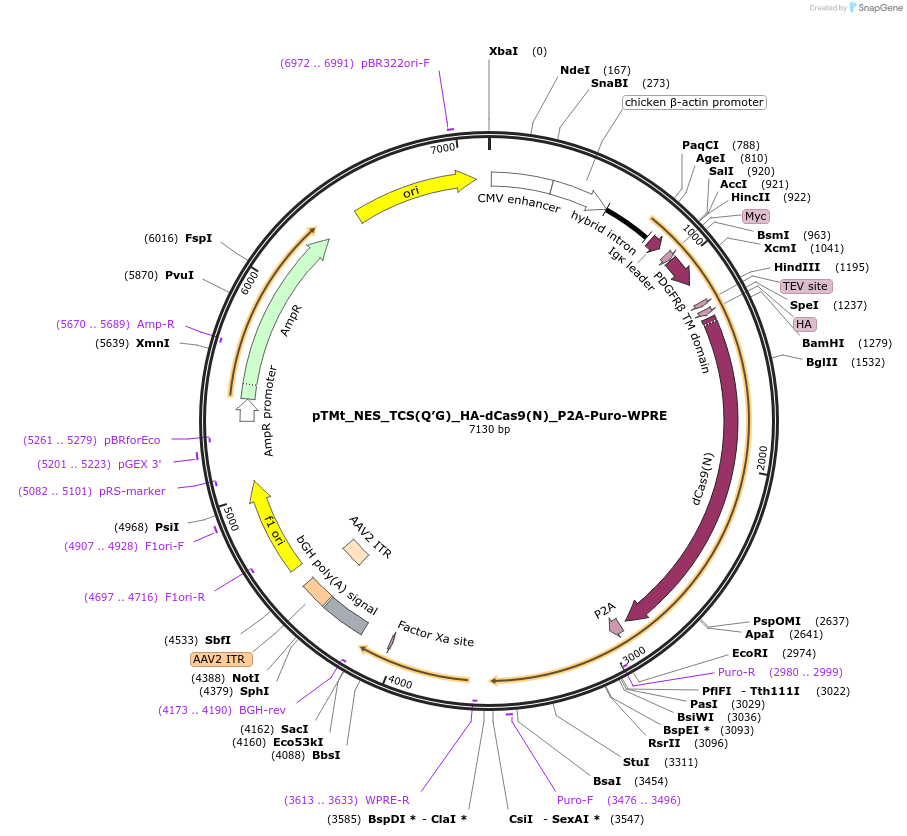
pTMt_NES_TCS(Q’G)_HA-dCas9(N)_P2A-Puro-WPRE
(Plasmid
#101101)
-
PurposeEncodes dCas9(N) fused to transmembrane tether
-
Depositing Lab
-
Depositing OrganizationUniversity of Oxford
Located in the United Kingdom of Great Britain and Northern Ireland -
Sequence Information
Ordering
| Item | Catalog # | Description | Quantity | Price (USD) | |
|---|---|---|---|---|---|
| Plasmid | 101101 | Standard format: Plasmid sent in bacteria as agar stab | 1 | $94 | |
| DNA | 101101-D50 | 50 μg of DNA in Tris buffer | $495 | ||
| DNA | 101101-D100 | 100 μg of DNA in Tris buffer | $585 | ||
Backbone
-
Vector backbonepX855
-
Modifications to backboneThe pX855 vector (gift from Feng Zhang, Addgene plasmid #62887) was modified as follows: the U6 promoter/sgRNA scaffold/U6 terminator cassette was removed; the dCas9(N) N-terminal NES and the C-terminal FRB+NES were also removed; a transmembrane tether (TMt; modified from the pDisplay Vector (Invitrogen)) containing the Igκ signal sequence, (GGGS)2 linker, myc epitope tag, PDGF receptor transmembrane domain and the XTEN linker, was synthesized as a gBlock (IDT). This transmembrane tether was then fused to the N-terminus of HA-dCas9(N) via a NES sequence and a TEV cleavage site (ENLYFQG); the puromycin resistance gene and the WPRE stabilising element from pCW-Cas9 (gift from Eric Lander and David Sabatini, Addgene plasmid #50661) were inserted downstream of dCas9(N).
-
Vector typeMammalian Expression, CRISPR, Synthetic Biology
-
Selectable markersPuromycin
Growth in Bacteria
-
Bacterial Resistance(s)Ampicillin, 100 μg/mL
-
Growth Temperature37°C
-
Growth Strain(s)DH5alpha
-
Copy numberHigh Copy
Gene/Insert
-
Gene/Insert nameTMt-dCas9(N)
-
Tags
/ Fusion Proteins
- Myc (N terminal on insert)
- HA (N terminal on insert)
Resource Information
-
A portion of this plasmid was derived from a plasmid made bypX855 vector (gift from Feng Zhang, Addgene plasmid #62887); pCW-Cas9 (gift from Eric Lander and David Sabatini, Addgene plasmid #50661)
Terms and Licenses
-
Academic/Nonprofit Terms
-
Industry Terms
- Not Available to Industry
Trademarks:
- Zeocin® is an InvivoGen trademark.
DNA (Catalog # 101101-D50)
Purpose
Ready-to-use, high-purity DNA prep. DNA aliquots are suitable for use in mammalian cell transfections and other molecular biology applications.
Delivery
- Amount 50 μg
- Concentration 1 μg/μL
- Pricing $495 USD
- Storage 4 ℃ (short-term) or -20 ℃ (long-term)
Terms and Licenses
-
Academic/Nonprofit Terms
-
Industry Terms
- Not Available to Industry
Quality Control
Every DNA prep is verified by next-generation sequencing, confirming plasmid identity, sequence integrity, and absence of DNA contaminants. Concentration is confirmed to be within ±2.5% of the stated concentration.
Our production process has been validated to consistently yield endotoxin levels below 1.0 EU/μg. Individual lots are not tested for endotoxin.
DNA (Catalog # 101101-D100)
Purpose
Ready-to-use, high-purity DNA prep. DNA aliquots are suitable for use in mammalian cell transfections and other molecular biology applications.
Delivery
- Amount 100 μg
- Concentration 1 μg/μL
- Pricing $585 USD
- Storage 4 ℃ (short-term) or -20 ℃ (long-term)
Terms and Licenses
-
Academic/Nonprofit Terms
-
Industry Terms
- Not Available to Industry
Quality Control
Every DNA prep is verified by next-generation sequencing, confirming plasmid identity, sequence integrity, and absence of DNA contaminants. Concentration is confirmed to be within ±2.5% of the stated concentration.
Our production process has been validated to consistently yield endotoxin levels below 1.0 EU/μg. Individual lots are not tested for endotoxin.
These plasmids were created by your colleagues. Please acknowledge the Principal Investigator, cite the article in which the plasmids were described, and include Addgene in the Materials and Methods of your future publications.
-
For your Materials & Methods section:
pTMt_NES_TCS(Q’G)_HA-dCas9(N)_P2A-Puro-WPRE was a gift from Tudor Fulga (Addgene plasmid # 101101 ; http://n2t.net/addgene:101101 ; RRID:Addgene_101101) -
For your References section:
Engineering Synthetic Signaling Pathways with Programmable dCas9-Based Chimeric Receptors. Baeumler TA, Ahmed AA, Fulga TA. Cell Rep. 2017 Sep 12;20(11):2639-2653. doi: 10.1016/j.celrep.2017.08.044. 10.1016/j.celrep.2017.08.044 PubMed 28903044