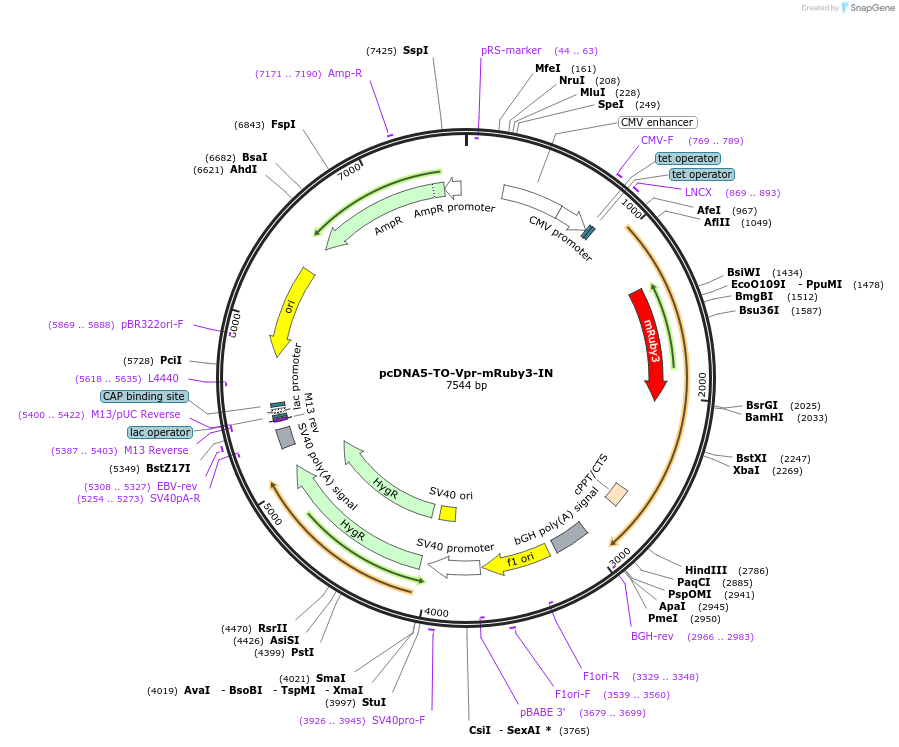
pcDNA5-TO-Vpr-mRuby3-IN
(Plasmid
#110695)
-
PurposeHIV-1 integrase fused to Vpr and mRuby3 for fluorescently labeling HIV particles. Vpr packages into virus particles and an HIV-1 protease cleavage site allows Vpr to be cleaved from mRuby3-IN.
-
Depositing Lab
-
Depositing OrganizationUniversity of Pittsburgh (University, School of Medicine, and Cancer Institute)
Located in the United States of America -
Sequence Information
Ordering
This material is available to academics and nonprofits only.
| Item | Catalog # | Description | Quantity | Price (USD) | |
|---|---|---|---|---|---|
| Plasmid | 110695 | Standard format: Plasmid sent in bacteria as agar stab | 1 | $94 | |
Backbone
-
Vector backbonepcDNA5-TO-DsRed
-
Backbone manufacturerAnton Bennett, Addgene plasmid #16340
- Backbone size w/o insert (bp) 5582
-
Vector typeMammalian Expression
Growth in Bacteria
-
Bacterial Resistance(s)Ampicillin, 100 μg/mL
-
Growth Temperature37°C
-
Growth Strain(s)DH5alpha
-
Copy numberHigh Copy
Gene/Insert
-
Gene/Insert nameVpr-mRuby3-IN
-
SpeciesHIV-1
-
Insert Size (bp)1962
-
Tag
/ Fusion Protein
- mRuby3 (N terminal on insert)
Cloning Information
- Cloning method Restriction Enzyme
- 5′ cloning site unknown (unknown if destroyed)
- 3′ cloning site unknown (unknown if destroyed)
- 5′ sequencing primer unknown
- (Common Sequencing Primers)
Terms and Licenses
-
Academic/Nonprofit Terms
-
Industry Terms
- Not Available to Industry
Trademarks:
- Zeocin® is an InvivoGen trademark.
Depositor Comments
mRuby3 was cloned into Vpr-IN obtained from John Kappes. mRuby3-IN maintains functional integrase activity. Vpr-mRuby3-IN was cloned in place of dsRed in pcDNA5-TO-DsRed.
How to cite this plasmid
( Back to top)
These plasmids were created by your colleagues. Please acknowledge the Principal Investigator, cite the article in which the plasmids were described, and include Addgene in the Materials and Methods of your future publications.
-
For your Materials & Methods section:
pcDNA5-TO-Vpr-mRuby3-IN was a gift from Zandrea Ambrose (Addgene plasmid # 110695) -
For your References section:
Truncated CPSF6 forms higher order complexes that bind and disrupt HIV-1 capsid. Ning J, Zhong Z, Fischer DK, Harris G, Watkins SC, Ambrose Z, Zhang P. J Virol. 2018 Apr 11. pii: JVI.00368-18. doi: 10.1128/JVI.00368-18. 10.1128/JVI.00368-18 PubMed 29643241