



aP2-GFPtpz
(Plasmid
#114211)
-
PurposeaP2/Fabp4 promoter driving GFPtopaz for labeling differentiated adipocytes and macrophage
-
Depositing Lab
-
Depositing OrganizationUniversity of Connecticut Health Center
Located in the United States of America -
Sequence Information


Ordering
| Item | Catalog # | Description | Quantity | Price (USD) | |
|---|---|---|---|---|---|
| Plasmid | 114211 | Standard format: Plasmid sent in bacteria as agar stab | 1 | $94 | |
| DNA | 114211-D50 | 50 μg of DNA in Tris buffer | $495 | ||
| DNA | 114211-D100 | 100 μg of DNA in Tris buffer | $585 | ||
Backbone
-
Vector backbonepBluescript SKII+
-
Backbone manufacturerStratagene
- Backbone size w/o insert (bp) 2961
- Total vector size (bp) 11800
-
Modifications to backboneRestriction sites added and rearranged in the vector MCS.
-
Vector typeMammalian Expression
Growth in Bacteria
-
Bacterial Resistance(s)Ampicillin, 100 μg/mL
-
Growth Temperature37°C
-
Growth Strain(s)DH5alpha
-
Copy numberHigh Copy
Gene/Insert
-
Gene/Insert nameaP2 promoter + pOB4 + eGFPtopaz
-
Alt nameFabp4 promoter + splicing intron + Topaz
-
SpeciesM. musculus (mouse), Synthetic; Aequorea victoria
-
GenBank ID
-
Entrez GeneFabp4 (a.k.a. 422/aP2, AFABP, ALBP, ALBP/Ap2, Ap2, Lbpl, P15)
- Promoter aP2/Fabp4
-
Tag
/ Fusion Protein
- None
Cloning Information
- Cloning method Restriction Enzyme
- 5′ cloning site Acc65 1 (destroyed during cloning)
- 3′ cloning site Acc65 1 (destroyed during cloning)
- 5′ sequencing primer T3 or M13R
- 3′ sequencing primer T7 or M13F
- (Common Sequencing Primers)
Resource Information
-
A portion of this plasmid was derived from a plasmid made by7.7 kb aP2 promoter was received from Dr. Charles Vinson at NCI/NIH. Topaz GFP was purchased from Packard (originally from Aurora).
Terms and Licenses
-
Academic/Nonprofit Terms
-
Industry Terms
- Not Available to Industry
Trademarks:
- Zeocin® is an InvivoGen trademark.
Depositor Comments
Construct was used to create transgenic mice and results of analyses of tissues from these animals were published in meeting abstracts appearing in 2004 and 2008 issues of the Journal of Bone & Mineral Research.
DNA (Catalog # 114211-D50)
Purpose
Ready-to-use, high-purity DNA prep. DNA aliquots are suitable for use in mammalian cell transfections and other molecular biology applications.
Delivery
- Amount 50 μg
- Concentration 1 μg/μL
- Pricing $495 USD
- Storage 4 ℃ (short-term) or -20 ℃ (long-term)
Terms and Licenses
-
Academic/Nonprofit Terms
-
Industry Terms
- Not Available to Industry
Quality Control
Every DNA prep is verified by next-generation sequencing, confirming plasmid identity, sequence integrity, and absence of DNA contaminants. Concentration is confirmed to be within ±2.5% of the stated concentration.
Our production process has been validated to consistently yield endotoxin levels below 1.0 EU/μg. Individual lots are not tested for endotoxin.
DNA (Catalog # 114211-D100)
Purpose
Ready-to-use, high-purity DNA prep. DNA aliquots are suitable for use in mammalian cell transfections and other molecular biology applications.
Delivery
- Amount 100 μg
- Concentration 1 μg/μL
- Pricing $585 USD
- Storage 4 ℃ (short-term) or -20 ℃ (long-term)
Terms and Licenses
-
Academic/Nonprofit Terms
-
Industry Terms
- Not Available to Industry
Quality Control
Every DNA prep is verified by next-generation sequencing, confirming plasmid identity, sequence integrity, and absence of DNA contaminants. Concentration is confirmed to be within ±2.5% of the stated concentration.
Our production process has been validated to consistently yield endotoxin levels below 1.0 EU/μg. Individual lots are not tested for endotoxin.
These plasmids were created by your colleagues. Please acknowledge the Principal Investigator, cite the article in which the plasmids were described, and include Addgene in the Materials and Methods of your future publications.
-
For your Materials & Methods section:
aP2-GFPtpz was a gift from David Rowe (Addgene plasmid # 114211 ; http://n2t.net/addgene:114211 ; RRID:Addgene_114211) -
For your References section:
Mechanical input restrains PPARgamma2 expression and action to preserve mesenchymal stem cell multipotentiality. Case N, Thomas J, Xie Z, Sen B, Styner M, Rowe D, Rubin J. Bone. 2013 Jan;52(1):454-64. doi: 10.1016/j.bone.2012.08.122. Epub 2012 Aug 23. 10.1016/j.bone.2012.08.122 PubMed 22951341
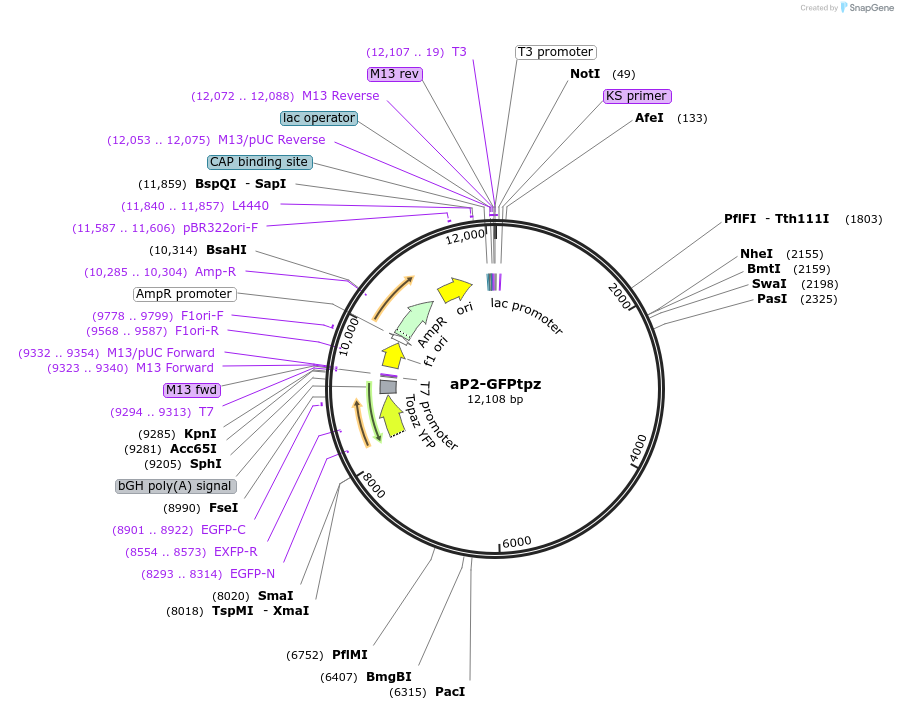
Map uploaded by the depositor.
