



-
Depositing Lab
-
Depositing OrganizationJohns Hopkins University and School of Medicine
Located in the United States of America -
Citations
-
Sequence Information
Full plasmid sequence is not available for this item.


Ordering
| Item | Catalog # | Description | Quantity | Price (USD) | |
|---|---|---|---|---|---|
| Plasmid | 16622 | Standard format: Plasmid sent in bacteria as agar stab | 1 | $94 | |
| DNA | 16622-D50 | 50 μg of DNA in Tris buffer | $495 | ||
| DNA | 16622-D100 | 100 μg of DNA in Tris buffer | $585 | ||
Backbone
-
Vector backbonepCEP4
-
Backbone manufacturerInvitrogen
-
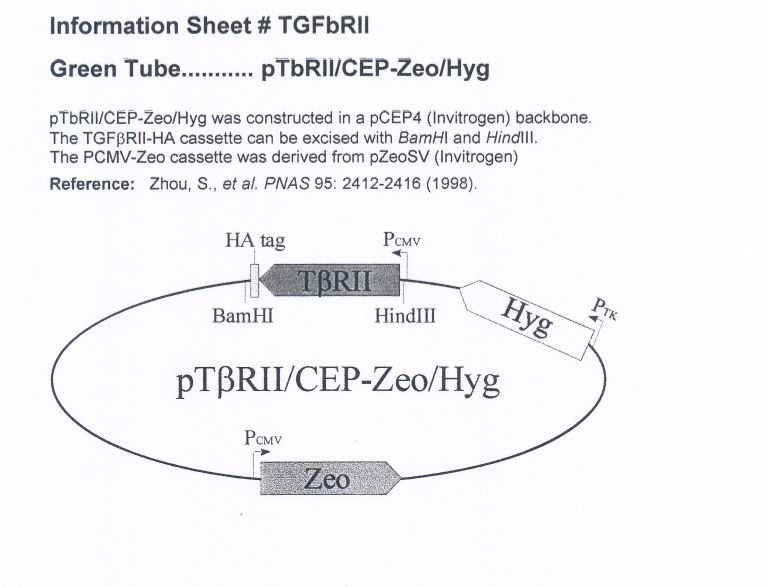
Modifications to backbonepCMV-Zeo cassette inserted into pCEP4
-
Vector typeMammalian Expression
-
Selectable markersHygromycin
Growth in Bacteria
-
Bacterial Resistance(s)Ampicillin, 100 μg/mL
-
Growth Temperature37°C
-
Growth Strain(s)DH5alpha
-
Copy numberUnknown
Gene/Insert
-
Gene/Insert nameTGF beta type II receptor
-
Alt nameTGFbRII
-
Alt nametransforming growth factor, beta receptor II
-
SpeciesH. sapiens (human)
-
Entrez GeneTGFBR2 (a.k.a. AAT3, FAA3, LDS1B, LDS2, LDS2B, MFS2, RIIC, TAAD2, TBR-ii, TBRII, TGFR-2, TGFbeta-RII, tbetaR-II)
-
Tag
/ Fusion Protein
- HA (C terminal on insert)
Cloning Information
- Cloning method Restriction Enzyme
- 5′ cloning site BamHI (not destroyed)
- 3′ cloning site HindIII (not destroyed)
- 5′ sequencing primer pGEX3
- (Common Sequencing Primers)
Resource Information
-
A portion of this plasmid was derived from a plasmid made byTGFbRII cDNA generously provided by Dr. Harvey Lodish and Dr. Robert Weinberg
Terms and Licenses
-
Academic/Nonprofit Terms
-
Industry Terms
- Not Available to Industry
Trademarks:
- Zeocin® is an InvivoGen trademark.
Depositor Comments
An expression construct for the TGF-beta RII gene was constructed by placing a TGF-beta RII cDNA between a cytomegalovirus (CMV) promoter and an simian virus 40 polyadenylation signal.
Please note that according to the map, this plasmid has 2 CMV promoters, so sequence confirmation with this primer may have limited success. Restriction digest with BamHI/HindIII is recommended for plasmid confirmation.
DNA (Catalog # 16622-D50)
Purpose
Ready-to-use, high-purity DNA prep. DNA aliquots are suitable for use in mammalian cell transfections and other molecular biology applications.
Delivery
- Amount 50 μg
- Concentration 1 μg/μL
- Pricing $495 USD
- Storage 4 ℃ (short-term) or -20 ℃ (long-term)
Terms and Licenses
-
Academic/Nonprofit Terms
-
Industry Terms
- Not Available to Industry
Quality Control
Every DNA prep is verified by next-generation sequencing, confirming plasmid identity, sequence integrity, and absence of DNA contaminants. Concentration is confirmed to be within ±2.5% of the stated concentration.
Our production process has been validated to consistently yield endotoxin levels below 1.0 EU/μg. Individual lots are not tested for endotoxin.
DNA (Catalog # 16622-D100)
Purpose
Ready-to-use, high-purity DNA prep. DNA aliquots are suitable for use in mammalian cell transfections and other molecular biology applications.
Delivery
- Amount 100 μg
- Concentration 1 μg/μL
- Pricing $585 USD
- Storage 4 ℃ (short-term) or -20 ℃ (long-term)
Terms and Licenses
-
Academic/Nonprofit Terms
-
Industry Terms
- Not Available to Industry
Quality Control
Every DNA prep is verified by next-generation sequencing, confirming plasmid identity, sequence integrity, and absence of DNA contaminants. Concentration is confirmed to be within ±2.5% of the stated concentration.
Our production process has been validated to consistently yield endotoxin levels below 1.0 EU/μg. Individual lots are not tested for endotoxin.
These plasmids were created by your colleagues. Please acknowledge the Principal Investigator, cite the article in which the plasmids were described, and include Addgene in the Materials and Methods of your future publications.
-
For your Materials & Methods section:
pTBRII / CEP-Zeo / Hygro was a gift from Bert Vogelstein (Addgene plasmid # 16622 ; http://n2t.net/addgene:16622 ; RRID:Addgene_16622) -
For your References section:
Targeted deletion of Smad4 shows it is required for transforming growth factor beta and activin signaling in colorectal cancer cells. Zhou S, Buckhaults P, Zawel L, Bunz F, Riggins G, Dai JL, Kern SE, Kinzler KW, Vogelstein B. Proc Natl Acad Sci U S A. 1998 Mar 3. 95(5):2412-6. 10.1073/pnas.95.5.2412 PubMed 9482899
Map uploaded by the depositor.
