-
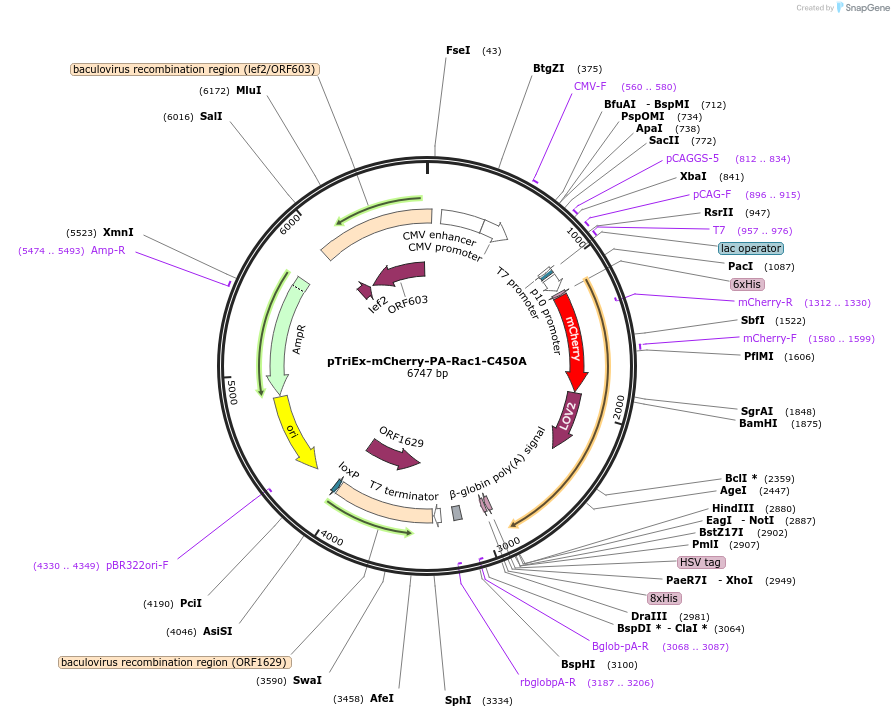
PurposeExpression of Rac1 fused with light-insensitive LOV2 (C450A mutation)
-
Depositing Lab
-
Depositing OrganizationUniversity of North Carolina at Chapel Hill
Located in the United States of America -
Publication
-
Citations
-
Sequence Information
Ordering
| Item | Catalog # | Description | Quantity | Price (USD) | |
|---|---|---|---|---|---|
| Plasmid | 22028 | Standard format: Plasmid sent in bacteria as agar stab | 1 | $94 | |
| DNA | 22028-D50 | 50 μg of DNA in Tris buffer | $495 | ||
| DNA | 22028-D100 | 100 μg of DNA in Tris buffer | $585 | ||
Backbone
-
Vector backbonepTriEx
-
Backbone manufacturerNovagen
- Backbone size w/o insert (bp) 6000
-
Vector typeMammalian Expression, Bacterial Expression, Insect Expression
Growth in Bacteria
-
Bacterial Resistance(s)Ampicillin, 100 μg/mL
-
Growth Temperature37°C
-
Growth Strain(s)DH5alpha
-
Copy numberHigh Copy
Gene/Insert
-
Gene/Insert namePA-Rac1-C450A
-
Alt nameLOV2-Rac1
-
SpeciesH. sapiens (human); Avena sativa (oat)
-
Insert Size (bp)1100
-
MutationLOV(Leu404-Leu546, C450A). Rac1 starts at Ile4 and contains mutations Q61L, E91H and N92H.
-
GenBank IDAAA36544
-
Entrez GeneRAC1 (a.k.a. MIG5, MRD48, Rac-1, TC-25, p21-Rac1)
- Promoter CMV, p10
-
Tags
/ Fusion Proteins
- 6xHis (N terminal on backbone)
- mCherry (N terminal on backbone)
Cloning Information
- Cloning method Restriction Enzyme
- 5′ cloning site Bam HI (not destroyed)
- 3′ cloning site HindIII (not destroyed)
- 5′ sequencing primer pTriExUP
- (Common Sequencing Primers)
Terms and Licenses
-
Academic/Nonprofit Terms
-
Industry Terms
- Not Available to Industry
Trademarks:
- Zeocin® is an InvivoGen trademark.
Depositor Comments
Protocols for production and use of Hahn lab biosensors and photoactivatable proteins can be found on their web page, at the URL below. If you have suggestions for the protocols or have any questions, please feel free to contact the Hahn lab. Good luck with your experiments!
Hahn lab biosensor protocol: http://www.hahnlab.com/tools/index.html
Please note, Addgene has not confirmed all the mutations associated with this construct. We suggest sequence verifying this plasmid upon receipt.
DNA (Catalog # 22028-D50)
Purpose
Ready-to-use, high-purity DNA prep. DNA aliquots are suitable for use in mammalian cell transfections and other molecular biology applications.
Delivery
- Amount 50 μg
- Concentration 1 μg/μL
- Pricing $495 USD
- Storage 4 ℃ (short-term) or -20 ℃ (long-term)
Terms and Licenses
-
Academic/Nonprofit Terms
-
Industry Terms
- Not Available to Industry
Quality Control
Every DNA prep is verified by next-generation sequencing, confirming plasmid identity, sequence integrity, and absence of DNA contaminants. Concentration is confirmed to be within ±2.5% of the stated concentration.
Our production process has been validated to consistently yield endotoxin levels below 1.0 EU/μg. Individual lots are not tested for endotoxin.
DNA (Catalog # 22028-D100)
Purpose
Ready-to-use, high-purity DNA prep. DNA aliquots are suitable for use in mammalian cell transfections and other molecular biology applications.
Delivery
- Amount 100 μg
- Concentration 1 μg/μL
- Pricing $585 USD
- Storage 4 ℃ (short-term) or -20 ℃ (long-term)
Terms and Licenses
-
Academic/Nonprofit Terms
-
Industry Terms
- Not Available to Industry
Quality Control
Every DNA prep is verified by next-generation sequencing, confirming plasmid identity, sequence integrity, and absence of DNA contaminants. Concentration is confirmed to be within ±2.5% of the stated concentration.
Our production process has been validated to consistently yield endotoxin levels below 1.0 EU/μg. Individual lots are not tested for endotoxin.
These plasmids were created by your colleagues. Please acknowledge the Principal Investigator, cite the article in which the plasmids were described, and include Addgene in the Materials and Methods of your future publications.
-
For your Materials & Methods section:
pTriEx-mCherry-PA-Rac1-C450A was a gift from Klaus Hahn (Addgene plasmid # 22028 ; http://n2t.net/addgene:22028 ; RRID:Addgene_22028) -
For your References section:
A genetically encoded photoactivatable Rac controls the motility of living cells. Wu YI, Frey D, Lungu OI, Jaehrig A, Schlichting I, Kuhlman B, Hahn KM. Nature. 2009 Sep 3. 461(7260):104-8. 10.1038/nature08241 PubMed 19693014