



pCDNA5-LRRK2
(Plasmid
#229019)
-
PurposeExpression of untagged full length human LRRK2 in mammalian cells
-
Depositing Lab
-
Depositing OrganizationUniversity of California, San Diego (UCSD)
Located in the United States of America -
Citations
-
Sequence Information


Ordering
| Item | Catalog # | Description | Quantity | Price (USD) | |
|---|---|---|---|---|---|
| Plasmid | 229019 | Standard format: Plasmid sent in bacteria as agar stab | 1 | $94 | |
| DNA | 229019-D50 | 50 μg of DNA in Tris buffer | $495 | ||
| DNA | 229019-D100 | 100 μg of DNA in Tris buffer | $585 | ||
Backbone
-
Vector backbonepCDNA5
-
Backbone manufacturerGenescript
- Backbone size w/o insert (bp) 5094
- Total vector size (bp) 12678
-
Vector typeMammalian Expression
-
Selectable markersHygromycin
Growth in Bacteria
-
Bacterial Resistance(s)Ampicillin, 100 μg/mL
-
Growth Temperature37°C
-
Growth Strain(s)DH5alpha
-
Copy numberHigh Copy
Gene/Insert
-
Gene/Insert nameLeucine-rich repeat kinase 2
-
Alt nameLRRK2
-
SpeciesH. sapiens (human)
-
Insert Size (bp)7584
-
Mutationnone
-
GenBank IDNM_198578.4 NM_198578.4
-
Entrez GeneLRRK2 (a.k.a. AURA17, DARDARIN, PARK8, RIPK7, ROCO2)
- Promoter CMV
-
Tag
/ Fusion Protein
- no tags (untagged)
Cloning Information
- Cloning method Gene Synthesis
- 5′ sequencing primer Plasmidsaurus full sequencing
- (Common Sequencing Primers)
Resource Information
-
A portion of this plasmid was derived from a plasmid made byGeneScript. We designed and ordered it as synthesized plasmid.
Terms and Licenses
-
Academic/Nonprofit Terms
-
Industry Terms
- Not Available to Industry
Trademarks:
- Zeocin® is an InvivoGen trademark.
Depositor Comments
Also used in : Type-II kinase inhibitors that target Parkinson’s Disease-associated LRRK2
Nicolai D. Raig, Katherine J. Surridge, Marta Sanz-Murillo, Verena Dederer, Andreas Krämer, Martin P. Schwalm, Lewis Elson, Deep Chatterjee, Sebastian Mathea, Thomas Hanke, Andres E. Leschziner, Samara L. Reck-Peterson, Stefan Knapp
bioRxiv 2024.09.17.613365; doi: https://doi.org/10.1101/2024.09.17.613365
DNA (Catalog # 229019-D50)
Purpose
Ready-to-use, high-purity DNA prep. DNA aliquots are suitable for use in mammalian cell transfections and other molecular biology applications.
Delivery
- Amount 50 μg
- Concentration 1 μg/μL
- Pricing $495 USD
- Storage 4 ℃ (short-term) or -20 ℃ (long-term)
Terms and Licenses
-
Academic/Nonprofit Terms
-
Industry Terms
- Not Available to Industry
Quality Control
Every DNA prep is verified by next-generation sequencing, confirming plasmid identity, sequence integrity, and absence of DNA contaminants. Concentration is confirmed to be within ±2.5% of the stated concentration.
Our production process has been validated to consistently yield endotoxin levels below 1.0 EU/μg. Individual lots are not tested for endotoxin.
DNA (Catalog # 229019-D100)
Purpose
Ready-to-use, high-purity DNA prep. DNA aliquots are suitable for use in mammalian cell transfections and other molecular biology applications.
Delivery
- Amount 100 μg
- Concentration 1 μg/μL
- Pricing $585 USD
- Storage 4 ℃ (short-term) or -20 ℃ (long-term)
Terms and Licenses
-
Academic/Nonprofit Terms
-
Industry Terms
- Not Available to Industry
Quality Control
Every DNA prep is verified by next-generation sequencing, confirming plasmid identity, sequence integrity, and absence of DNA contaminants. Concentration is confirmed to be within ±2.5% of the stated concentration.
Our production process has been validated to consistently yield endotoxin levels below 1.0 EU/μg. Individual lots are not tested for endotoxin.
These plasmids were created by your colleagues. Please acknowledge the Principal Investigator, cite the article in which the plasmids were described, and include Addgene in the Materials and Methods of your future publications.
-
For your Materials & Methods section:
pCDNA5-LRRK2 was a gift from Samara Reck-Peterson (Addgene plasmid # 229019 ; http://n2t.net/addgene:229019 ; RRID:Addgene_229019) -
For your References section:
A designed ankyrin-repeat protein that targets Parkinson's disease-associated LRRK2. Dederer V, Sanz Murillo M, Karasmanis EP, Hatch KS, Chatterjee D, Preuss F, Abdul Azeez KR, Nguyen LV, Galicia C, Dreier B, Pluckthun A, Versees W, Mathea S, Leschziner AE, Reck-Peterson SL, Knapp S. J Biol Chem. 2024 Jul;300(7):107469. doi: 10.1016/j.jbc.2024.107469. Epub 2024 Jun 12. 10.1016/j.jbc.2024.107469 PubMed 38876305
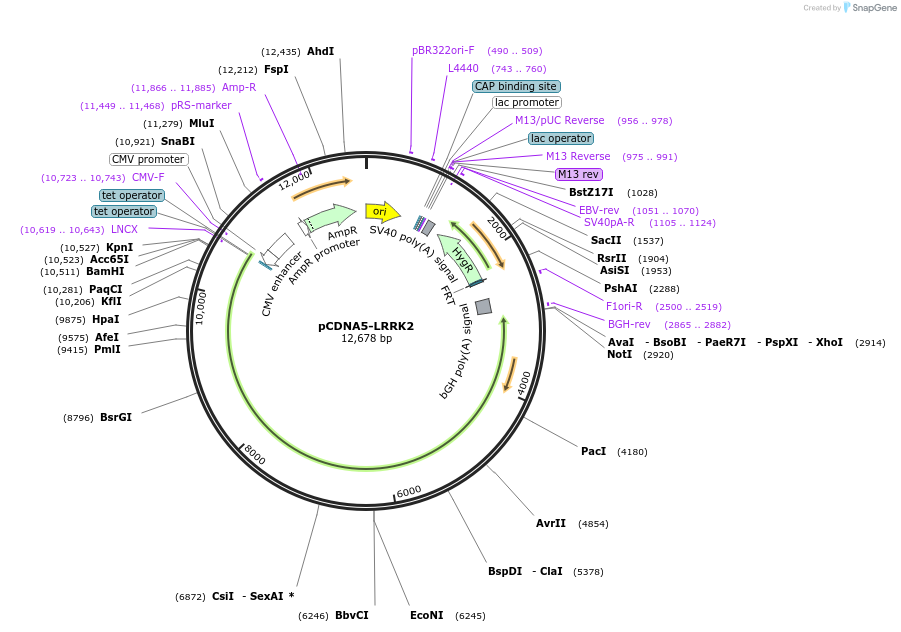
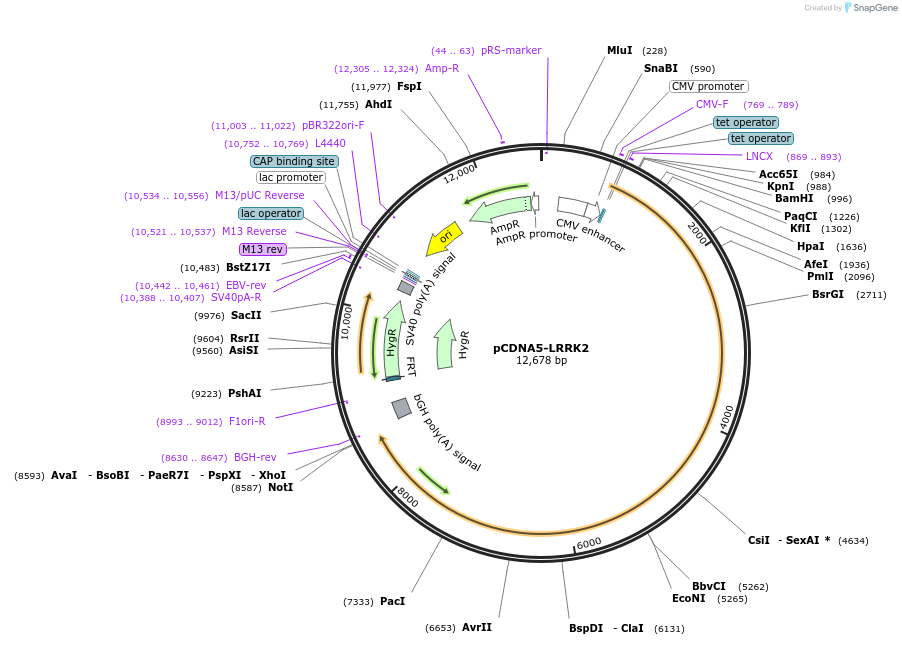
Map uploaded by the depositor.
