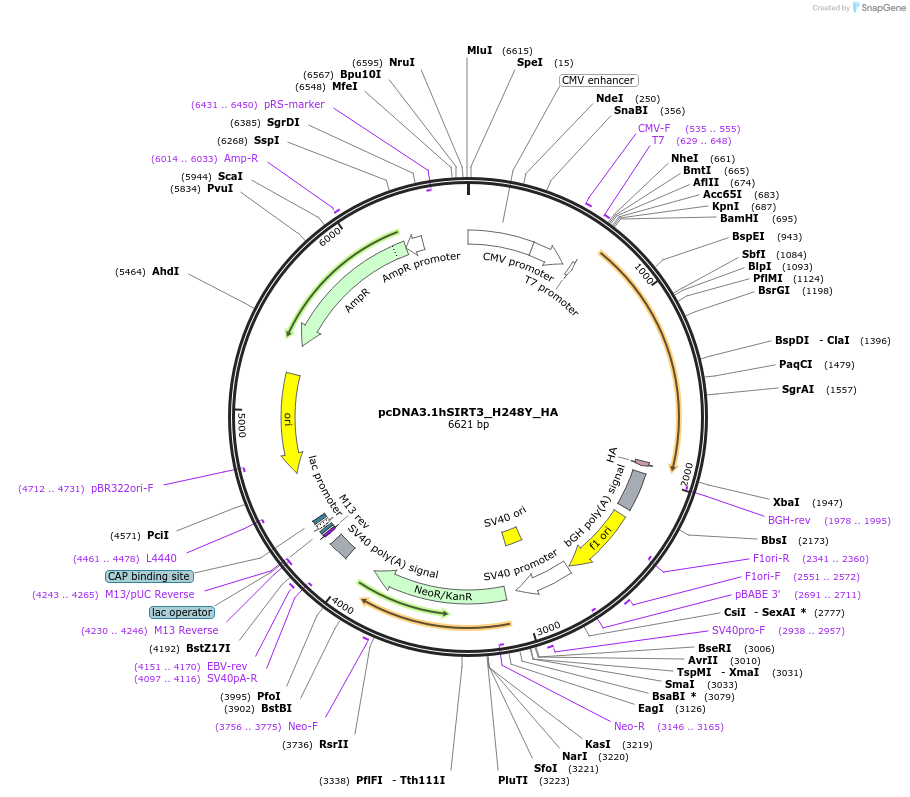
-
Depositing Lab
-
Depositing OrganizationJ. David Gladstone Institutes
Located in the United States of America -
Publication
-
Citations
-
Sequence Information
Ordering
| Item | Catalog # | Description | Quantity | Price (USD) | |
|---|---|---|---|---|---|
| Plasmid | 24492 | Standard format: Plasmid sent in bacteria as agar stab | 1 | $94 | |
| DNA | 24492-D50 | 50 μg of DNA in Tris buffer | $495 | ||
| DNA | 24492-D100 | 100 μg of DNA in Tris buffer | $585 | ||
Backbone
-
Vector backbonepcDNA3.1
-
Backbone manufacturerInvitrogen
- Backbone size w/o insert (bp) 5500
-
Vector typeMammalian Expression
-
Selectable markersNeomycin (select with G418)
Growth in Bacteria
-
Bacterial Resistance(s)Ampicillin, 100 μg/mL
-
Growth Temperature37°C
-
Growth Strain(s)DH5alpha
-
Copy numberUnknown
Gene/Insert
-
Gene/Insert nameHuman Sirtuin 3 catalytically inactive mutant
-
Alt nameSIRT3
-
Alt nameSIRT3-H248Y
-
SpeciesH. sapiens (human)
-
Insert Size (bp)1000
-
MutationH248Y
-
GenBank IDNM_012239
-
Entrez GeneSIRT3 (a.k.a. SIR2L3)
-
Tag
/ Fusion Protein
- HA (C terminal on insert)
Cloning Information
- Cloning method Restriction Enzyme
- 5′ cloning site EcoRI (not destroyed)
- 3′ cloning site EcoRI (not destroyed)
- 5′ sequencing primer n/a
- (Common Sequencing Primers)
Terms and Licenses
-
Academic/Nonprofit Terms
-
Industry Terms
- Not Available to Industry
Trademarks:
- Zeocin® is an InvivoGen trademark.
Depositor Comments
SIRT3 contains a mutation at amino acid Q32H. This mutation is present in the first 100 amino acids of SIRT3 which serve as its mitochondrial import signal. A peptide corresponding to the first 100 aa of SIRT3 is normally cleaved once the protein has been imported into the mitochondria and the active form of SIRT3 in the mitochondrial matrix therefore lacks this part of the protein. Therefore the mutation should not modify SIRT3 activity.
DNA (Catalog # 24492-D50)
Purpose
Ready-to-use, high-purity DNA prep. DNA aliquots are suitable for use in mammalian cell transfections and other molecular biology applications.
Delivery
- Amount 50 μg
- Concentration 1 μg/μL
- Pricing $495 USD
- Storage 4 ℃ (short-term) or -20 ℃ (long-term)
Terms and Licenses
-
Academic/Nonprofit Terms
-
Industry Terms
- Not Available to Industry
Quality Control
Every DNA prep is verified by next-generation sequencing, confirming plasmid identity, sequence integrity, and absence of DNA contaminants. Concentration is confirmed to be within ±2.5% of the stated concentration.
Our production process has been validated to consistently yield endotoxin levels below 1.0 EU/μg. Individual lots are not tested for endotoxin.
DNA (Catalog # 24492-D100)
Purpose
Ready-to-use, high-purity DNA prep. DNA aliquots are suitable for use in mammalian cell transfections and other molecular biology applications.
Delivery
- Amount 100 μg
- Concentration 1 μg/μL
- Pricing $585 USD
- Storage 4 ℃ (short-term) or -20 ℃ (long-term)
Terms and Licenses
-
Academic/Nonprofit Terms
-
Industry Terms
- Not Available to Industry
Quality Control
Every DNA prep is verified by next-generation sequencing, confirming plasmid identity, sequence integrity, and absence of DNA contaminants. Concentration is confirmed to be within ±2.5% of the stated concentration.
Our production process has been validated to consistently yield endotoxin levels below 1.0 EU/μg. Individual lots are not tested for endotoxin.
These plasmids were created by your colleagues. Please acknowledge the Principal Investigator, cite the article in which the plasmids were described, and include Addgene in the Materials and Methods of your future publications.
-
For your Materials & Methods section:
pcDNA3.1hSIRT3_H248Y_HA was a gift from Eric Verdin (Addgene plasmid # 24492 ; http://n2t.net/addgene:24492 ; RRID:Addgene_24492) -
For your References section:
SIRT3 regulates mitochondrial fatty-acid oxidation by reversible enzyme deacetylation. Hirschey MD, Shimazu T, Goetzman E, Jing E, Schwer B, Lombard DB, Grueter CA, Harris C, Biddinger S, Ilkayeva OR, Stevens RD, Li Y, Saha AK, Ruderman NB, Bain JR, Newgard CB, Farese RV, Alt FW, Kahn CR, Verdin E. Nature. 2010 Mar 4. 464(7285):121-5. 10.1038/nature08778 PubMed 20203611