


EIF1a-CRE-AID / Ubc-GFP
(Plasmid
#249049)
-
PurposeExpresses CRE fused to auxin inducible degron and GFP
-
Depositing Lab
-
Depositing OrganizationWeizmann Institute of Science
Located in Israel -
Sequence Information


Ordering
This material is available to academics and nonprofits only.
| Item | Catalog # | Description | Quantity | Price (USD) | |
|---|---|---|---|---|---|
| Plasmid | 249049 | Standard format: Plasmid sent in bacteria as agar stab | 1 | $94 | |
Backbone
-
Vector backbonepHAGE
-
Vector typeMammalian Expression, Lentiviral
Growth in Bacteria
-
Bacterial Resistance(s)Ampicillin, 100 μg/mL
-
Growth Temperature37°C
-
Growth Strain(s)NEB Stable
-
Copy numberLow Copy
Gene/Insert 1
-
Gene/Insert nameCRE recombinase
- Promoter EIF1alpha
-
Tag
/ Fusion Protein
- Auxin inducible degron (C terminal on insert)
Cloning Information for Gene/Insert 1
- Cloning method Gibson Cloning
- 5′ sequencing primer -
- (Common Sequencing Primers)
Gene/Insert 2
-
Gene/Insert nameGFP
- Promoter Ubc
Cloning Information for Gene/Insert 2
- Cloning method Restriction Enzyme
- 5′ cloning site SpeI (not destroyed)
- 3′ cloning site SpeI (not destroyed)
- 5′ sequencing primer -
- (Common Sequencing Primers)
Resource Information
Terms and Licenses
-
Academic/Nonprofit Terms
-
Industry Terms
- Not Available to Industry
Trademarks:
- Zeocin® is an InvivoGen trademark.
Depositor Comments
Auxin inducible degron was PCR amplified from SINAPS vector ( a gift from Robert H. Singer, Albert Einstein college of Medicine, NY, USA; Addgene #84561) and fused to CRE C-terminal by Gibson cloning, to replace the MS2 sequence in plasmid CRE-MS2/GFP (Addgene # 219536).
Please visit https://doi.org/10.1101/2024.11.06.622258 for bioRxiv preprint.
How to cite this plasmid
( Back to top)
These plasmids were created by your colleagues. Please acknowledge the Principal Investigator, cite the article in which the plasmids were described, and include Addgene in the Materials and Methods of your future publications.
-
For your Materials & Methods section:
EIF1a-CRE-AID / Ubc-GFP was a gift from Jeffrey Gerst (Addgene plasmid # 249049 ; http://n2t.net/addgene:249049 ; RRID:Addgene_249049) -
For your References section:
Complementation of a human disease phenotype by intercellular mRNA transfer. Haimovich G, Dasgupta S, Govindan Ravi A, Gerst JE. Cell Rep. 2026 Sep 7;45(9):117959. doi: 10.1016/j.celrep.2026.117959. 10.1016/j.celrep.2026.117959 PubMed 42704713
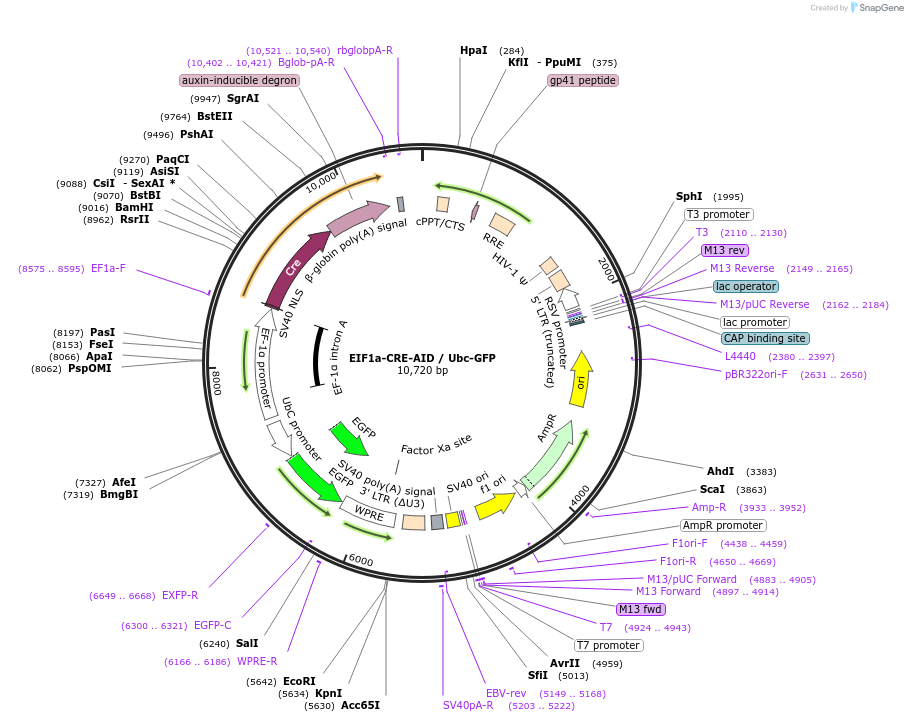
Map uploaded by the depositor.