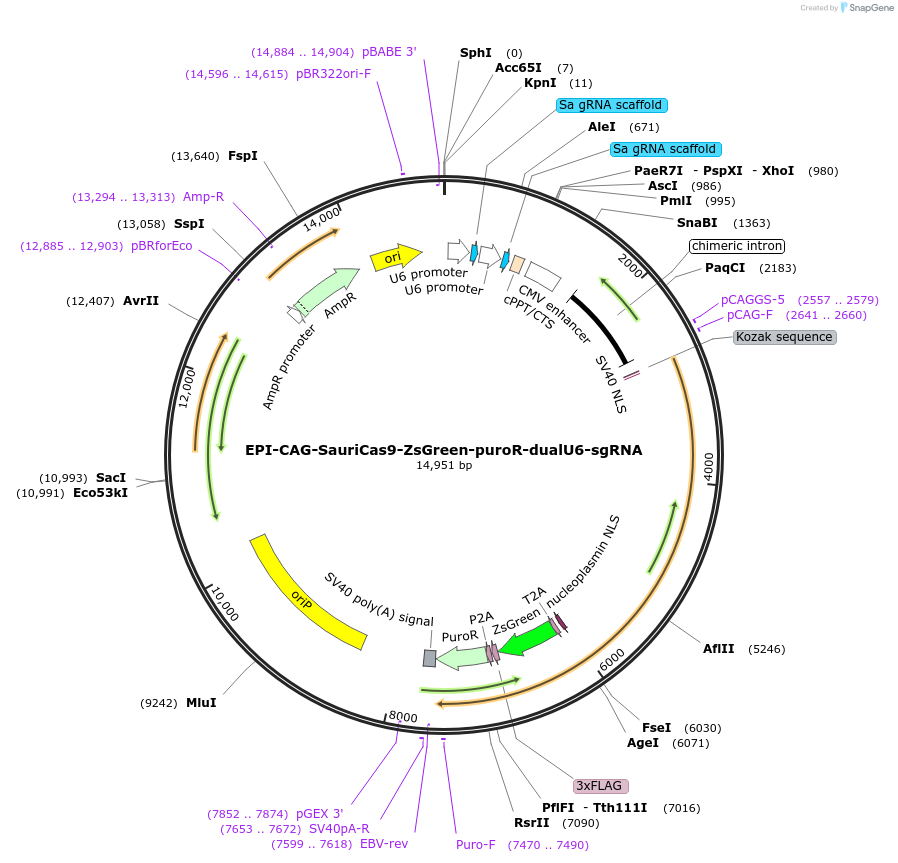
EPI-CAG-SauriCas9-ZsGreen-puroR-dualU6-sgRNA
(Plasmid
#249830)
-
PurposeEpisomal CAG-SauriCas9-ZsGreen-puroR vector with dual U6 sgRNA cassettes for CRISPR editing in mammalian cells.
-
Depositing Lab
-
Depositing OrganizationShanghai Jiao Tong University, School of Medicine
Located in China -
Sequence Information
Ordering
This material is available to academics and nonprofits only.
| Item | Catalog # | Description | Quantity | Price (USD) | |
|---|---|---|---|---|---|
| Plasmid | 249830 | Standard format: Plasmid sent in bacteria as agar stab | 1 | $94 | |
Backbone
-
Vector backboneepiCRISPR plasmid
-
Vector typeMammalian Expression, CRISPR
-
Selectable markersPuromycin
Growth in Bacteria
-
Bacterial Resistance(s)Ampicillin, 100 μg/mL
-
Growth Temperature37°C
-
Growth Strain(s)DH5alpha
-
Copy numberHigh Copy
Gene/Insert
-
Gene/Insert nameNone
-
gRNA/shRNA sequenceTATCCGACTGTGACTCCTCC
-
SpeciesM. musculus (mouse)
-
Entrez GeneTrp53 (a.k.a. Tp53, bbl, bfy, bhy, p44, p53)
- Promoter CAG and U6
Cloning Information
- Cloning method Unknown
- 5′ sequencing primer Not applicable
- 3′ sequencing primer Not applicable
- (Common Sequencing Primers)
Resource Information
Terms and Licenses
-
Academic/Nonprofit Terms
-
Industry Terms
- Not Available to Industry
Trademarks:
- Zeocin® is an InvivoGen trademark.
Depositor Comments
Please note: Due to its repetitive and G/C-rish nature, Addgene NGS is unable to fully resolve the EBNA1 element within the plasmid. Also, this plasmid contains an A nucleotide deletion immediately upstream of the gRNA sequence and a ten amino acid insertion between nucleoplasmin NLS and T2A. These differences are not known to impact plasmid function.
How to cite this plasmid
( Back to top)
These plasmids were created by your colleagues. Please acknowledge the Principal Investigator, cite the article in which the plasmids were described, and include Addgene in the Materials and Methods of your future publications.
-
For your Materials & Methods section:
EPI-CAG-SauriCas9-ZsGreen-puroR-dualU6-sgRNA was a gift from Bin Yu (Addgene plasmid # 249830 ; http://n2t.net/addgene:249830 ; RRID:Addgene_249830) -
For your References section:
EPI-SauriCas9-based mouse ovarian cancer models recapitulating pten deletion in patients. Chen W, He P, Ding L, Lou W, Wang Y, Shi W, Fan Z, Sheng Y, Luo J, Tan Z, Wang Y, Di W, Ke X, Yu B. Commun Biol. 2025 Dec 29;9(1):159. doi: 10.1038/s42003-025-09437-2. 10.1038/s42003-025-09437-2 PubMed 41466059