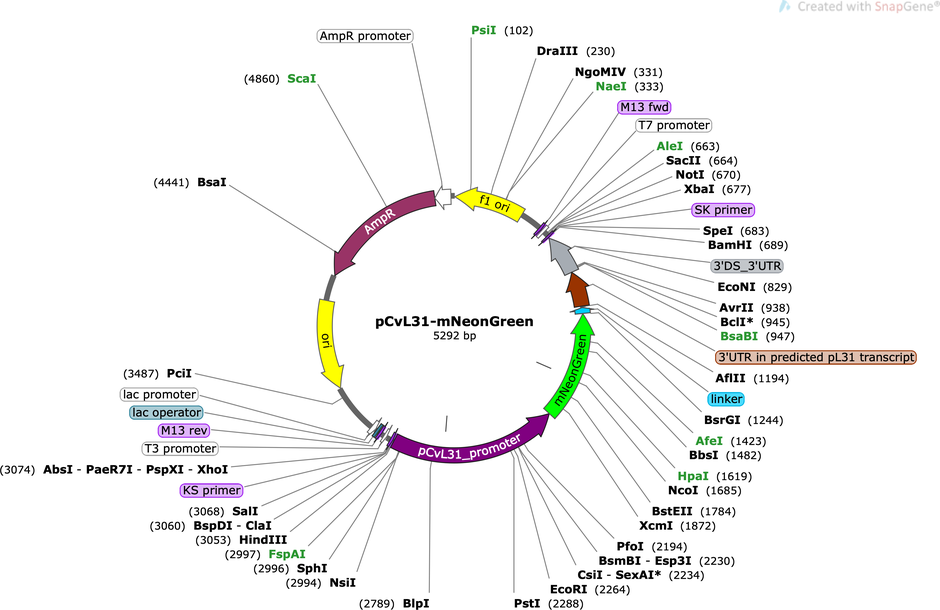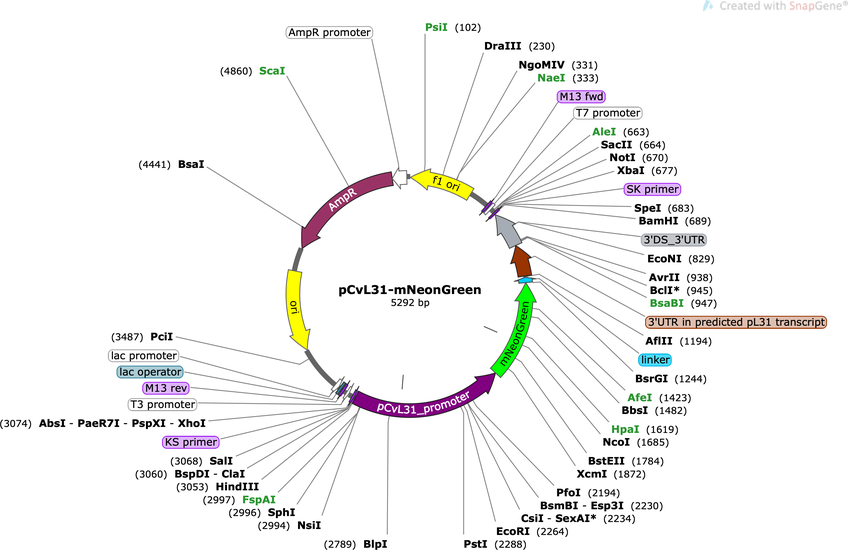



pCvL31-mNeonGreen
(Plasmid
#255779)
-
PurposeExpresses mNeonGreen in Chromera velia
-
Depositing Lab
-
Depositing OrganizationArizona State University
Located in the United States of America -
Sequence Information


Ordering
| Item | Catalog # | Description | Quantity | Price (USD) | |
|---|---|---|---|---|---|
| Plasmid | 255779 | Standard format: Plasmid sent in bacteria as agar stab | 1 | $94 | |
Backbone
-
Vector backbonepBluescript
- Backbone size w/o insert (bp) 2931
- Total vector size (bp) 5292
-
Vector typeBacterial Expression ; Chromera velia
Growth in Bacteria
-
Bacterial Resistance(s)Ampicillin, 100 μg/mL
-
Growth Temperature37°C
-
Growth Strain(s)DH5alpha
-
Copy numberUnknown
Gene/Insert
-
Gene/Insert namemNeonGreen
-
Insert Size (bp)705
- Promoter putative C. velia L31 promoter (1103 bp)
-
Tag
/ Fusion Protein
- GGTGSGGTGSGGS (C terminal on insert)
Cloning Information
- Cloning method Restriction Enzyme
- 5′ cloning site HindIII (not destroyed)
- 3′ cloning site BamHI (not destroyed)
- 5′ sequencing primer pBluescript KS
- 3′ sequencing primer pBluescript SK
- (Common Sequencing Primers)
Terms and Licenses
-
Academic/Nonprofit Terms
-
Industry Terms
- Not Available to Industry
Trademarks:
- Zeocin® is an InvivoGen trademark.
Depositor Comments
pBluescript-derived expression vector for Chromera velia. A synthesized DNA fragment containing the putative C. velia L31 promoter region (1103 bp; VEuPathDB: Cvel_7598), mNeonGreen CDS, a 13-aa linker, and the C. velia L31 3′ UTR (499 bp) was ligated into the HindIII and BamHI sites of pBluescript. The putative L31 promoter is intended to drive reporter expression in C. velia.
These plasmids were created by your colleagues. Please acknowledge the Principal Investigator, cite the article in which the plasmids were described, and include Addgene in the Materials and Methods of your future publications.
-
For your Materials & Methods section:
pCvL31-mNeonGreen was a gift from Ke Hu (Addgene plasmid # 255779 ; http://n2t.net/addgene:255779 ; RRID:Addgene_255779) -
For your References section:
Transfection of the free-living alga Chromera velia enables direct comparisons with its parasitic apicomplexan relative, Toxoplasma gondii. Tengganu IF, Hu K. J Cell Sci. 2026 Jan 1;139(1):jcs.264400. doi: 10.1242/jcs.264400. Epub 2026 Jan 13. 10.1242/jcs.264400 PubMed 41208444
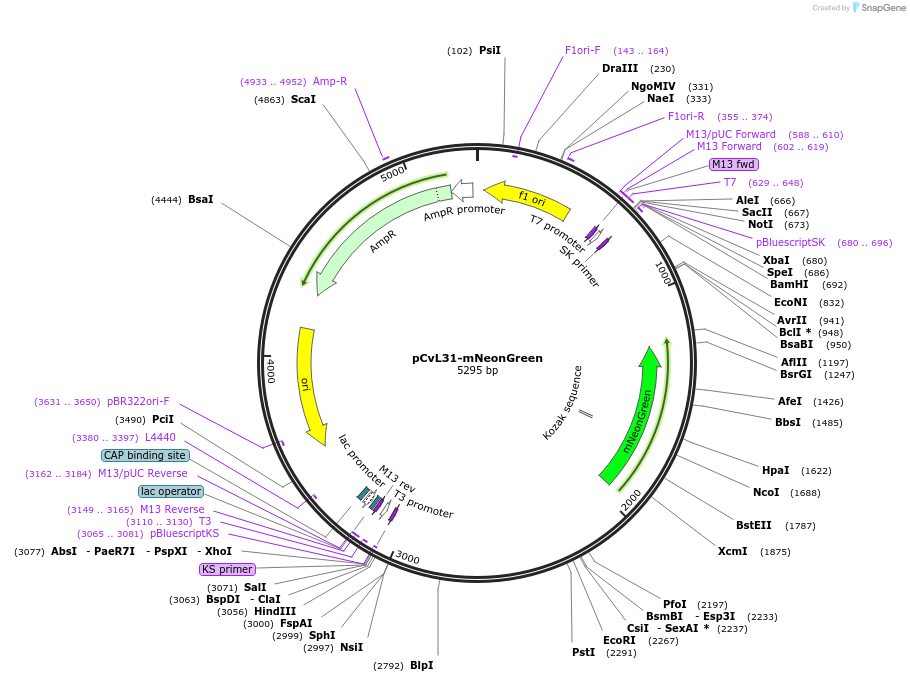
Map uploaded by the depositor.