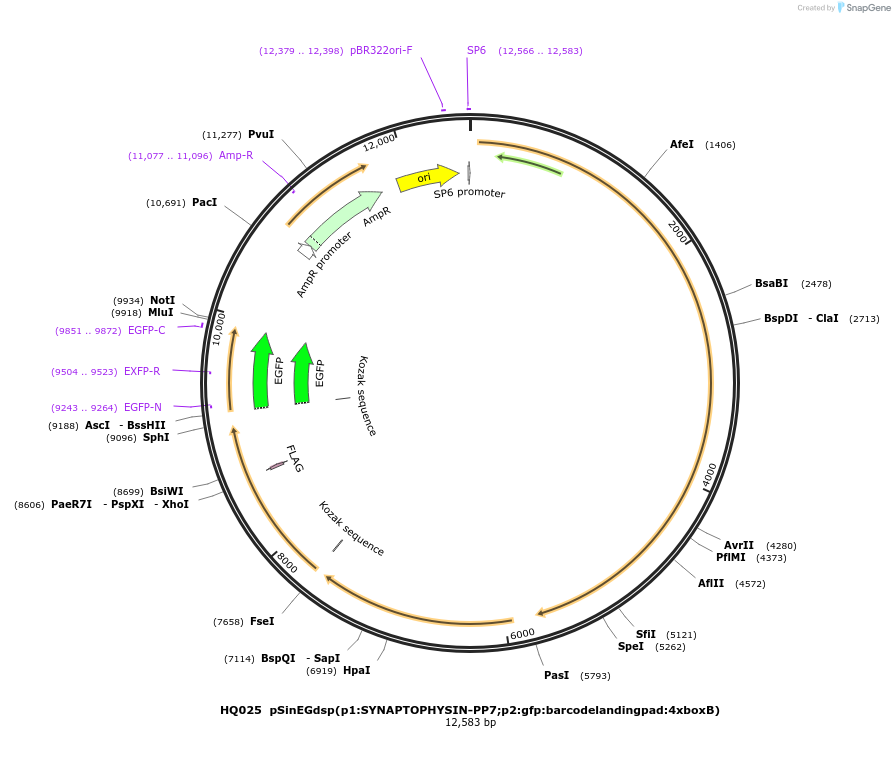
HQ025 pSinEGdsp(p1:SYNAPTOPHYSIN-PP7;p2:gfp:barcodelandingpad:4xboxB)
(Plasmid
#262085)
-
PurposeCarrier protein screening, SYNAPTOPHYSIN-PP7
-
Depositing Lab
-
Depositing OrganizationJohns Hopkins University and School of Medicine
Located in the United States of America -
Publication
-
Sequence Information
Ordering
This material is available to academics and nonprofits only.
| Item | Catalog # | Description | Quantity | Price (USD) | |
|---|---|---|---|---|---|
| Plasmid | 262085 | Standard format: Plasmid sent in bacteria as agar stab | 1 | $94 | |
Backbone
-
Vector backbonepSinEGdsp(p1:MAPPnL;p2:gfp:barcodelandingpad:4xboxB)
-
Vector typeMammalian Expression
Growth in Bacteria
-
Bacterial Resistance(s)Ampicillin, 100 μg/mL
-
Growth Temperature37°C
-
Growth Strain(s)DH5alpha
-
Copy numberHigh Copy
Gene/Insert
-
Gene/Insert nameSYNAPTOPHYSIN-PP7
-
SpeciesMacaca mulatta
-
Entrez GeneSYP
- Promoter subgenomic promoter
Cloning Information
- Cloning method Gibson Cloning
Resource Information
Terms and Licenses
-
Academic/Nonprofit Terms
-
Industry Terms
- Not Available to Industry
Trademarks:
- Zeocin® is an InvivoGen trademark.
Depositor Comments
Plasmid contains P438L and K634E mutations in NSP2- depositor confirms these will not effect function. Please visit https://doi.org/10.64898/2026.11.19.767886 for bioRxiv preprint.
How to cite this plasmid
( Back to top)
These plasmids were created by your colleagues. Please acknowledge the Principal Investigator, cite the article in which the plasmids were described, and include Addgene in the Materials and Methods of your future publications.
-
For your Materials & Methods section:
HQ025 pSinEGdsp(p1:SYNAPTOPHYSIN-PP7;p2:gfp:barcodelandingpad:4xboxB) was a gift from Justus Kebschull (Addgene plasmid # 262085 ; http://n2t.net/addgene:262085 ; RRID:Addgene_262085) -
For your References section:
Universal barcoded connectomics for massively parallel single-neuron projection mapping in diverse vertebrate species. Qi H, Wan X, Cheron J, Majeed M, Elorette C, Fan A, Yang Z, Anant MMG, Faltine-Gonzalez DZ, Shi C, Washington C, Lowman M, Bourne JA, Horwitz GD, Rudebeck PH, Chen X, Long MA, Sakata JT, Kebschull JM. bioRxiv 2026.11.19.767886 10.64898/2026.11.19.767886