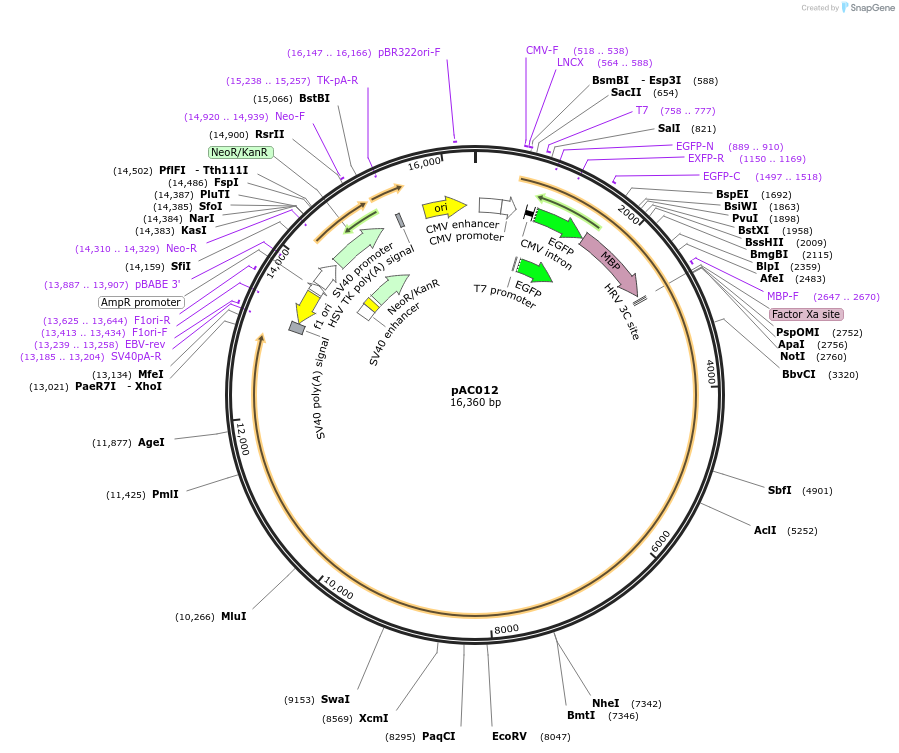
pAC012
(Plasmid
#263543)
-
PurposeExpression of GFP-MBP-tagged human BRCA2 in mammalian cells
-
Depositing Lab
-
Depositing OrganizationInstitut Curie
Located in France -
Sequence Information
Ordering
| Item | Catalog # | Description | Quantity | Price (USD) | |
|---|---|---|---|---|---|
| Plasmid | 263543 | Standard format: Plasmid sent in bacteria as agar stab | 1 | $94 | |
| DNA | 263543-D50 | 50 μg of DNA in Tris buffer | $495 | ||
| DNA | 263543-D100 | 100 μg of DNA in Tris buffer | $585 | ||
Backbone
-
Vector backbonephCMV1
-
Vector typeMammalian Expression
Growth in Bacteria
-
Bacterial Resistance(s)Kanamycin, 50 μg/mL
-
Growth Temperature37°C
-
Growth Strain(s)NEB Stable
-
Copy numberHigh Copy
Gene/Insert
-
Gene/Insert nameEGFP-MBP-BRCA2
-
SpeciesH. sapiens (human)
-
Entrez GeneBRCA2 (a.k.a. BRCC2, BROVCA2, FACD, FAD, FAD1, FANCD, FANCD1, GLM3, PNCA2, XRCC11)
- Promoter CMV
Cloning Information
- Cloning method Restriction Enzyme
- 5′ cloning site Unknown (unknown if destroyed)
Resource Information
Terms and Licenses
-
Academic/Nonprofit Terms
-
Industry Terms
- Not Available to Industry
Trademarks:
- Zeocin® is an InvivoGen trademark.
Depositor Comments
To clone plasmid pAC012, we used a plasmid that contains a 2xMBP-tagged version of BRCA2. This plasmid was originally described in the following publication:
Jensen RB, Carreira A, Kowalczykowski SC. Purified human BRCA2 stimulates RAD51-mediated recombination. Nature. 2010 Oct 7;467(7316):678-83. doi: 10.1038/nature09399. PMID: 20729832; PMCID: PMC2952063.
DNA (Catalog # 263543-D50)
Purpose
Ready-to-use, high-purity DNA prep. DNA aliquots are suitable for use in mammalian cell transfections and other molecular biology applications.
Delivery
- Amount 50 μg
- Concentration 1 μg/μL
- Pricing $495 USD
- Storage 4 ℃ (short-term) or -20 ℃ (long-term)
Terms and Licenses
-
Academic/Nonprofit Terms
-
Industry Terms
- Not Available to Industry
Quality Control
Every DNA prep is verified by next-generation sequencing, confirming plasmid identity, sequence integrity, and absence of DNA contaminants. Concentration is confirmed to be within ±2.5% of the stated concentration.
Our production process has been validated to consistently yield endotoxin levels below 1.0 EU/μg. Individual lots are not tested for endotoxin.
DNA (Catalog # 263543-D100)
Purpose
Ready-to-use, high-purity DNA prep. DNA aliquots are suitable for use in mammalian cell transfections and other molecular biology applications.
Delivery
- Amount 100 μg
- Concentration 1 μg/μL
- Pricing $585 USD
- Storage 4 ℃ (short-term) or -20 ℃ (long-term)
Terms and Licenses
-
Academic/Nonprofit Terms
-
Industry Terms
- Not Available to Industry
Quality Control
Every DNA prep is verified by next-generation sequencing, confirming plasmid identity, sequence integrity, and absence of DNA contaminants. Concentration is confirmed to be within ±2.5% of the stated concentration.
Our production process has been validated to consistently yield endotoxin levels below 1.0 EU/μg. Individual lots are not tested for endotoxin.
These plasmids were created by your colleagues. Please acknowledge the Principal Investigator, cite the article in which the plasmids were described, and include Addgene in the Materials and Methods of your future publications.
-
For your Materials & Methods section:
pAC012 was a gift from Aura Carreira (Addgene plasmid # 263543 ; http://n2t.net/addgene:263543 ; RRID:Addgene_263543) -
For your References section:
BRCA2 Hypomorphic Missense Variants Confer Moderate Risks of Breast Cancer. Shimelis H, Mesman RLS, Von Nicolai C, Ehlen A, Guidugli L, Martin C, Calleja FMGR, Meeks H, Hallberg E, Hinton J, Lilyquist J, Hu C, Aalfs CM, Aittomaki K, Andrulis I, Anton-Culver H, Arndt V, Beckmann MW, Benitez J, Bogdanova NV, Bojesen SE, Bolla MK, Borresen-Dale AL, Brauch H, Brennan P, Brenner H, Broeks A, Brouwers B, Bruning T, Burwinkel B, Chang-Claude J, Chenevix-Trench G, Cheng CY, Choi JY, Collee JM, Cox A, Cross SS, Czene K, Darabi H, Dennis J, Dork T, Dos-Santos-Silva I, Dunning AM, Fasching PA, Figueroa J, Flyger H, Garcia-Closas M, Giles GG, Glendon G, Guenel P, Haiman CA, Hall P, Hamann U, Hartman M, Hogervorst FB, Hollestelle A, Hopper JL, Ito H, Jakubowska A, Kang D, Kosma VM, Kristensen V, Lai KN, Lambrechts D, Marchand LL, Li J, Lindblom A, Lophatananon A, Lubinski J, Machackova E, Mannermaa A, Margolin S, Marme F, Matsuo K, Miao H, Michailidou K, Milne RL, Muir K, Neuhausen SL, Nevanlinna H, Olson JE, Olswold C, Oosterwijk JJC, Osorio A, Peterlongo P, Peto J, Pharoah PDP, Pylkas K, Radice P, Rashid MU, Rhenius V, Rudolph A, Sangrajrang S, Sawyer EJ, Schmidt MK, Schoemaker MJ, Seynaeve C, Shah M, Shen CY, Shrubsole M, Shu XO, Slager S, Southey MC, Stram DO, Swerdlow A, Teo SH, Tomlinson I, Torres D, Truong T, van Asperen CJ, van der Kolk LE, Wang Q, Winqvist R, Wu AH, Yu JC, Zheng W, Zheng Y, Leary J, Walker L, Foretova L, Fostira F, Claes KBM, Varesco L, Moghadasi S, Easton DF, Spurdle A, Devilee P, Vrieling H, Monteiro ANA, Goldgar DE, Carreira A, Vreeswijk MPG, Couch FJ. Cancer Res. 2017 Jun 1;77(11):2789-2799. doi: 10.1158/0008-5472.CAN-16-2568. Epub 2017 Mar 10. 10.1158/0008-5472.CAN-16-2568 PubMed 28283652