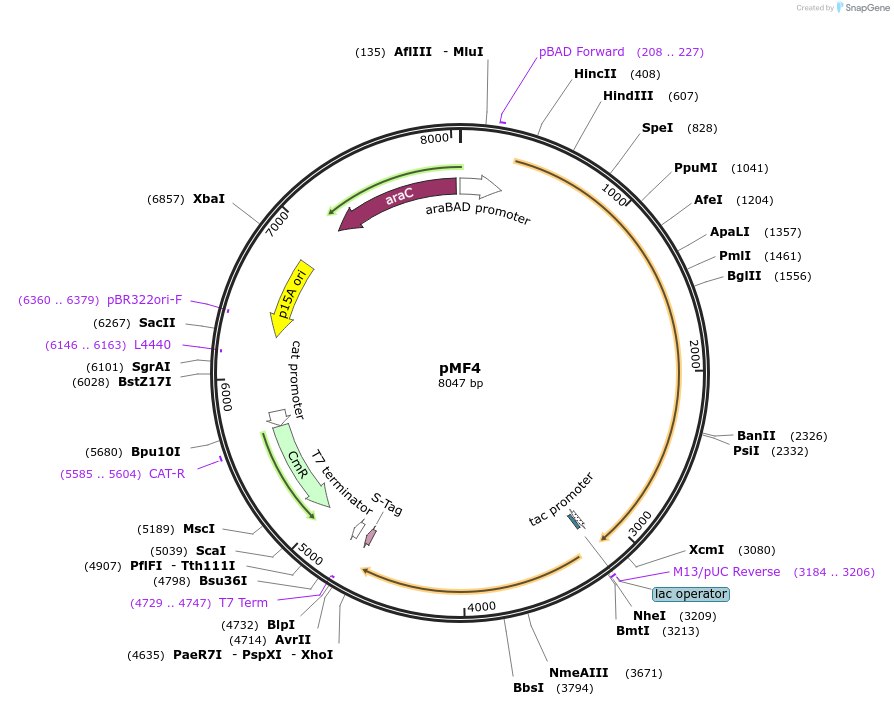
pMF4
(Plasmid
#263789)
-
PurposeExpression of the N-terminal part of the split indigoidine synthetase (IndC) in E. coli.
-
Depositing Lab
-
Depositing OrganizationMax Planck Institute for Terrestrial Microbiology
Located in Germany -
Sequence Information
Ordering
This material is available to academics and nonprofits only.
| Item | Catalog # | Description | Quantity | Price (USD) | |
|---|---|---|---|---|---|
| Plasmid | 263789 | Standard format: Plasmid sent in bacteria as agar stab | 1 | $94 | |
Backbone
-
Vector backbonepACYC
-
Vector typeBacterial Expression
Growth in Bacteria
-
Bacterial Resistance(s)Chloramphenicol, 25 μg/mL
-
Growth Temperature37°C
-
Growth Strain(s)NEB Stable
-
Growth instructionsBoth plasmids (this and pMF05) are supposed to be co-transformed into an E. coli strain that expresses a broad-spectrum phosphopantetheinyl transferase, such as MtaA (DH10B::mtaA, Bacterial strain #255799) or Sfp (BAP1), which is required for the post-translational activation of the T domain. Expression is controlled by an araBAD promoter, inducible with 0.2% arabinose.
-
Copy numberLow Copy
Gene/Insert
-
Gene/Insert nameindC-N
-
SpeciesPhotorhabdus laumondii TT01
Cloning Information
- Cloning method Gibson Cloning
Terms and Licenses
-
Academic/Nonprofit Terms
-
Industry Terms
- Not Available to Industry
Trademarks:
- Zeocin® is an InvivoGen trademark.
Depositor Comments
This plasmid encodes the N-terminal part of the indigoidine synthetase (IndC), split at an XUTI site, but not fused to any PPI-mediating tool as negative control. When co-expressed with pMF05, it is not expected to reconstitute the indigoidine synthetase or result in indigoidine production.
Please visit https://doi.org/10.64898/2026.06.03.729908 for bioRxiv preprint.
How to cite this plasmid
( Back to top)
These plasmids were created by your colleagues. Please acknowledge the Principal Investigator, cite the article in which the plasmids were described, and include Addgene in the Materials and Methods of your future publications.
-
For your Materials & Methods section:
pMF4 was a gift from Helge Bode (Addgene plasmid # 263789 ; http://n2t.net/addgene:263789 ; RRID:Addgene_263789) -
For your References section:
Split-Indigoidine synthetase as optical reporter for benchmarking protein-protein interactions. Gonschorek P, Schelhas C, Flakowski M, Schenk L, Podolski A, Bode HB. bioRxiv 2026.06.03.729908; doi: 10.64898/2026.06.03.729908 10.64898/2026.06.03.729908