



-
Depositing Labs
-
Depositing OrganizationMemorial Sloan-Kettering Cancer Center
Located in the United States of America -
Publication
-
Citations
-
Sequence Information


Ordering
| Item | Catalog # | Description | Quantity | Price (USD) | |
|---|---|---|---|---|---|
| Plasmid | 32599 | Standard format: Plasmid sent in bacteria as agar stab | 1 | $94 | |
| DNA | 32599-D50 | 50 μg of DNA in Tris buffer | $495 | ||
| DNA | 32599-D100 | 100 μg of DNA in Tris buffer | $585 | ||
Backbone
-
Vector backbonepCAGGS
-
Vector typeMammalian Expression
Growth in Bacteria
-
Bacterial Resistance(s)Ampicillin, 100 μg/mL
-
Growth Temperature37°C
-
Growth Strain(s)DH5alpha
-
Copy numberHigh Copy
Gene/Insert
-
Gene/Insert nameH2B-EGFP
-
GenBank IDX00088 X57127
- Promoter CAG
Cloning Information
- Cloning method Restriction Enzyme
- 5′ cloning site XhoI (not destroyed)
- 3′ cloning site Xho1 (not destroyed)
- 5′ sequencing primer IMR 872 AAGTTCATCTGCACCACCG
- 3′ sequencing primer IMR 873 TGCTCAGGTAGTGGTTGTCG
- (Common Sequencing Primers)
Terms and Licenses
-
Academic/Nonprofit Terms
-
Industry Terms
- Not Available to Industry
Trademarks:
- Zeocin® is an InvivoGen trademark.
Depositor Comments
Please note that the plasmid contains a duplication of the H2B-EGFP region as compared to the original depositor sequence. The depositor has confirmed that the plasmid functions as described in the associated publication.
The coding sequence for the human histone H2B gene
(X57127) was amplified from genomic DNA by PCR
using Pfx Polymerase (Invitrogen). The resulting product
was cloned into pCR4 TOPO (Invitrogen) to generate
pH2B. The H2B fragment was then cloned into plasmids
pEGFP-N1, pDsRed2-N1 pDsRedExpress-N1 (BD Biosciences, Inc) in order to generate plasmids pH2B-EGFP,
pH2B-DsRed2 and pH2B-DsRedExpress (oligonucleotide
sequences are available upon request). The resulting
fusions were then re-amplified by PCR and cloned into
the XhoI site of pCAGGS [19] to generate pCX-H2B-EGFP,
pCX-H2B-DsRed2 and pCX-H2B-DsRedExpress.
DNA (Catalog # 32599-D50)
Purpose
Ready-to-use, high-purity DNA prep. DNA aliquots are suitable for use in mammalian cell transfections and other molecular biology applications.
Delivery
- Amount 50 μg
- Concentration 1 μg/μL
- Pricing $495 USD
- Storage 4 ℃ (short-term) or -20 ℃ (long-term)
Terms and Licenses
-
Academic/Nonprofit Terms
-
Industry Terms
- Not Available to Industry
Quality Control
Every DNA prep is verified by next-generation sequencing, confirming plasmid identity, sequence integrity, and absence of DNA contaminants. Concentration is confirmed to be within ±2.5% of the stated concentration.
Our production process has been validated to consistently yield endotoxin levels below 1.0 EU/μg. Individual lots are not tested for endotoxin.
DNA (Catalog # 32599-D100)
Purpose
Ready-to-use, high-purity DNA prep. DNA aliquots are suitable for use in mammalian cell transfections and other molecular biology applications.
Delivery
- Amount 100 μg
- Concentration 1 μg/μL
- Pricing $585 USD
- Storage 4 ℃ (short-term) or -20 ℃ (long-term)
Terms and Licenses
-
Academic/Nonprofit Terms
-
Industry Terms
- Not Available to Industry
Quality Control
Every DNA prep is verified by next-generation sequencing, confirming plasmid identity, sequence integrity, and absence of DNA contaminants. Concentration is confirmed to be within ±2.5% of the stated concentration.
Our production process has been validated to consistently yield endotoxin levels below 1.0 EU/μg. Individual lots are not tested for endotoxin.
These plasmids were created by your colleagues. Please acknowledge the Principal Investigator, cite the article in which the plasmids were described, and include Addgene in the Materials and Methods of your future publications.
-
For your Materials & Methods section:
pCAG:H2B-EGFP was a gift from Anna-Katerina Hadjantonakis & Virginia Papaioannou (Addgene plasmid # 32599 ; http://n2t.net/addgene:32599 ; RRID:Addgene_32599) -
For your References section:
Dynamic in vivo imaging and cell tracking using a histone fluorescent protein fusion in mice. Hadjantonakis AK, Papaioannou VE. BMC Biotechnol. 2004 Dec 24;4:33. 10.1186/1472-6750-4-33 PubMed 15619330
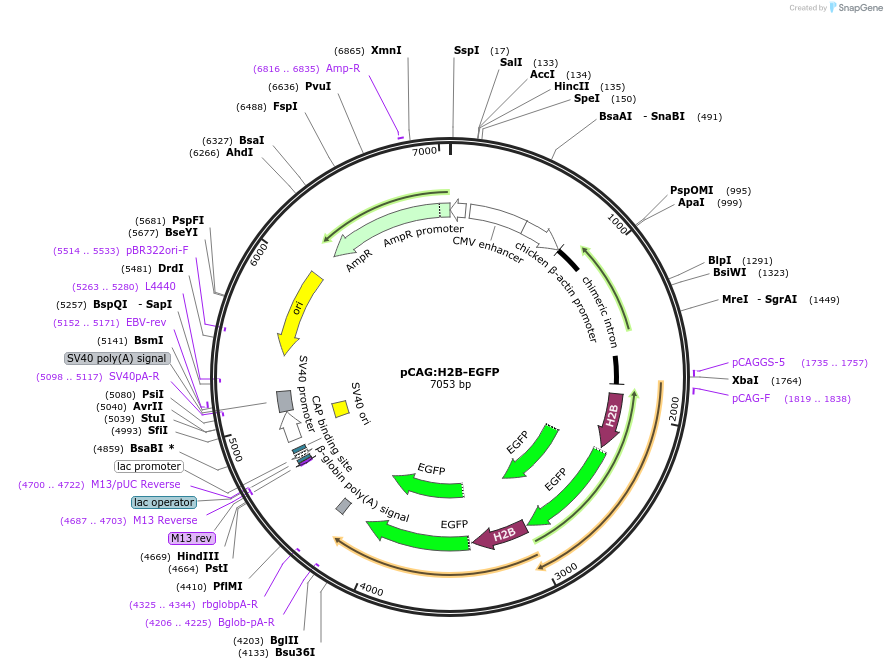
Map uploaded by the depositor.
