



pFRT/TO/HIS/FLAG/HA-MYEF2
(Plasmid
#38069)
-
Depositing Lab
-
Depositing OrganizationMax-Delbrueck-Centrum fuer Molekulare Medizin (MDC)
Located in Germany -
Publication
-
Sequence Information


Ordering
| Item | Catalog # | Description | Quantity | Price (USD) | |
|---|---|---|---|---|---|
| Plasmid | 38069 | Standard format: Plasmid sent in bacteria as agar stab | 1 | $94 | |
| DNA | 38069-D50 | 50 μg of DNA in Tris buffer | $495 | ||
| DNA | 38069-D100 | 100 μg of DNA in Tris buffer | $585 | ||
Backbone
-
Vector backbonepFRT/TO/HIS/FLAG/HA-DEST
- Backbone size w/o insert (bp) 5508
- Total vector size (bp) 7311
-
Vector typeMammalian Expression
-
Selectable markersHygromycin
Growth in Bacteria
-
Bacterial Resistance(s)Ampicillin, 100 μg/mL
-
Growth Temperature37°C
-
Growth Strain(s)DH5alpha
-
Copy numberUnknown
Gene/Insert
-
Gene/Insert nameMYEF2 myelin expression factor 2
-
Alt nameMEF-2; MST156; MSTP156; HsT18564
-
SpeciesH. sapiens (human)
-
Insert Size (bp)1803
-
GenBank IDNM_016132.3
-
Entrez GeneMYEF2 (a.k.a. HsT18564, MEF-2, MST156, MSTP156, myEF-2)
-
Tag
/ Fusion Protein
- HIS/FLAG/HA (N terminal on backbone)
Cloning Information
- Cloning method Gateway Cloning
- 5′ sequencing primer CMV
- 3′ sequencing primer BGH
- (Common Sequencing Primers)
Resource Information
-
Addgene Notes
Terms and Licenses
-
Academic/Nonprofit Terms
-
Industry Terms
- Not Available to Industry
Trademarks:
- Zeocin® is an InvivoGen trademark.
Depositor Comments
Digest and NGS results suggest that the original Gateway entry vector is still present in the DNA stock from which the bacterial stocks are created. Because the entry vector does not contain a promoter for the insert or selection marker, it should not interfere with function.
To attempt to remove the entry vector, recipient scientists could try to cure the plasmid from isolated colonies. Alternatively, they can linearize the entry vector with BmtI, HpaI or NheI digest, which will not cut the expression vector, and retransform into bacteria.
DNA (Catalog # 38069-D50)
Purpose
Ready-to-use, high-purity DNA prep. DNA aliquots are suitable for use in mammalian cell transfections and other molecular biology applications.
Delivery
- Amount 50 μg
- Concentration 1 μg/μL
- Pricing $495 USD
- Storage 4 ℃ (short-term) or -20 ℃ (long-term)
Terms and Licenses
-
Academic/Nonprofit Terms
-
Industry Terms
- Not Available to Industry
Quality Control
Every DNA prep is verified by next-generation sequencing, confirming plasmid identity, sequence integrity, and absence of DNA contaminants. Concentration is confirmed to be within ±2.5% of the stated concentration.
Our production process has been validated to consistently yield endotoxin levels below 1.0 EU/μg. Individual lots are not tested for endotoxin.
DNA (Catalog # 38069-D100)
Purpose
Ready-to-use, high-purity DNA prep. DNA aliquots are suitable for use in mammalian cell transfections and other molecular biology applications.
Delivery
- Amount 100 μg
- Concentration 1 μg/μL
- Pricing $585 USD
- Storage 4 ℃ (short-term) or -20 ℃ (long-term)
Terms and Licenses
-
Academic/Nonprofit Terms
-
Industry Terms
- Not Available to Industry
Quality Control
Every DNA prep is verified by next-generation sequencing, confirming plasmid identity, sequence integrity, and absence of DNA contaminants. Concentration is confirmed to be within ±2.5% of the stated concentration.
Our production process has been validated to consistently yield endotoxin levels below 1.0 EU/μg. Individual lots are not tested for endotoxin.
These plasmids were created by your colleagues. Please acknowledge the Principal Investigator, cite the article in which the plasmids were described, and include Addgene in the Materials and Methods of your future publications.
-
For your Materials & Methods section:
pFRT/TO/HIS/FLAG/HA-MYEF2 was a gift from Markus Landthaler (Addgene plasmid # 38069 ; http://n2t.net/addgene:38069 ; RRID:Addgene_38069) -
For your References section:
The mRNA-Bound Proteome and Its Global Occupancy Profile on Protein-Coding Transcripts. Baltz AG, Munschauer M, Schwanhausser B, Vasile A, Murakawa Y, Schueler M, Youngs N, Penfold-Brown D, Drew K, Milek M, Wyler E, Bonneau R, Selbach M, Dieterich C, Landthaler M. Mol Cell. 2012 Jun 8;46(5):674-90. 10.1016/j.molcel.2012.05.021 PubMed 22681889
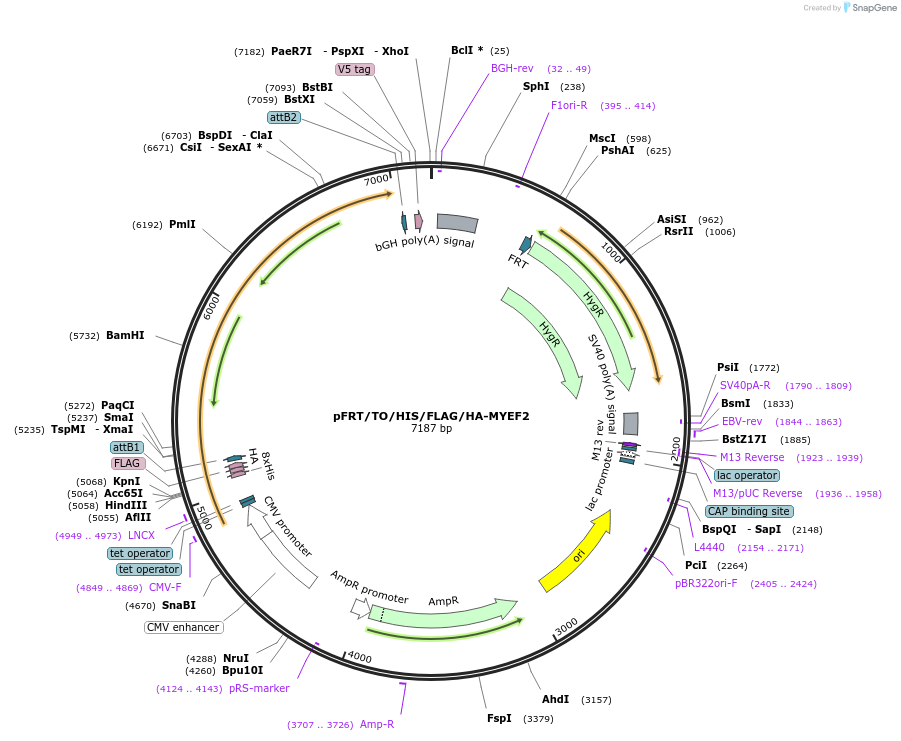
Map uploaded by the depositor.
