



pEYFPC1-ECFP/GgVcl 1-419 control 1 FRET
(Plasmid
#46277)
-
Depositing Lab
-
Depositing OrganizationJohns Hopkins University and School of Medicine
Located in the United States of America -
Publication
-
Sequence Information


Ordering
| Item | Catalog # | Description | Quantity | Price (USD) | |
|---|---|---|---|---|---|
| Plasmid | 46277 | Standard format: Plasmid sent in bacteria as agar stab | 1 | $94 | |
| DNA | 46277-D50 | 50 μg of DNA in Tris buffer | $495 | ||
| DNA | 46277-D100 | 100 μg of DNA in Tris buffer | $585 | ||
Backbone
-
Vector backbonepEYFP-C1
-
Backbone manufacturerClonetech
- Backbone size w/o insert (bp) 4700
- Total vector size (bp) 6732
-
Vector typeMammalian Expression
-
Selectable markersNeomycin (select with G418)
Growth in Bacteria
-
Bacterial Resistance(s)Kanamycin, 50 μg/mL
-
Growth Temperature37°C
-
Growth Strain(s)DH5alpha
-
Copy numberUnknown
Gene/Insert
-
Gene/Insert nameECFP + Vcl 1-419
-
Alt nameVinculin
-
Alt nameVcl
-
SpeciesG. gallus (chicken)
-
Mutationaa 1-419
-
Entrez GeneVCL (a.k.a. VINC1)
- Promoter CMV
-
Tag
/ Fusion Protein
- EYFP (N terminal on backbone)
Cloning Information
- Cloning method Restriction Enzyme
- 5′ cloning site HindIII (not destroyed)
- 3′ cloning site KpnI (not destroyed)
- 5′ sequencing primer CMV-F
- 3′ sequencing primer SV40pA-R
- (Common Sequencing Primers)
Terms and Licenses
-
Academic/Nonprofit Terms
-
Industry Terms
- Not Available to Industry
Trademarks:
- Zeocin® is an InvivoGen trademark.
Depositor Comments
To make the control FRET probe pEYFP-C1/CFPV1-400, a HindIII site was engineered before the ATG site of pET15b/CFP-V1-851 and a KpnI site after codon 400 by PCR amplification with 5 -CAAGCTTCGatggtgagcaagggc-3 and 5 -GGTACCTCAtgcaactttccttgc-3 . The PCR product was introduced into TOPO pCRII and sequenced. The HindIII–KpnI fragment of CFP-vinculin1-400 was subcloned into pEYFP-C1 to generate the control plasmid pEYFP-CFPV1-400.
Tandem EYFP-ECFP- hooked to portion of vinculin that localizes to FA; maximum FRET.
DNA (Catalog # 46277-D50)
Purpose
Ready-to-use, high-purity DNA prep. DNA aliquots are suitable for use in mammalian cell transfections and other molecular biology applications.
Delivery
- Amount 50 μg
- Concentration 1 μg/μL
- Pricing $495 USD
- Storage 4 ℃ (short-term) or -20 ℃ (long-term)
Terms and Licenses
-
Academic/Nonprofit Terms
-
Industry Terms
- Not Available to Industry
Quality Control
Every DNA prep is verified by next-generation sequencing, confirming plasmid identity, sequence integrity, and absence of DNA contaminants. Concentration is confirmed to be within ±2.5% of the stated concentration.
Our production process has been validated to consistently yield endotoxin levels below 1.0 EU/μg. Individual lots are not tested for endotoxin.
DNA (Catalog # 46277-D100)
Purpose
Ready-to-use, high-purity DNA prep. DNA aliquots are suitable for use in mammalian cell transfections and other molecular biology applications.
Delivery
- Amount 100 μg
- Concentration 1 μg/μL
- Pricing $585 USD
- Storage 4 ℃ (short-term) or -20 ℃ (long-term)
Terms and Licenses
-
Academic/Nonprofit Terms
-
Industry Terms
- Not Available to Industry
Quality Control
Every DNA prep is verified by next-generation sequencing, confirming plasmid identity, sequence integrity, and absence of DNA contaminants. Concentration is confirmed to be within ±2.5% of the stated concentration.
Our production process has been validated to consistently yield endotoxin levels below 1.0 EU/μg. Individual lots are not tested for endotoxin.
These plasmids were created by your colleagues. Please acknowledge the Principal Investigator, cite the article in which the plasmids were described, and include Addgene in the Materials and Methods of your future publications.
-
For your Materials & Methods section:
pEYFPC1-ECFP/GgVcl 1-419 control 1 FRET was a gift from Susan Craig (Addgene plasmid # 46277 ; http://n2t.net/addgene:46277 ; RRID:Addgene_46277) -
For your References section:
Spatial distribution and functional significance of activated vinculin in living cells. Chen H, Cohen DM, Choudhury DM, Kioka N, Craig SW. J Cell Biol. 2005 May 9;169(3):459-70. 10.1083/jcb.200410100 PubMed 15883197
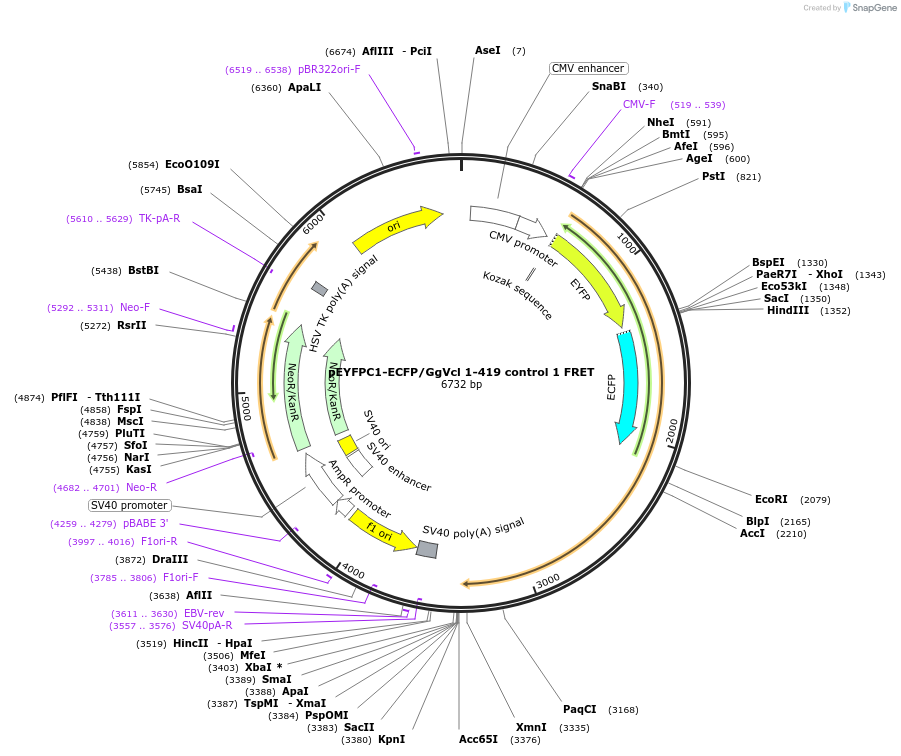
Map uploaded by the depositor.
