



-
PurposeExpression of a membrane-targeted form of eGFP
-
Depositing Lab
-
Depositing OrganizationUniversity of Iowa
Located in the United States of America -
Citations
-
Sequence Information


Ordering
| Item | Catalog # | Description | Quantity | Price (USD) | |
|---|---|---|---|---|---|
| Plasmid | 61099 | Standard format: Plasmid sent in bacteria as agar stab | 1 | $94 | |
| DNA | 61099-D50 | 50 μg of DNA in Tris buffer | $495 | ||
| DNA | 61099-D100 | 100 μg of DNA in Tris buffer | $585 | ||
Backbone
-
Vector backboneEGFP-C1
-
Backbone manufacturerClontech
- Backbone size w/o insert (bp) 4731
-
Modifications to backboneThis modified GFP is myristoylated and targeted to the plasma membrane (rafts). It was constructed from a parent Lck-GFPN1 construct. The parent Lck sequence was removed and replaced with a new Lck sequence containing two glycine residues at the C-term of Lck, as opposed to an isoleucine and a valine. The new Lck sequenced was prepared by PCR with BglII at the 5’ end and EcoRI at the 3’ end. The parent Lck was digested with BglII and EcoRI, removing the old Lck sequence, and insertng the new Lck using the same restriction sites.
-
Vector typeMammalian Expression
-
Selectable markersNeomycin (select with G418)
Growth in Bacteria
-
Bacterial Resistance(s)Kanamycin, 50 μg/mL
-
Growth Temperature37°C
-
Growth Strain(s)DH10B
-
Copy numberHigh Copy
Gene/Insert
-
Gene/Insert nameLck-GFP
- Promoter CMV
-
Tag
/ Fusion Protein
- EGFP (N terminal on backbone)
Cloning Information
- Cloning method Restriction Enzyme
- 5′ cloning site BglI (unknown if destroyed)
- 3′ cloning site EcoRI (unknown if destroyed)
- 5′ sequencing primer EGFP-C
- 3′ sequencing primer SV40 poly A Reverse
- (Common Sequencing Primers)
Resource Information
-
A portion of this plasmid was derived from a plasmid made bySee publication for cloning details.
Terms and Licenses
-
Academic/Nonprofit Terms
-
Industry Terms
- Not Available to Industry
Trademarks:
- Zeocin® is an InvivoGen trademark.
DNA (Catalog # 61099-D50)
Purpose
Ready-to-use, high-purity DNA prep. DNA aliquots are suitable for use in mammalian cell transfections and other molecular biology applications.
Delivery
- Amount 50 μg
- Concentration 1 μg/μL
- Pricing $495 USD
- Storage 4 ℃ (short-term) or -20 ℃ (long-term)
Terms and Licenses
-
Academic/Nonprofit Terms
-
Industry Terms
- Not Available to Industry
Quality Control
Every DNA prep is verified by next-generation sequencing, confirming plasmid identity, sequence integrity, and absence of DNA contaminants. Concentration is confirmed to be within ±2.5% of the stated concentration.
Our production process has been validated to consistently yield endotoxin levels below 1.0 EU/μg. Individual lots are not tested for endotoxin.
DNA (Catalog # 61099-D100)
Purpose
Ready-to-use, high-purity DNA prep. DNA aliquots are suitable for use in mammalian cell transfections and other molecular biology applications.
Delivery
- Amount 100 μg
- Concentration 1 μg/μL
- Pricing $585 USD
- Storage 4 ℃ (short-term) or -20 ℃ (long-term)
Terms and Licenses
-
Academic/Nonprofit Terms
-
Industry Terms
- Not Available to Industry
Quality Control
Every DNA prep is verified by next-generation sequencing, confirming plasmid identity, sequence integrity, and absence of DNA contaminants. Concentration is confirmed to be within ±2.5% of the stated concentration.
Our production process has been validated to consistently yield endotoxin levels below 1.0 EU/μg. Individual lots are not tested for endotoxin.
These plasmids were created by your colleagues. Please acknowledge the Principal Investigator, cite the article in which the plasmids were described, and include Addgene in the Materials and Methods of your future publications.
-
For your Materials & Methods section:
Lck-GFP was a gift from Steven Green (Addgene plasmid # 61099 ; http://n2t.net/addgene:61099 ; RRID:Addgene_61099) -
For your References section:
Ballistic labeling and dynamic imaging of astrocytes in organotypic hippocampal slice cultures. Benediktsson AM, Schachtele SJ, Green SH, Dailey ME. J Neurosci Methods. 2005 Jan 30;141(1):41-53. 10.1016/j.jneumeth.2004.05.013 PubMed 15585287
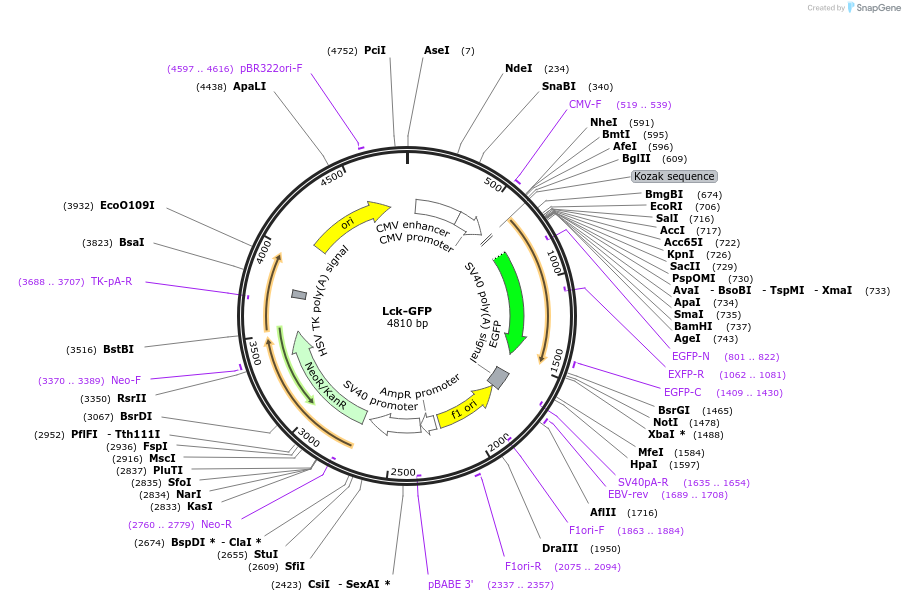
Map uploaded by the depositor.
