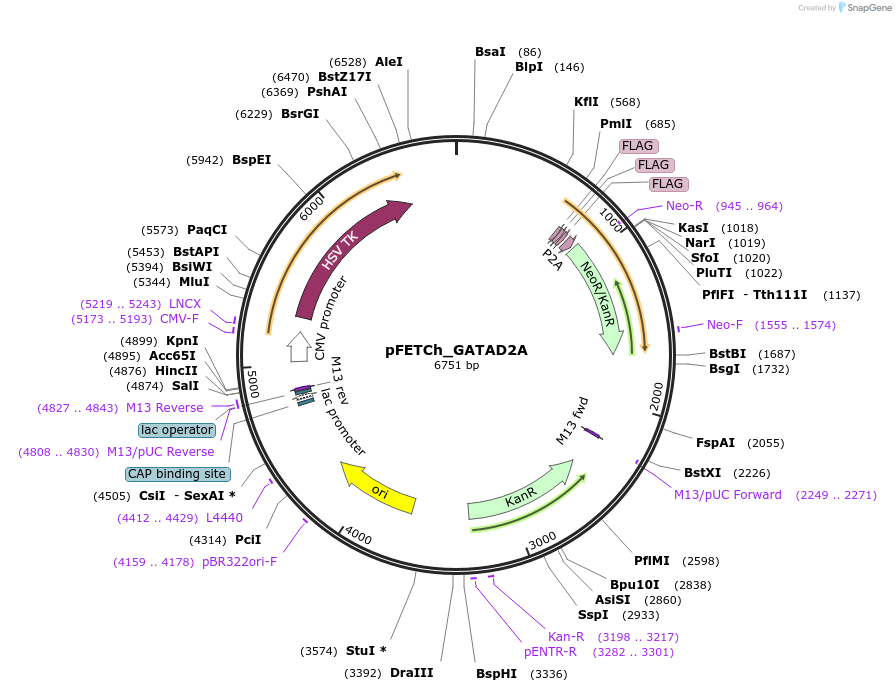
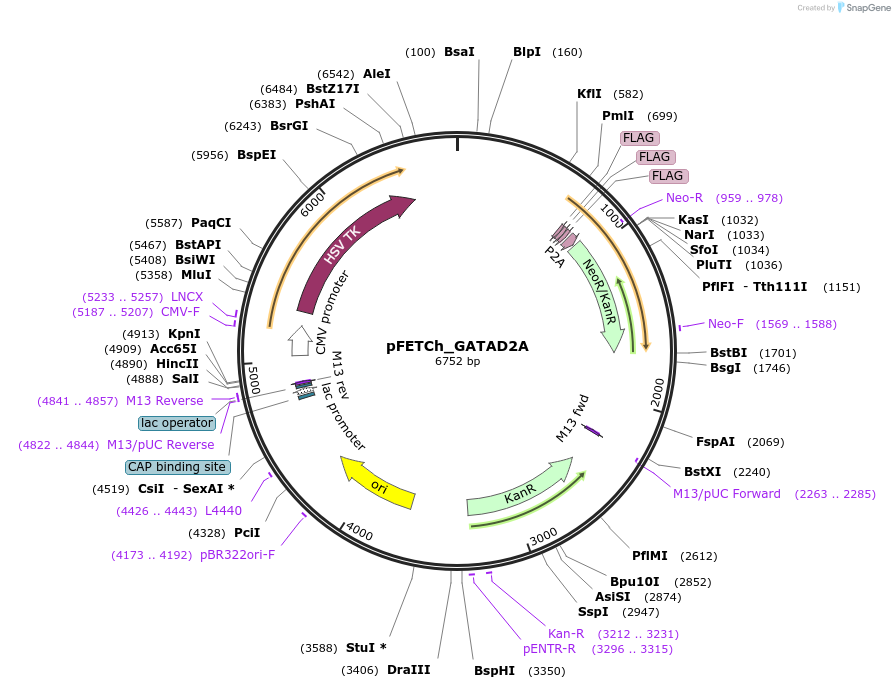
pFETCh_GATAD2A
(Plasmid
#86279)
-
PurposeDonor vector for 3' FLAG tag of human GATAD2A
-
Depositing Labs
-
Depositing OrganizationUniversity of Alabama in Huntsville
Located in the United States of America -
Publication
-
Sequence Information
Ordering
| Item | Catalog # | Description | Quantity | Price (USD) | |
|---|---|---|---|---|---|
| Plasmid | 86279 | Standard format: Plasmid sent in bacteria as agar stab | 1 | $94 | |
| DNA | 86279-D50 | 50 μg of DNA in Tris buffer | $495 | ||
| DNA | 86279-D100 | 100 μg of DNA in Tris buffer | $585 | ||
Backbone
-
Vector backbonepFETCh_Donor
-
Vector typeCRISPR
Growth in Bacteria
-
Bacterial Resistance(s)Kanamycin, 50 μg/mL
-
Growth Temperature37°C
-
Growth Strain(s)DH5alpha
-
Copy numberHigh Copy
Gene/Insert
-
Gene/Insert nameGATAD2A homology arms
-
SpeciesH. sapiens (human)
-
Entrez GeneGATAD2A (a.k.a. p66alpha)
-
Tag
/ Fusion Protein
- 3XFLAG-P2A-NeoR (C terminal on insert)
Cloning Information
- Cloning method Gibson Cloning
- 5′ sequencing primer acgcctgtgaaaccgtacta
- 3′ sequencing primer aactgttgggaagggcgatc
- (Common Sequencing Primers)
Terms and Licenses
-
Academic/Nonprofit Terms
-
Industry Terms
- Not Available to Industry
Trademarks:
- Zeocin® is an InvivoGen trademark.
Depositor Comments
This plasmid was co-transfected along with PX458_GATAD2A_1 and PX458_GATAD2A_2 into HepG2 cells, and genomic editing was verified by PCR. We performed ChIP-seq on this cell line using anti-FLAG Sigma F1804 and obtained data that passed our quality tests. Immunoprecipitation with anti-FLAG Sigma F1804 followed by mass spectrometry identified GATAD2A. All released data, including ChIP-seq files and validation data, are available at the ENCODE web portal: https://www.encodeproject.org/search/?searchTerm=flag&type=Experiment&lab.title=Richard+Myers%2C+HAIB . Note: This plasmid is part of the Mendenhall and Meyers CRISPR-based Tagging system to add a tag (currently using FLAG) to endogenous proteins. Please see https://www.addgene.org/crispr/tagging/ for more details.
DNA (Catalog # 86279-D50)
Purpose
Ready-to-use, high-purity DNA prep. DNA aliquots are suitable for use in mammalian cell transfections and other molecular biology applications.
Delivery
- Amount 50 μg
- Concentration 1 μg/μL
- Pricing $495 USD
- Storage 4 ℃ (short-term) or -20 ℃ (long-term)
Terms and Licenses
-
Academic/Nonprofit Terms
-
Industry Terms
- Not Available to Industry
Quality Control
Every DNA prep is verified by next-generation sequencing, confirming plasmid identity, sequence integrity, and absence of DNA contaminants. Concentration is confirmed to be within ±2.5% of the stated concentration.
Our production process has been validated to consistently yield endotoxin levels below 1.0 EU/μg. Individual lots are not tested for endotoxin.
DNA (Catalog # 86279-D100)
Purpose
Ready-to-use, high-purity DNA prep. DNA aliquots are suitable for use in mammalian cell transfections and other molecular biology applications.
Delivery
- Amount 100 μg
- Concentration 1 μg/μL
- Pricing $585 USD
- Storage 4 ℃ (short-term) or -20 ℃ (long-term)
Terms and Licenses
-
Academic/Nonprofit Terms
-
Industry Terms
- Not Available to Industry
Quality Control
Every DNA prep is verified by next-generation sequencing, confirming plasmid identity, sequence integrity, and absence of DNA contaminants. Concentration is confirmed to be within ±2.5% of the stated concentration.
Our production process has been validated to consistently yield endotoxin levels below 1.0 EU/μg. Individual lots are not tested for endotoxin.
These plasmids were created by your colleagues. Please acknowledge the Principal Investigator, cite the article in which the plasmids were described, and include Addgene in the Materials and Methods of your future publications.
-
For your Materials & Methods section:
pFETCh_GATAD2A was a gift from Eric Mendenhall & Richard M. Myers (Addgene plasmid # 86279 ; http://n2t.net/addgene:86279 ; RRID:Addgene_86279) -
For your References section:
CETCh-seq: CRISPR epitope tagging ChIP-seq of DNA-binding proteins. Savic D, Partridge EC, Newberry KM, Smith SB, Meadows SK, Roberts BS, Mackiewicz M, Mendenhall EM, Myers RM. Genome Res. 2015 Sep 9. 10.1101/gr.193540.115 PubMed 26355004