


Plant MoClo Tags, Promoters, Terminators, and Acceptors
(Kit #
1000000277, #1000000278
)
Depositing Lab: Mark Youles
Kit #1000000277: The MoClo N-Terminal and C-Terminal Tag Kit collection contains a selection of common N-terminal and C-terminal tag modules which are consistent with the Modular Cloning (MoClo) overhang syntax. These modules have been predominantly (but not exclusively) generated for plant-based research.
Kit #1000000278: The MoClo Plant Promoter, Plant Terminator and Chromoprotein/Low Copy (LC) Acceptor Kit collection contains a selection of common plant promoters and terminators. It also contains a selection of Level 0 and Level 1 MoClo acceptor vectors carrying chromoprotein negative selection cassettes. Lastly the kit contains a set of low copy Level 1 MoClo acceptors and two new Level 1 position 7B acceptors which negate the use of MoClo Level 2 position 7 end-linkers.
These kits will be sent as bacterial glycerol stocks in 96-well plate format.
Ordering
| Item | Catalog # | Description | Quantity | Price (USD) | ||
|---|---|---|---|---|---|---|
| Kit | 1000000277 | MoClo N-Terminal and C-Terminal Tag Kit | 1 | $484 | Add to Cart | |
| Kit | 1000000278 | MoClo Plant Promoter, Plant Terminator and Chromoprotein/LC Acceptor Kit | 1 | $484 | Add to Cart | |
Description
Kit #1000000277: The MoClo N-Terminal and C-Terminal Tag Kit collection contains 96 Golden Gate Level 0 modules which are compatible with the Modular Cloning (MoClo) overhang syntax. 47 modules encode frequently used N-terminal tags (CCAT–AATG), and 49 modules encode frequently used C-terminal tags (TTCG–GCTT). The majority of these modules are predominantly associated, but not restricted to the functions of protein fluorescence, affinity/antigenic purification, proximity/localisation targeting and/or solubility. These modules have predominantly been generated, but do not restrict their use, within plant-based research. All the modules have been domesticated to remove any native BsaI or BpiI enzyme recognition sequences. Two remaining, vector backbone BsaI recognition sequences flank each of the tag inserts and are used to release the tag modules to create higher order (Level 1) constructs, via the Golden Gate cloning method.
Kit #1000000278: The MoClo Plant Promoter, Plant Terminator and Chromoprotein/LC Acceptor Kit collection contains 96 Golden Gate plasmids. 40 plasmids encode common plant promoter parts (28x GGAG–AATG and 12x GGAG-CCAT), 22 plasmids encode common plant terminator parts (13x GCTT–CGCT, 4x TerP1 GCTT–TAGA and 5x TerP2 TAGA–CGCT). The kit also contains 11 common Level 0 acceptor vectors, all of which contain a vibrant purple (AmilCP) coral derived chromoprotein negative selection cassette and 23 Level 1 acceptor vectors, 14 of which contain a vibrant red (AmilRFP) coral derived chromoprotein negative selection cassette. The benefit of these coral derived chromoproteins is that it negates the unnecessary requirement of adding X-Gal/IPTG to your selection media for the identification of positive clones. The 14 (AmilRFP) Level 1 vectors consist of standard MoClo Level 1 acceptors positions (1–7) in both the forward and reverse orientations. In addition, the kit also contains an additional set of the MoClo Level 1 forward acceptors positions (1–7), but this additional set of acceptor vectors all carry a low-copy origin (ori) of replication. The final two Level 1 acceptor vectors (Level 1 position 7B), negate the use of any additional end-linkers in Level 2 reactions as the left-hand position 7 overhang (GAGC) links directly to the terminal right-hand Level 2 GGGA overhang. The low copy set of MoClo Level 1 acceptors and the two (forward and reverse) position 7B MoClo Level 1 acceptors all contain a standard LacZ negative selection cassette.
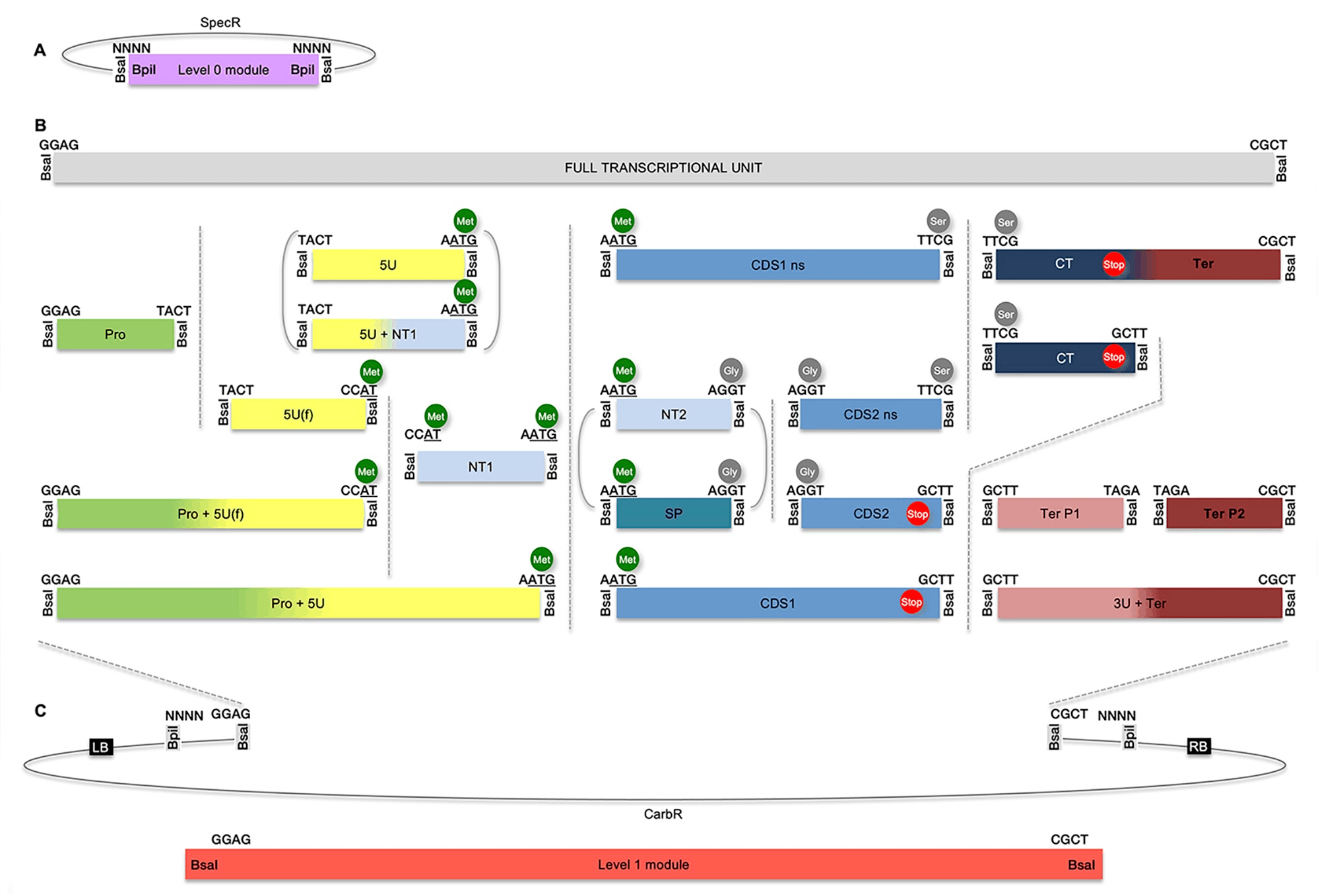
Figure 1: The construct locations with colour coding highlighting how the parts fit into broader MoClo construct syntax. A) Level 0 modules are cloned into a vector backbone carrying a spectinomycin resistance gene and are flanked by two oppositely oriented BsaI sites (5′: ggtctcannnn; 3′: nnnntgagacc). B) Parts of the same type share identical pairs of fusion sites (top strand sequences shown only). C) Modules can be combinatorially assembled into a Level 1 acceptor backbone to generate transcriptional units. All Level 1 and higher acceptor backbones include left and right borders (LB and RB) for T-strand transfer into plant cells and an origin of replication for Agrobacterium tumefaciens. Pro, promoter; 5U, 5′ untranslated region; 5U(f), 5′ untranslated region for N-terminal fusions; NT, N-terminal tag or localization signal; SP, signal peptide; CDS, coding sequence; CT, C-terminal tag or localization signal; 3U, 3′ untranslated region; Ter, terminator; ns, no stop codon. Adapted from Engler et al. (2014).
Kit Documentation
- Protocols (DOCX, 18 KB)
- 1000000277: Plate Layout Figure (JPG, 347 KB), Plate Layout Spreadsheet (CSV, 4 KB)
- 1000000278: Plate Layout Figure (JPG, 413 KB), Plate Layout Spreadsheet (CSV, 4 KB)
Additional References
A Golden Gate Modular Cloning Toolbox for Plants. Engler C, Youles M, Gruetzner R, Ehnert T-M, Werner S, Jones JDG, Patron NJ, and Marillonnet S. ACS Synth Biol. 2014 Nov 21;3(11):839-43. doi: 10.1021/sb4001504. PubMed (Link opens in a new window) Article (Link opens in a new window)
Standards for plant synthetic biology: a common syntax for exchange of DNA parts. Patron NJ, Orzaez D, Marillonnet S, Warzecha H, Matthewman C, Youles M, Raitskin O, Leveau A, Farre G, Rogers C, Smith A, Hibberd J, Webb AA, Locke J, Schornack S, Ajioka J, Baulcombe DC, Zipfel C, Kamoun S, Jones JD, Kuhn H, Robatzek S, Van Esse HP, Sanders D, Oldroyd G, Martin C, Field R, O'Connor S, Fox S, Wulff B, Miller B, Breakspear A, Radhakrishnan G, Delaux PM, Loque D, Granell A, Tissier A, Shih P, Brutnell TP, Quick WP, Rischer H, Fraser PD, Aharoni A, Raines C, South PF, Ane JM, Hamberger BR, Langdale J, Stougaard J, Bouwmeester H, Udvardi M, Murray JA, Ntoukakis V, Schafer P, Denby K, Edwards KJ, Osbourn A, Haseloff J. New Phytol. 2015 Jul 14. doi: 10.1111/nph.13532. PubMed (Link opens in a new window) Article (Link opens in a new window)
How to Cite this Kit
These plasmids were created by your colleagues. Please acknowledge the Principal Investigator, cite the article in which they were created, and include Addgene in the Materials and Methods of your future publications.
For your Materials and Methods section:
"The MoClo N-Terminal and C-Terminal Tag Kit was a gift from Mark Youles (Addgene kit #1000000277)."
"The MoClo Plant Promoter, Plant Terminator and Chromoprotein/Low Copy (LC) Acceptor Kit was a gift from Mark Youles (Addgene kit #1000000278)."
MoClo N-Terminal and C-Terminal Tag Kit - #1000000277
- Resistance Color Key
Each circle corresponds to a specific antibiotic resistance in the kit plate map wells.
- Inventory
Searchable and sortable table of all plasmids in kit. The Well column lists the plasmid well location in its plate. The Plasmid column links to a plasmid's individual web page.
- Kit Plate Map
96-well plate map for plasmid layout. Hovering over a well reveals the plasmid name, while clicking on a well opens the plasmid page.
Resistance Color Key
| Spectinomycin | |
| Chloramphenicol |
Inventory
| Well | Plasmid | Resistance |
|---|---|---|
| A / 1 | pICSL30001 |
|
| A / 2 | pICSL30002 |
|
| A / 3 | pICSL30007 |
|
| A / 4 | pICSL30012 |
|
| A / 5 | pICSL30013 |
|
| A / 6 | pICSL30014 |
|
| A / 7 | pICSL30016A |
|
| A / 8 | pICSL30020 |
|
| A / 9 | pICSL30021 |
|
| A / 10 | pICSL30023 |
|
| A / 11 | pICSL30024 |
|
| A / 12 | pICSL30026 |
|
| B / 1 | pICSL30031 |
|
| B / 2 | pICSL30032 |
|
| B / 3 | pICSL30033 |
|
| B / 4 | pICSL30034 |
|
| B / 5 | pICSL30040 |
|
| B / 6 | pICSL30041 |
|
| B / 7 | pICSL30042 |
|
| B / 8 | pICSL30043 |
|
| B / 9 | pICSL30044 |
|
| B / 10 | pICSL30047 |
|
| B / 11 | pICSL30048 |
|
| B / 12 | pICSL30049 |
|
| C / 1 | pICSL30050 |
|
| C / 2 | pICSL30051 |
|
| C / 3 | pICSL30052 |
|
| C / 4 | pICSL30053 |
|
| C / 5 | pICSL30054 |
|
| C / 6 | pICSL30055 |
|
| C / 7 | pICSL30056 |
|
| C / 8 | pICSL30057 |
|
| C / 9 | pICSL30058 |
|
| C / 10 | pICSL30059 |
|
| C / 11 | pICSL30060 |
|
| C / 12 | pICSL30061 |
|
| D / 1 | pICSL30062 |
|
| D / 2 | pICSL30063 |
|
| D / 3 | pICSL30064 |
|
| D / 4 | pICSL30065 |
|
| D / 5 | pICSL30066 |
|
| D / 6 | pICSL30068 |
|
| D / 7 | pICSL30069 |
|
| D / 8 | pICSL30070 |
|
| D / 9 | pICSL30071 |
|
| D / 10 | pICSL30072 |
|
| D / 11 | pICSL30073 |
|
| D / 12 | pICSL50002 |
|
| E / 1 | pICSL50003 |
|
| E / 2 | pICSL50005 |
|
| E / 3 | pICSL50017 |
|
| E / 4 | pICSL50018 |
|
| E / 5 | pICSL50019 |
|
| E / 6 | pICSL50020 |
|
| E / 7 | pICSL50021 |
|
| E / 8 | pICSL50022 |
|
| E / 9 | pICSL50023 |
|
| E / 10 | pICSL50028 |
|
| E / 11 | pICSL50029 |
|
| E / 12 | pICSL50030 |
|
| F / 1 | pICSL50031 |
|
| F / 2 | pICSL50032 |
|
| F / 3 | pICSL50033 |
|
| F / 4 | pICSL50034 |
|
| F / 5 | pICSL50035 |
|
| F / 6 | pICSL50036 |
|
| F / 7 | pICSL50037 |
|
| F / 8 | pICSL50038 |
|
| F / 9 | pICSL50039 |
|
| F / 10 | pICSL50040 |
|
| F / 11 | pICSL50041 |
|
| F / 12 | pICSL50042 |
|
| G / 1 | pICSL50043 |
|
| G / 2 | pICSL50044 |
|
| G / 3 | pICSL50047 |
|
| G / 4 | pICSL50048 |
|
| G / 5 | pICSL50049 |
|
| G / 6 | pICSL50050 |
|
| G / 7 | pICSL50051 |
|
| G / 8 | pICSL50052 |
|
| G / 9 | pICSL50053 |
|
| G / 10 | pICSL50055 |
|
| G / 11 | pICSL50056 |
|
| G / 12 | pICSL50057 |
|
| H / 1 | pICSL50058 |
|
| H / 2 | pICSL50059 |
|
| H / 3 | pICSL50060 |
|
| H / 4 | pICSL50061 |
|
| H / 5 | pICSL50062 |
|
| H / 6 | pICSL50063 |
|
| H / 7 | pICSL50064 |
|
| H / 8 | pICSL50065 |
|
| H / 9 | pICSL50066 |
|
| H / 10 | pICSL50067 |
|
| H / 11 | pICSL50068 |
|
| H / 12 | pICSL50069 |
|
Kit Plate Map - #1000000277
MoClo Plant Promoter, Plant Terminator and Chromoprotein/Low Copy (LC) Acceptor Kit - #1000000278
- Resistance Color Key
Each circle corresponds to a specific antibiotic resistance in the kit plate map wells.
- Inventory
Searchable and sortable table of all plasmids in kit. The Well column lists the plasmid well location in its plate. The Plasmid column links to a plasmid's individual web page.
- Kit Plate Map
96-well plate map for plasmid layout. Hovering over a well reveals the plasmid name, while clicking on a well opens the plasmid page.
Resistance Color Key
| Spectinomycin | |
| Ampicillin |
Inventory
| Well | Plasmid | Resistance |
|---|---|---|
| A / 1 | pICSL12001 |
|
| A / 2 | pICSL12002 |
|
| A / 3 | pICSL12005 |
|
| A / 4 | pICSL12007 |
|
| A / 5 | pICSL12009A |
|
| A / 6 | pICSL12013 |
|
| A / 7 | pICSL12014 |
|
| A / 8 | pICSL12015 |
|
| A / 9 | pICSL12026 |
|
| A / 10 | pICSL12027 |
|
| A / 11 | pICSL12028 |
|
| A / 12 | pICSL12029 |
|
| B / 1 | pICSL12030 |
|
| B / 2 | pICSL12033 |
|
| B / 3 | pICSL12034 |
|
| B / 4 | pICSL12038 |
|
| B / 5 | pICSL12039 |
|
| B / 6 | pICSL12040 |
|
| B / 7 | pICSL12046 |
|
| B / 8 | pICSL12047 |
|
| B / 9 | pICSL12048 |
|
| B / 10 | pICSL12049 |
|
| B / 11 | pICSL12050 |
|
| B / 12 | pICSL12055 |
|
| C / 1 | pICSL12063 |
|
| C / 2 | pICSL12080 |
|
| C / 3 | pICSL12081 |
|
| C / 4 | pICSL12082 |
|
| C / 5 | pICSL13003 |
|
| C / 6 | pICSL13004 |
|
| C / 7 | pICSL13005 |
|
| C / 8 | pICSL13008 |
|
| C / 9 | pICSL13009 |
|
| C / 10 | pICSL13010 |
|
| C / 11 | pICSL13015 |
|
| C / 12 | pICSL13016A |
|
| D / 1 | pICSL13017 |
|
| D / 2 | pICSL13018 |
|
| D / 3 | pICSL13019 |
|
| D / 4 | pICSL13020 |
|
| D / 5 | pICSL60002 |
|
| D / 6 | pICSL60005 |
|
| D / 7 | pICSL60006 |
|
| D / 8 | pICSL60007 |
|
| D / 9 | pICSL60008 |
|
| D / 10 | pICSL60013 |
|
| D / 11 | pICSL60020 |
|
| D / 12 | pICSL60024 |
|
| E / 1 | pICSL60025 |
|
| E / 2 | pICSL60026 |
|
| E / 3 | pICSL60027 |
|
| E / 4 | pICSL60028 |
|
| E / 5 | pICSL60038 |
|
| E / 6 | pICSL61001 |
|
| E / 7 | pICSL61002 |
|
| E / 8 | pICSL61003 |
|
| E / 9 | pICSL61004 |
|
| E / 10 | pICSL62001 |
|
| E / 11 | pICSL62002 |
|
| E / 12 | pICSL62003 |
|
| F / 1 | pICSL62004 |
|
| F / 2 | pICSL62005 |
|
| F / 3 | pICSL01002_CP |
|
| F / 4 | pICSL01003_CP |
|
| F / 5 | pICSL01005_CP |
|
| F / 6 | pICSL01008_CP |
|
| F / 7 | pICSL41258_CP |
|
| F / 8 | pICSL41264_CP |
|
| F / 9 | pICSL41276_CP |
|
| F / 10 | pICSL41295_CP |
|
| F / 11 | pICSL41308_CP |
|
| F / 12 | pICSL41308-LC |
|
| G / 1 | pICSL01005-LC |
|
| G / 2 | pICSL47732_RFP |
|
| G / 3 | pICSL47742_RFP |
|
| G / 4 | pICSL47751_RFP |
|
| G / 5 | pICSL47761_RFP |
|
| G / 6 | pICSL47772_RFP |
|
| G / 7 | pICSL47781_RFP |
|
| G / 8 | pICSL47791_RFP |
|
| G / 9 | pICSL47802_RFP |
|
| G / 10 | pICSL47811_RFP |
|
| G / 11 | pICSL47822_RFP |
|
| G / 12 | pICSL47831_RFP |
|
| H / 1 | pICSL47841_RFP |
|
| H / 2 | pICSL47852_RFP |
|
| H / 3 | pICSL47861_RFP |
|
| H / 4 | pICSL47732-LC |
|
| H / 5 | pICSL47742-LC |
|
| H / 6 | pICSL47751-LC |
|
| H / 7 | pICSL47761-LC |
|
| H / 8 | pICSL47772-LC |
|
| H / 9 | pICSL47781-LC |
|
| H / 10 | pICSL47791-LC |
|
| H / 11 | pICSL47799 |
|
| H / 12 | pICSL47869 |
|