



pKF-P14MM2AG5h
(Plasmid
#128254)
-
PurposeMammalian positive feedback synthetic gene circuit within a Flp-In expression vector.
-
Depositing Lab
-
Depositing OrganizationStony Brook University
Located in the United States of America -
Citations
-
Sequence Information


Ordering
| Item | Catalog # | Description | Quantity | Price (USD) | |
|---|---|---|---|---|---|
| Plasmid | 128254 | Standard format: Plasmid sent in bacteria as agar stab | 1 | $94 | |
| DNA | 128254-D50 | 50 μg of DNA in Tris buffer | $495 | ||
| DNA | 128254-D100 | 100 μg of DNA in Tris buffer | $585 | ||
Backbone
-
Vector backbonepcDNA5/FRT
-
Backbone manufacturerInvitrogen
- Backbone size w/o insert (bp) 5070
- Total vector size (bp) 6246
-
Vector typeMammalian Expression, Synthetic Biology ; Flp-In expression vector
-
Selectable markersHygromycin
Growth in Bacteria
-
Bacterial Resistance(s)Ampicillin, 100 μg/mL
-
Growth Temperature37°C
-
Growth Strain(s)DH5alpha
-
Copy numberHigh Copy
Gene/Insert
-
Gene/Insert namertTA-Advanced::P2A::EGFP
-
Alt namereverse tetracycline Transactivator
-
Alt nameEGFP
-
SpeciesSynthetic
-
Insert Size (bp)1877
- Promoter tight TRE promoter
Cloning Information
- Cloning method Restriction Enzyme
- 5′ cloning site MluI (not destroyed)
- 3′ cloning site BamHI (not destroyed)
- 5′ sequencing primer ATATACGCGTCGAGGCCCTTTC
- 3′ sequencing primer GATCCTTACTTGTACAGCTCGTCCATGC
- (Common Sequencing Primers)
Resource Information
Terms and Licenses
-
Academic/Nonprofit Terms
-
Industry Terms
- Not Available to Industry
Trademarks:
- Zeocin® is an InvivoGen trademark.
Depositor Comments
The plasmid encodes a mammalian synthetic gene circuit that contains the regulator reverse tetracycline Trans Activator (rtTA) and the reporter EGFP, which is controlled by a tight TRE promoter that rtTA binds to activate its own expression in a positive feedback loop. The backbone consists of the Flp-In expression vector (pcDNA5/FRT). The synthetic gene circuit is also called mPF-GFP.
DNA (Catalog # 128254-D50)
Purpose
Ready-to-use, high-purity DNA prep. DNA aliquots are suitable for use in mammalian cell transfections and other molecular biology applications.
Delivery
- Amount 50 μg
- Concentration 1 μg/μL
- Pricing $495 USD
- Storage 4 ℃ (short-term) or -20 ℃ (long-term)
Terms and Licenses
-
Academic/Nonprofit Terms
-
Industry Terms
- Not Available to Industry
Quality Control
Every DNA prep is verified by next-generation sequencing, confirming plasmid identity, sequence integrity, and absence of DNA contaminants. Concentration is confirmed to be within ±2.5% of the stated concentration.
Our production process has been validated to consistently yield endotoxin levels below 1.0 EU/μg. Individual lots are not tested for endotoxin.
DNA (Catalog # 128254-D100)
Purpose
Ready-to-use, high-purity DNA prep. DNA aliquots are suitable for use in mammalian cell transfections and other molecular biology applications.
Delivery
- Amount 100 μg
- Concentration 1 μg/μL
- Pricing $585 USD
- Storage 4 ℃ (short-term) or -20 ℃ (long-term)
Terms and Licenses
-
Academic/Nonprofit Terms
-
Industry Terms
- Not Available to Industry
Quality Control
Every DNA prep is verified by next-generation sequencing, confirming plasmid identity, sequence integrity, and absence of DNA contaminants. Concentration is confirmed to be within ±2.5% of the stated concentration.
Our production process has been validated to consistently yield endotoxin levels below 1.0 EU/μg. Individual lots are not tested for endotoxin.
These plasmids were created by your colleagues. Please acknowledge the Principal Investigator, cite the article in which the plasmids were described, and include Addgene in the Materials and Methods of your future publications.
-
For your Materials & Methods section:
pKF-P14MM2AG5h was a gift from Gabor Balazsi (Addgene plasmid # 128254 ; http://n2t.net/addgene:128254 ; RRID:Addgene_128254) -
For your References section:
Role of network-mediated stochasticity in mammalian drug resistance. Farquhar KS, Charlebois DA, Szenk M, Cohen J, Nevozhay D, Balazsi G. Nat Commun. 2019 Jun 24;10(1):2766. doi: 10.1038/s41467-019-10330-w. 10.1038/s41467-019-10330-w PubMed 31235692
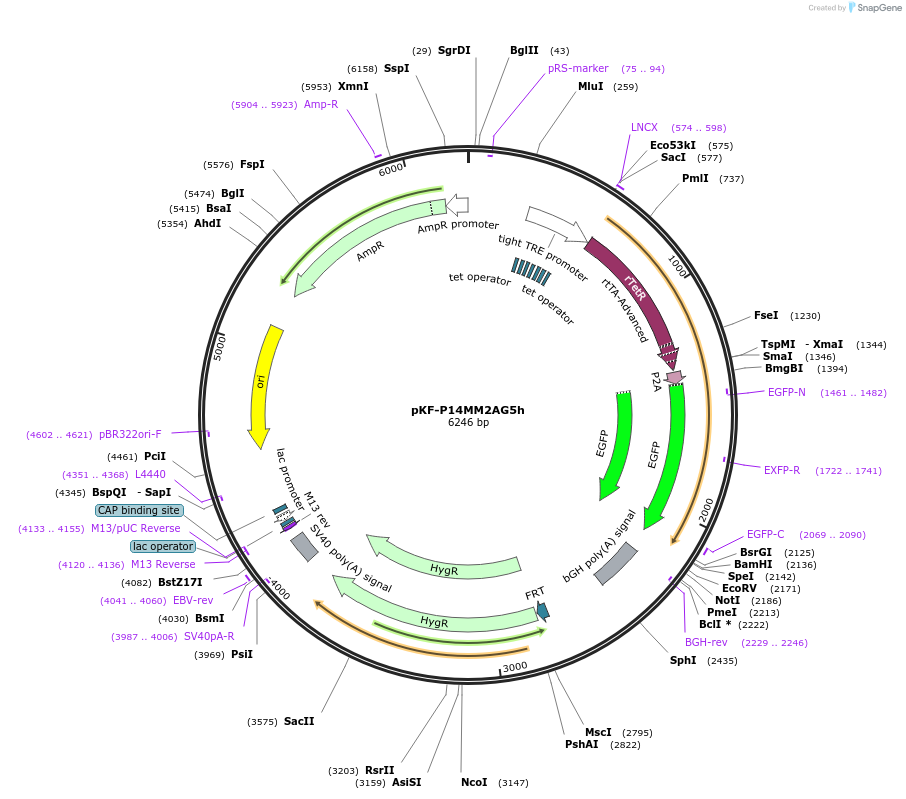
Map uploaded by the depositor.
