



pSpdCas9-huTET1CD-T2A-GFP (PX458)
(Plasmid
#129025)
-
Purposetargeted DNA demethylation, expression of dCas9-huTET1CD-T2A-EGFP and cloning backbone for sgRNA
-
Depositing Lab
-
Depositing OrganizationCharite Universitaetsmedizin Berlin
Located in Germany -
Citations
-
Sequence Information


Ordering
| Item | Catalog # | Description | Quantity | Price (USD) | |
|---|---|---|---|---|---|
| Plasmid | 129025 | Standard format: Plasmid sent in bacteria as agar stab | 1 | $94 | |
| DNA | 129025-D50 | 50 μg of DNA in Tris buffer | $495 | ||
| DNA | 129025-D100 | 100 μg of DNA in Tris buffer | $585 | ||
Backbone
-
Vector backbonePX458
-
Backbone manufacturerFeng Zhang (Addgene plasmid # 48138)
-
Vector typeMammalian Expression
Growth in Bacteria
-
Bacterial Resistance(s)Ampicillin, 100 μg/mL
-
Growth Temperature37°C
-
Growth Strain(s)DH5alpha
-
Copy numberUnknown
Gene/Insert
-
Gene/Insert namedCas9-huTET1CD, SgRNA cloning site
-
Alt namedCas9-huTET1CD-T2A-EGFP
-
SpeciesSynthetic
-
MutationdCas9 (D10A;H840A)
- Promoter CbH (for dCas9-huTET1CD-T2A-EGFP) U6 (for sgRNA)
-
Tags
/ Fusion Proteins
- HA-Tag, NLS (N terminal on insert)
- T2A-EGFP (C terminal on backbone)
Cloning Information
- Cloning method Restriction Enzyme
- 5′ cloning site Unknown (unknown if destroyed)
- 3′ cloning site Unknown (unknown if destroyed)
- 5′ sequencing primer SgRNA-cloning-site: hU6-F (GAGGGCCTATTTCCCATGATT)
- (Common Sequencing Primers)
Resource Information
-
A portion of this plasmid was derived from a plasmid made byHA tag-NLS-dCas9 from Rudolf Jaenisch (Addgene plasmid # 48223); huTET1CD from Keith Joung (Addgene plasmid # 49236)
Terms and Licenses
-
Academic/Nonprofit Terms
-
Industry Terms
- Not Available to Industry
Trademarks:
- Zeocin® is an InvivoGen trademark.
Depositor Comments
For SgRNA cloning: Caution! BbsI cannot be used for SgRNA cloning in this plasmid, there are BbsI sites in TET1CD. Instead the guide sequence can be cloned into Addgene#48138 and in a second step transferred into this plasmid (for example using PvuI & XbaI).
This Plasmid was generated by Christopher Kressler.
DNA (Catalog # 129025-D50)
Purpose
Ready-to-use, high-purity DNA prep. DNA aliquots are suitable for use in mammalian cell transfections and other molecular biology applications.
Delivery
- Amount 50 μg
- Concentration 1 μg/μL
- Pricing $495 USD
- Storage 4 ℃ (short-term) or -20 ℃ (long-term)
Terms and Licenses
-
Academic/Nonprofit Terms
-
Industry Terms
- Not Available to Industry
Quality Control
Every DNA prep is verified by next-generation sequencing, confirming plasmid identity, sequence integrity, and absence of DNA contaminants. Concentration is confirmed to be within ±2.5% of the stated concentration.
Our production process has been validated to consistently yield endotoxin levels below 1.0 EU/μg. Individual lots are not tested for endotoxin.
DNA (Catalog # 129025-D100)
Purpose
Ready-to-use, high-purity DNA prep. DNA aliquots are suitable for use in mammalian cell transfections and other molecular biology applications.
Delivery
- Amount 100 μg
- Concentration 1 μg/μL
- Pricing $585 USD
- Storage 4 ℃ (short-term) or -20 ℃ (long-term)
Terms and Licenses
-
Academic/Nonprofit Terms
-
Industry Terms
- Not Available to Industry
Quality Control
Every DNA prep is verified by next-generation sequencing, confirming plasmid identity, sequence integrity, and absence of DNA contaminants. Concentration is confirmed to be within ±2.5% of the stated concentration.
Our production process has been validated to consistently yield endotoxin levels below 1.0 EU/μg. Individual lots are not tested for endotoxin.
These plasmids were created by your colleagues. Please acknowledge the Principal Investigator, cite the article in which the plasmids were described, and include Addgene in the Materials and Methods of your future publications.
-
For your Materials & Methods section:
pSpdCas9-huTET1CD-T2A-GFP (PX458) was a gift from Julia K Polansky (Addgene plasmid # 129025 ; http://n2t.net/addgene:129025 ; RRID:Addgene_129025) -
For your References section:
Targeted De-Methylation of the FOXP3-TSDR Is Sufficient to Induce Physiological FOXP3 Expression but Not a Functional Treg Phenotype. Kressler C, Gasparoni G, Nordstrom K, Hamo D, Salhab A, Dimitropoulos C, Tierling S, Reinke P, Volk HD, Walter J, Hamann A, Polansky JK. Front Immunol. 2021 Jan 7;11:609891. doi: 10.3389/fimmu.2020.609891. eCollection 2020. 10.3389/fimmu.2020.609891 PubMed 33488615
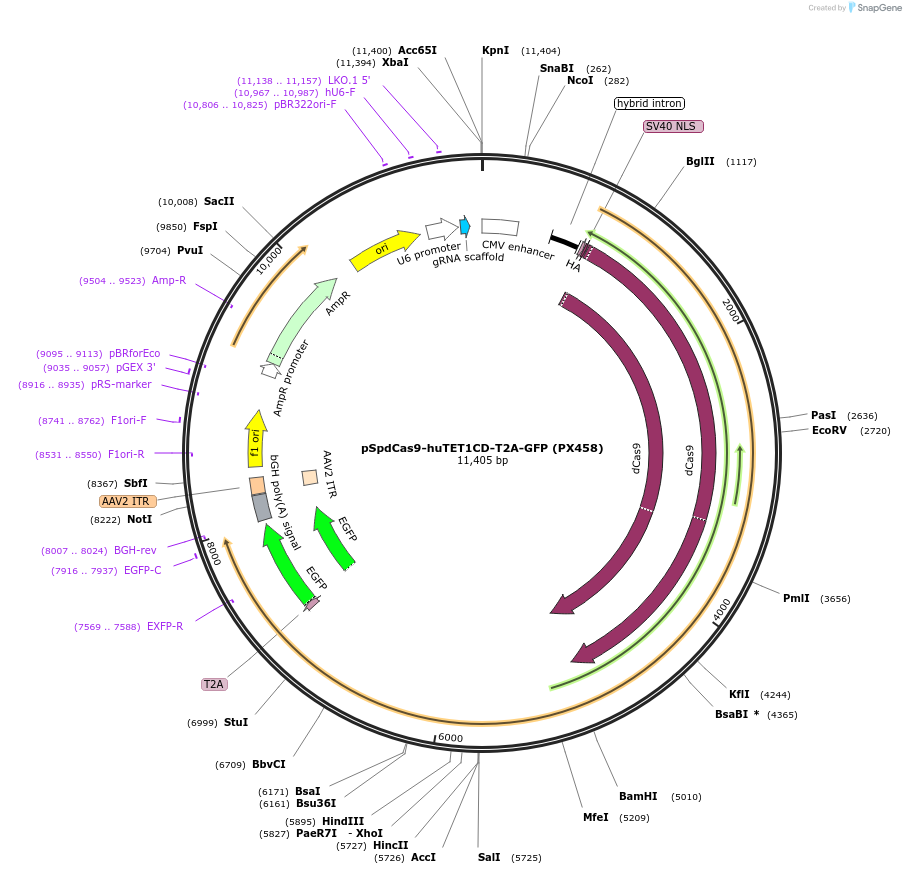
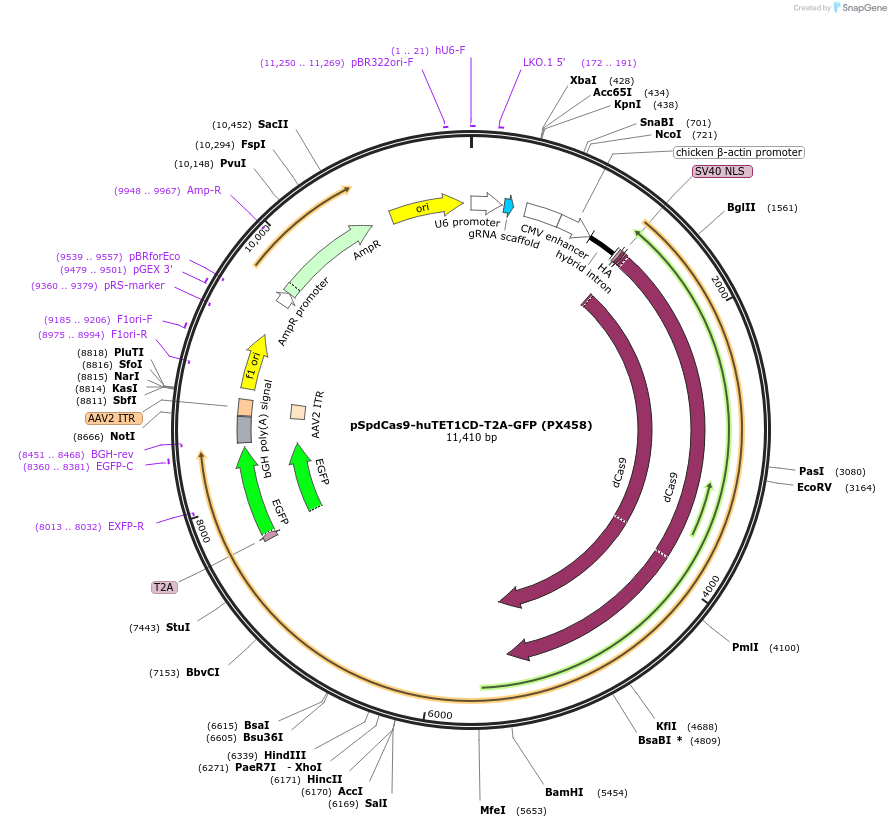
Map uploaded by the depositor.
