



-
Depositing Lab
-
Depositing OrganizationMemorial Sloan-Kettering Cancer Center
Located in the United States of America -
Citations
-
Sequence Information


Ordering
| Item | Catalog # | Description | Quantity | Price (USD) | |
|---|---|---|---|---|---|
| Plasmid | 16076 | Standard format: Plasmid sent in bacteria as agar stab | 1 | $94 | |
| DNA | 16076-D50 | 50 μg of DNA in Tris buffer | $495 | ||
| DNA | 16076-D100 | 100 μg of DNA in Tris buffer | $585 | ||
Backbone
-
Vector backbonepECFP-N1
-
Backbone manufacturerClontech
- Backbone size w/o insert (bp) 5190
-
Vector typeMammalian Expression
-
Selectable markersNeomycin (select with G418)
Growth in Bacteria
-
Bacterial Resistance(s)Kanamycin, 50 μg/mL
-
Growth Temperature37°C
-
Growth Strain(s)DH5alpha
-
Copy numberHigh Copy
Gene/Insert
-
Gene/Insert nameHSP33 cys
-
SpeciesE. coli
-
Insert Size (bp)900
-
Tags
/ Fusion Proteins
- EYFP (N terminal on insert)
- ECFP (C terminal on backbone)
Cloning Information
- Cloning method Restriction Enzyme
- 5′ cloning site EcoRI (not destroyed)
- 3′ cloning site BamHI (not destroyed)
- 5′ sequencing primer na
- (Common Sequencing Primers)
Resource Information
-
A portion of this plasmid was derived from a plasmid made byDr. Ursula Jakob, Univ of MI
Terms and Licenses
-
Academic/Nonprofit Terms
-
Industry Terms
- Not Available to Industry
Trademarks:
- Zeocin® is an InvivoGen trademark.
Depositor Comments
The HSP-FRET probe was generated by inserting YFP into the pECFP-N1 plasmid between the NheI and BglII sites and then ligating the redox-sensitive regulatory domain from the Escherichia coli HSP-33 between YFP and CFP via the EcoRI and BamHI sites. HSP-33: 210 amino acids; BA000007 region 4241962-4242826. Made in Hammerling lab; used in Waypa et al., Increases in mitochondrial reactive oxygen species trigger hypoxia-induced calcium responses in pulmonary artery smooth muscle cells, Circ Res. 2006 Oct 27; 99(9):970-8 PMID: 17008601.
DNA (Catalog # 16076-D50)
Purpose
Ready-to-use, high-purity DNA prep. DNA aliquots are suitable for use in mammalian cell transfections and other molecular biology applications.
Delivery
- Amount 50 μg
- Concentration 1 μg/μL
- Pricing $495 USD
- Storage 4 ℃ (short-term) or -20 ℃ (long-term)
Terms and Licenses
-
Academic/Nonprofit Terms
-
Industry Terms
- Not Available to Industry
Quality Control
Every DNA prep is verified by next-generation sequencing, confirming plasmid identity, sequence integrity, and absence of DNA contaminants. Concentration is confirmed to be within ±2.5% of the stated concentration.
Our production process has been validated to consistently yield endotoxin levels below 1.0 EU/μg. Individual lots are not tested for endotoxin.
DNA (Catalog # 16076-D100)
Purpose
Ready-to-use, high-purity DNA prep. DNA aliquots are suitable for use in mammalian cell transfections and other molecular biology applications.
Delivery
- Amount 100 μg
- Concentration 1 μg/μL
- Pricing $585 USD
- Storage 4 ℃ (short-term) or -20 ℃ (long-term)
Terms and Licenses
-
Academic/Nonprofit Terms
-
Industry Terms
- Not Available to Industry
Quality Control
Every DNA prep is verified by next-generation sequencing, confirming plasmid identity, sequence integrity, and absence of DNA contaminants. Concentration is confirmed to be within ±2.5% of the stated concentration.
Our production process has been validated to consistently yield endotoxin levels below 1.0 EU/μg. Individual lots are not tested for endotoxin.
These plasmids were created by your colleagues. Please acknowledge the Principal Investigator, cite the article in which the plasmids were described, and include Addgene in the Materials and Methods of your future publications.
-
For your Materials & Methods section:
pFRET-HSP33 cys was a gift from Ulrich Hammerling (Addgene plasmid # 16076 ; http://n2t.net/addgene:16076 ; RRID:Addgene_16076) -
For your References section:
Mitochondrial complex III is required for hypoxia-induced ROS production and cellular oxygen sensing. Guzy RD, Hoyos B, Robin E, Chen H, Liu L, Mansfield KD, Simon MC, Hammerling U, Schumacker PT. Cell Metab. 2005 Jun;1(6):401-8. doi: 10.1016/j.cmet.2005.05.001. 10.1016/j.cmet.2005.05.001 PubMed 16054089
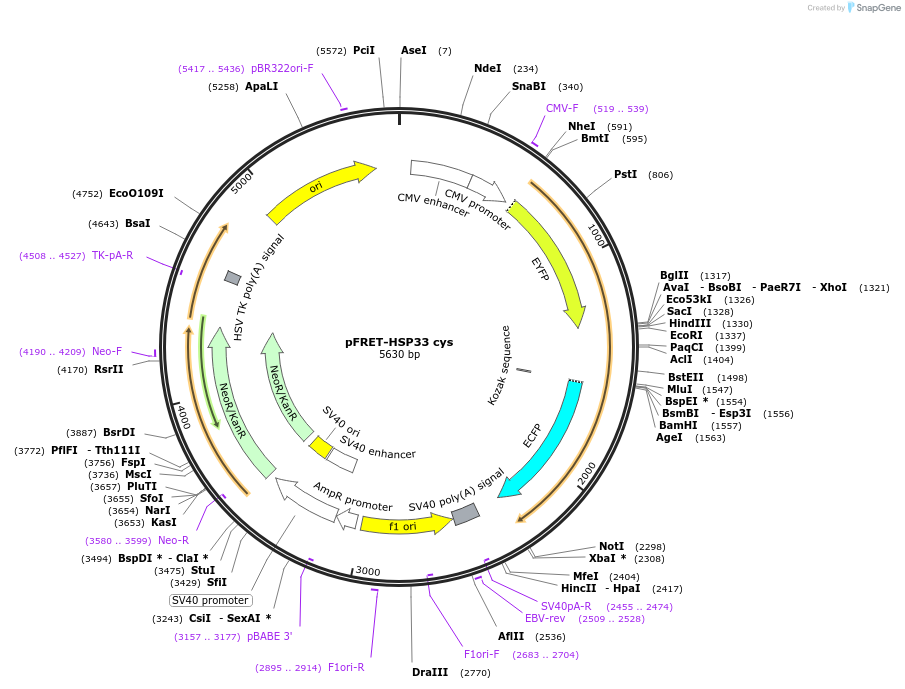
Map uploaded by the depositor.
