



pBScMXT + Slo1
(Plasmid
#16194)
-
Depositing Lab
-
Depositing OrganizationWashington University in Saint Louis
Located in the United States of America -
Sequence Information


Ordering
| Item | Catalog # | Description | Quantity | Price (USD) | |
|---|---|---|---|---|---|
| Plasmid | 16194 | Standard format: Plasmid sent in bacteria as agar stab | 1 | $94 | |
| DNA | 16194-D50 | 50 μg of DNA in Tris buffer | $495 | ||
| DNA | 16194-D100 | 100 μg of DNA in Tris buffer | $585 | ||
Backbone
-
Vector backbonepBScMXT
- Backbone size w/o insert (bp) 3200
-
Vector typeXenopus Oocyte expression
Growth in Bacteria
-
Bacterial Resistance(s)Ampicillin, 100 μg/mL
-
Growth Temperature37°C
-
Growth Strain(s)DH5alpha
-
Copy numberUnknown
Gene/Insert
-
Gene/Insert namecalcium-activated potassium channel
-
Alt nameAAA92290
-
SpeciesH. sapiens (human), M. musculus (mouse)
-
Insert Size (bp)3900
-
MutationN/A
-
GenBank IDU23767
-
Entrez GeneKCNMA1 (a.k.a. BKTM, CADEDS, IEG16, KCa1.1, LIWAS, MaxiK, PNKD3, SAKCA, SLO, SLO-ALPHA, SLO1, bA205K10.1, hSlo, mSLO1)
-
Entrez GeneKcnma1 (a.k.a. 5730414M22Rik, BKCA alpha, BKCa, KCa1.1, MaxiK, Slo, Slo1, k(VCA)alpha, mSlo, mSlo1, slo-alpha)
Cloning Information
- Cloning method Restriction Enzyme
- 5′ cloning site Cla1 (not destroyed)
- 3′ cloning site EcoR1 (not destroyed)
- 5′ sequencing primer T3
- 3′ sequencing primer T7
- (Common Sequencing Primers)
Terms and Licenses
-
Academic/Nonprofit Terms
-
Industry Terms
- Not Available to Industry
Trademarks:
- Zeocin® is an InvivoGen trademark.
Depositor Comments
Please note that Addgene's sequencing results do not exactly match the above GenBank accession numbers U23767 (nucleotide) and AAA92290 (protein) due to the cloning strategy employed for this plasmid. The beginning of the insert sequence from the Hind3 site (AAGCTT) to the Mlu1 site (ACGCGT) is from a mouse cDNA that contains an N-terminus that is highly conserved but not identical to that of the human channel. Prior to the starting Met of Slo1, this plasmid contains a short sequence from the mouse Slo1 5' untranslated region (5'UTR).
DNA (Catalog # 16194-D50)
Purpose
Ready-to-use, high-purity DNA prep. DNA aliquots are suitable for use in mammalian cell transfections and other molecular biology applications.
Delivery
- Amount 50 μg
- Concentration 1 μg/μL
- Pricing $495 USD
- Storage 4 ℃ (short-term) or -20 ℃ (long-term)
Terms and Licenses
-
Academic/Nonprofit Terms
-
Industry Terms
- Not Available to Industry
Quality Control
Every DNA prep is verified by next-generation sequencing, confirming plasmid identity, sequence integrity, and absence of DNA contaminants. Concentration is confirmed to be within ±2.5% of the stated concentration.
Our production process has been validated to consistently yield endotoxin levels below 1.0 EU/μg. Individual lots are not tested for endotoxin.
DNA (Catalog # 16194-D100)
Purpose
Ready-to-use, high-purity DNA prep. DNA aliquots are suitable for use in mammalian cell transfections and other molecular biology applications.
Delivery
- Amount 100 μg
- Concentration 1 μg/μL
- Pricing $585 USD
- Storage 4 ℃ (short-term) or -20 ℃ (long-term)
Terms and Licenses
-
Academic/Nonprofit Terms
-
Industry Terms
- Not Available to Industry
Quality Control
Every DNA prep is verified by next-generation sequencing, confirming plasmid identity, sequence integrity, and absence of DNA contaminants. Concentration is confirmed to be within ±2.5% of the stated concentration.
Our production process has been validated to consistently yield endotoxin levels below 1.0 EU/μg. Individual lots are not tested for endotoxin.
These plasmids were created by your colleagues. Please acknowledge the Principal Investigator, cite the article in which the plasmids were described, and include Addgene in the Materials and Methods of your future publications.
-
For your Materials & Methods section:
pBScMXT + Slo1 was a gift from Larry Salkoff (Addgene plasmid # 16194 ; http://n2t.net/addgene:16194 ; RRID:Addgene_16194) -
For your References section:
A human calcium-activated potassium channel gene expressed in vascular smooth muscle. McCobb DP, Fowler NL, Featherstone T, Lingle CJ, Saito M, Krause JE, Salkoff L. Am J Physiol. 1995 Sep . 269(3 Pt 2):H767-77. 10.1152/ajpheart.1995.269.3.H767 PubMed 7573516
Ready-to-use antibodies


Looking for antibodies related to this plasmid? Check out this option:
Learn More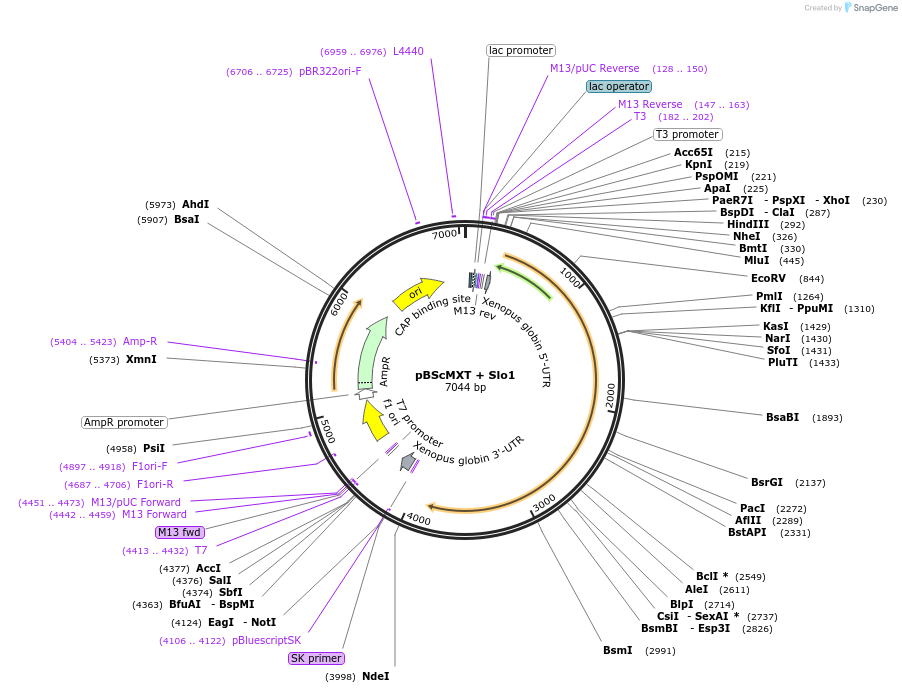
Map uploaded by the depositor.
