-
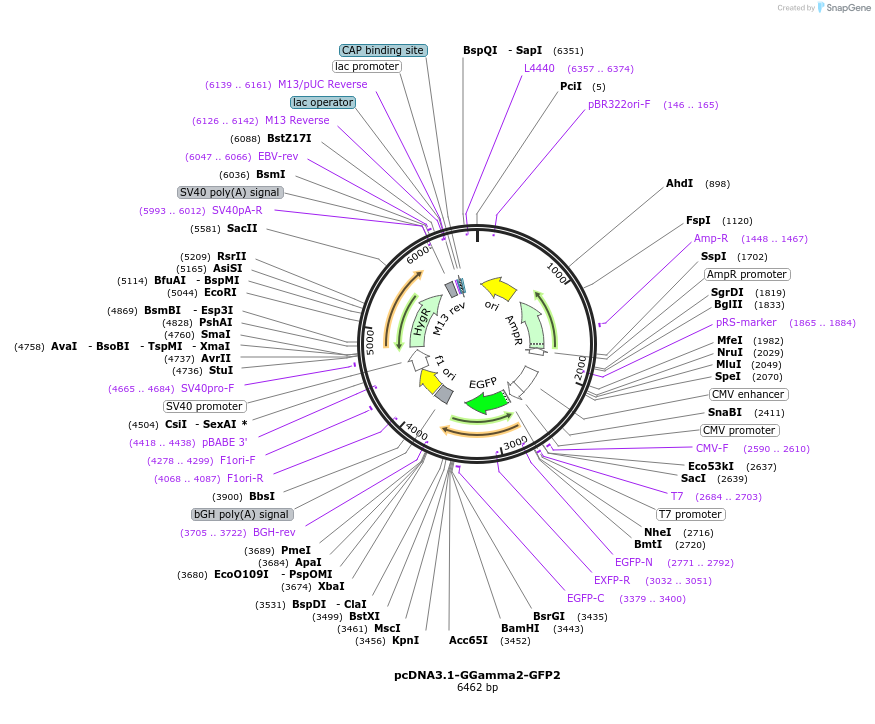
PurposeEncodes a G gamma subunit containing GFP2 as an "non-optimal" component of a BRET2 biosensor for studying heterotrimeric G protein dissociation
-
Depositing Lab
-
Depositing OrganizationUniversity of North Carolina at Chapel Hill
Located in the United States of America -
Sequence Information
Ordering
| Item | Catalog # | Description | Quantity | Price (USD) | |
|---|---|---|---|---|---|
| Plasmid | 166774 | Standard format: Plasmid sent in bacteria as agar stab | 1 | $94 | |
| DNA | 166774-D50 | 50 μg of DNA in Tris buffer | $495 | ||
| DNA | 166774-D100 | 100 μg of DNA in Tris buffer | $585 | ||
Backbone
-
Vector backbonepcDNA3.1
-
Backbone manufacturerInvitrogen
- Backbone size w/o insert (bp) 5432
-
Vector typeMammalian Expression
-
Selectable markersHygromycin
Growth in Bacteria
-
Bacterial Resistance(s)Ampicillin, 100 μg/mL
-
Growth Temperature37°C
-
Growth Strain(s)NEB Stable
-
Copy numberHigh Copy
Gene/Insert
-
Gene/Insert nameGGamma2-GFP2
-
Alt nameGNG2
-
Alt nameGreen Fluorescent Protein 2
-
SpeciesH. sapiens (human), Synthetic
-
Insert Size (bp)948
-
MutationContains an N-terminal GFP2 and GSAG linker
-
Entrez GeneGNG2 (a.k.a. HG3F1)
- Promoter CMV
Cloning Information
- Cloning method Gibson Cloning
- 5′ sequencing primer CGCAAATGGGCGGTAGGCGTG
- 3′ sequencing primer TAGAAGGCACAGTCGAGG
- (Common Sequencing Primers)
Terms and Licenses
-
Academic/Nonprofit Terms
-
Industry Terms
- Not Available to Industry
Trademarks:
- Zeocin® is an InvivoGen trademark.
Depositor Comments
These plasmids were generated as part of the Illuminating the Druggable Genome (IDG) program sponsored by the NIH Common Fund. The goal of this program is to identify, gather, and distribute information and resources for proteins that currently are not well-studied yet belong to commonly drug-targeted protein families: protein kinases, non-olfactory G-protein coupled receptors (GPCRs), and ion channels. The IDG program is designed to develop fundamental research tools for understudied proteins, elucidate their function, and disseminate the IDG-related resources and data to the greater scientific community.
DNA (Catalog # 166774-D50)
Purpose
Ready-to-use, high-purity DNA prep. DNA aliquots are suitable for use in mammalian cell transfections and other molecular biology applications.
Delivery
- Amount 50 μg
- Concentration 1 μg/μL
- Pricing $495 USD
- Storage 4 ℃ (short-term) or -20 ℃ (long-term)
Terms and Licenses
-
Academic/Nonprofit Terms
-
Industry Terms
- Not Available to Industry
Quality Control
Every DNA prep is verified by next-generation sequencing, confirming plasmid identity, sequence integrity, and absence of DNA contaminants. Concentration is confirmed to be within ±2.5% of the stated concentration.
Our production process has been validated to consistently yield endotoxin levels below 1.0 EU/μg. Individual lots are not tested for endotoxin.
DNA (Catalog # 166774-D100)
Purpose
Ready-to-use, high-purity DNA prep. DNA aliquots are suitable for use in mammalian cell transfections and other molecular biology applications.
Delivery
- Amount 100 μg
- Concentration 1 μg/μL
- Pricing $585 USD
- Storage 4 ℃ (short-term) or -20 ℃ (long-term)
Terms and Licenses
-
Academic/Nonprofit Terms
-
Industry Terms
- Not Available to Industry
Quality Control
Every DNA prep is verified by next-generation sequencing, confirming plasmid identity, sequence integrity, and absence of DNA contaminants. Concentration is confirmed to be within ±2.5% of the stated concentration.
Our production process has been validated to consistently yield endotoxin levels below 1.0 EU/μg. Individual lots are not tested for endotoxin.
These plasmids were created by your colleagues. Please acknowledge the Principal Investigator, cite the article in which the plasmids were described, and include Addgene in the Materials and Methods of your future publications.
-
For your Materials & Methods section:
pcDNA3.1-GGamma2-GFP2 was a gift from Bryan Roth (Addgene plasmid # 166774 ; http://n2t.net/addgene:166774 ; RRID:Addgene_166774) -
For your References section:
TRUPATH, an open-source biosensor platform for interrogating the GPCR transducerome. Olsen RHJ, DiBerto JF, English JG, Glaudin AM, Krumm BE, Slocum ST, Che T, Gavin AC, McCorvy JD, Roth BL, Strachan RT. Nat Chem Biol. 2020 May 4. pii: 10.1038/s41589-020-0535-8. doi: 10.1038/s41589-020-0535-8. 10.1038/s41589-020-0535-8 PubMed 32367019